Thermal Priming Enhances Tomato Heat Tolerance and Yield in Leibniz Institute Study
Executive summary
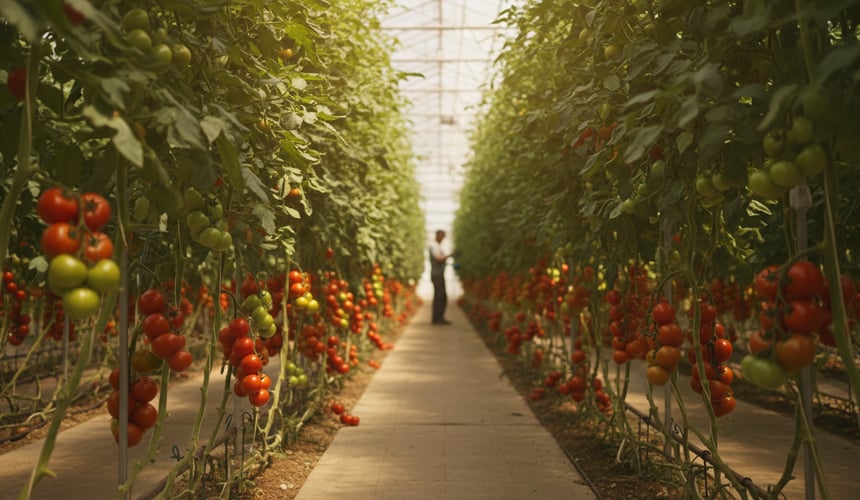
Researchers at the Leibniz Institute for Horticultural Sciences (IGZ) have shown that thermal priming, a process of exposing tomato plants to moderate heat stress, significantly boosts their heat tolerance and fruit yield. This effect was observed in both controlled laboratory conditions and a field experiment in Germany. The study identified key molecular regulators involved in this thermal stress memory, offering a promising strategy for developing heat-resilient tomato varieties amidst rising global temperatures.
Key data
- Yield increase in controlled conditions (Moneymaker): 41%[2]
- Yield increase in field experiment (Großbeeren): 53%[2]
- Duration of protective effect (measurable): 10 days[2]
- Duration of protective effect (not detectable): 20 days[2]
Cropenta Market Analysis
Research from the Leibniz Institute for Horticultural Sciences indicates that thermal priming significantly improves tomato plants' resilience to recurrent heat stress, leading to increased fruit yields. This mechanism, which involves specific molecular regulators, could be a valuable strategy for horticulture to adapt to rising global temperatures and maintain fruit production. While field results are promising, further research is needed to understand practical applications and the full molecular pathway to yield increases.[1, 2, 3, 4]
Why it matters
- Enhances crop resilience to heat stress, a growing concern due to climate change.
- Offers a potential strategy for increasing fruit production in horticultural crops like tomatoes.
- Identifies molecular targets for developing heat-resilient tomato varieties through breeding or biotechnology.
Introduction to Thermal Priming in Tomatoes
Researchers at the Leibniz Institute for Horticultural Sciences (IGZ) have demonstrated that exposing tomato plants to moderate heat stress, a process known as thermal priming, significantly enhances their ability to withstand subsequent severe heat stress. This adaptive response also leads to increased fruit yield, a finding with important implications for horticulture as global temperatures rise [1, 2].
The study, published in 'The Plant Journal' in 2026, investigated the molecular mechanisms behind this thermal stress memory in tomatoes [1, 2]. High temperatures are known to severely impair crop growth and yield, making the development of heat-resilient varieties crucial for food security [1, 4].
Experimental Findings: Enhanced Yield and Stress Memory
Under controlled laboratory conditions, thermally primed 'Moneymaker' tomato plants, when subjected to recurrent severe heat stress, produced an average of 41% more fruit compared to non-heat-stressed control plants [1, 2]. A field experiment conducted in Großbeeren, Germany, in 2025 further supported these findings, showing that thermally primed tomato plants yielded approximately 53% more fruit than their non-heat-stressed counterparts [1, 2].
The protective effect of thermal priming in tomatoes was found to last longer than in Arabidopsis thaliana, with a measurable effect still present after a 10-day interval [1, 2]. However, this effect was no longer detectable after 20 days, indicating that the duration of thermal memory varies between plant species [1, 2]. Importantly, analyses of β-carotene and lutein showed no significant differences in fruit quality markers, suggesting that thermal priming does not negatively impact fruit quality [1, 2].
Molecular Mechanisms of Thermal Memory
The research team conducted RNA-sequencing of shoot apical meristem tissue, identifying 267 genes that were strongly activated during both initial and subsequent heat stress. These are referred to as type II genes of transcriptional thermal memory [1, 2]. Among these, SlBAG6 and SlHSFA2 were highlighted, with SlHSFA2 identified as a central transcription factor in the thermal memory response [1, 2].
Further investigation using CRISPR-modified tomato plants, which lacked functional SlHSFA2, revealed a significant loss in the ability to undergo thermal priming and impaired recovery of the shoot apical meristem [1, 2]. The study also found that SlHSFA2 regulates the activation of the SlBAG6 gene and interacts with ETHYLENE RESPONSE FACTORs (SlERFs), collectively enhancing SlBAG6 activation [1, 2]. Temporarily silencing individual SlERFs reduced heat tolerance, pointing to a regulatory module involving SlHSFA2-SlERF that contributes to transcriptional thermal memory [1, 2].
Limitations and Future Outlook
While the field experiment in Großbeeren yielded promising results, the researchers note that these findings do not yet allow for definitive conclusions regarding the effects of such treatment under diverse practical conditions. This is due to varying environmental factors and the experiment being conducted only once [1]. Additionally, the precise mechanism by which the molecular stress-memory response ultimately contributes to increased yield is not yet fully understood [1, 2].
Despite these limitations, the findings provide a strong foundation for further research into, and potential application of, this mechanism in developing heat-resilient tomato varieties [1, 2]. The Leibniz Institute for Horticultural Sciences (IGZ) focuses on fundamental plant research to provide science-based solutions for sustainable and resilient horticultural agri-food systems, addressing challenges like climate change [3].
What to monitor
- Publication of detailed or peer-reviewed results from follow-up or replication trials.
- Further research into the economic feasibility and practical application of thermal priming in commercial tomato cultivation.
- Developments in understanding the molecular stress-memory response and its contribution to increased yield.
Disclaimer
This article, including the market analysis, has been compiled automatically from publicly available sources and is intended for information purposes only. The content does not constitute advice and does not necessarily represent the views of Cropenta. No rights can be derived from the information. Cropenta gives no guarantees as to its accuracy or completeness and, to the extent permitted by law, accepts no liability for its use.
Technical Questions
What is thermal priming in the context of this study?
Thermal priming is a process where plants are exposed to an initial, moderate heat stress. This exposure reprograms the plants, allowing them to retain a 'memory' for several days and respond more rapidly and effectively to subsequent, more severe heat stress events. This adaptive response helps improve their tolerance and yield.
Which tomato variety was used in the study?
The 'Moneymaker' tomato variety was used for the controlled laboratory conditions experiment. The specific variety used in the field experiment conducted in Großbeeren was not detailed in the available information.
Does thermal priming affect the quality of the tomatoes?
Analyses of key fruit quality markers, specifically β-carotene and lutein, showed no significant differences in thermally primed tomatoes compared to control plants. This suggests that thermal priming does not negatively affect the fruit quality.
What are the limitations of the field experiment results?
The field experiment, conducted in Großbeeren in 2025, was a single trial. The researchers noted that due to varying environmental factors and the limited scope of the experiment, the results do not yet allow for definitive conclusions about the effects of such treatment under diverse practical conditions.
- 1.HortiDaily: Thermal priming enhances heat tolerance and yield in tomatoes after recurrent heat stress
- 2.pubmed.ncbi.nlm.nih.gov: Thermal priming enhances yield after recurrent heat stress and involves SlHSFA2-SlERFs in the regulation of transcriptional thermal memory in tomato - PubMed
- 3.leibniz-gemeinschaft.de: Leibniz Association: Leibniz Institute for Horticultural Sciences
- 4.frontiersin.org: Frontiers | Genetic and Molecular Mechanisms Conferring Heat Stress Tolerance in Tomato Plants
Related articles

Looking for something specific?
Our team is there to help you find the right raw materials and solutions for your formulations

