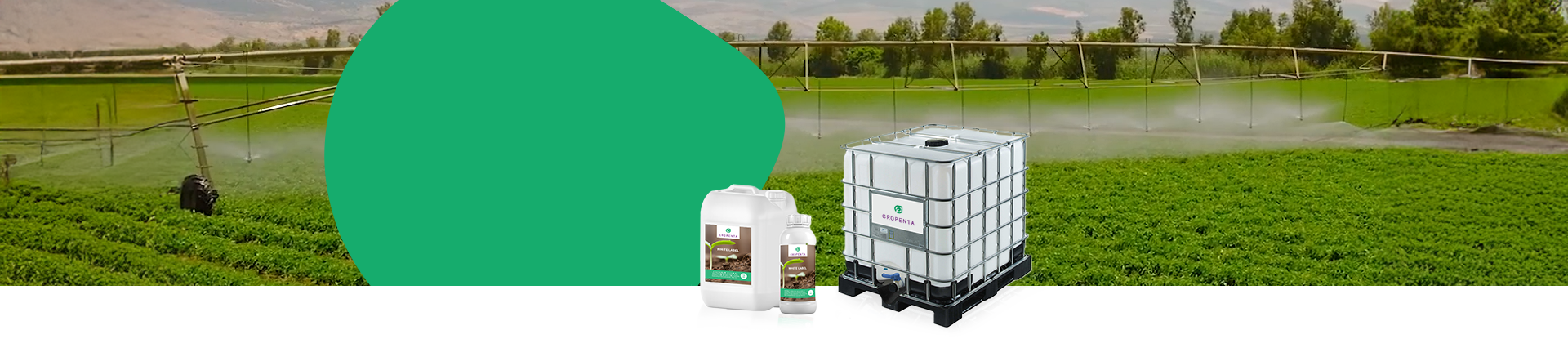
Fertilizer Specialties
 Cropenta in 60 seconds

Technical
Expertise

Specialized
Inputs

Long-Term
Partnerships

Sustainable
Solutions
Sustainable fertilizers
Sustainable fertilizers play a central role in modern agriculture and the agro-industry. The concept encompasses solutions and applications that contribute to higher efficiency, sustainability, and economic value within agricultural production chains.
Within circular and biobased systems, sustainable fertilizers are becoming increasingly important. By making smart use of natural resources, residual streams, and innovative processes, dependence on primary input can be reduced while improving yield, soil quality, and product quality.
What are sustainable fertilizers?
Sustainable fertilizers are fertilizers aimed at efficient nutrient utilization with minimal impact on the environment and climate. They provide essential nutrients to crops but do so in a way that better aligns with natural soil processes and cycles.
This means, among other things, less leaching of nitrogen and phosphate, fewer emissions to air and water, and improved alignment between nutrient supply and crop need. Sustainable fertilizers thus form an important alternative or supplement to traditional fertilizers.
Types of sustainable fertilizers
Various categories of products fall under sustainable fertilizers. Depending on the raw material, composition, and function, they can be applied in different ways:
- Organic fertilizers – based on animal manure, compost, digestate, or plant residual streams and rich in organic matter.
- Organic-mineral fertilizers – combine organic carriers with mineral nutrients for predictable performance.
- Recycled fertilizers – produced from nutrients recovered from residual streams or wastewater.
- Biobased fertilizers – developed from renewable resources with attention to CO2 reduction and circularity.
These fertilizers contribute not only to crop nutrition but also to soil improvement and long-term fertility.
Soil health as a starting point
Sustainable fertilizers are closely linked to the concept of soil health. A healthy soil can better retain nutrients, make them more efficiently available to plants, and handle extreme weather conditions better.
The use of sustainable fertilizers works towards:
- A stable soil structure.
- A more active soil life.
- A higher organic matter content.
- A better water and nutrient balance.
This results in stronger crops, fewer input losses, and a more robust cultivation system.
Role of biostimulants in sustainable fertilization
In modern fertilization strategies, biostimulants play an increasingly important role. Biostimulants themselves provide little or no nutrients but enhance the effects of sustainable fertilizers by activating natural processes in the soil and plant.
In combination with sustainable fertilizers, biostimulants can:
- Improve nutrient uptake and utilization.
- Stimulate root development and root activity.
- Activate and stabilize soil life.
- Make plants more resistant to abiotic stress.
Combining sustainable fertilizers with biostimulants creates an integrated approach where nutrition, soil, and plant are optimally aligned.
Sustainable fertilizers and circular agriculture
In circular agriculture systems, sustainable fertilizers are an essential link. Nutrients from the food industry, feed sector, and agriculture are reused instead of being lost.
Residual flows are processed into valuable fertilizers and soil improvers, closing cycles and reducing dependence on primary, often fossil, resources. This directly contributes to climate objectives and the sustainability of the food chain.
Practical application and customization
The use of sustainable fertilizers requires customization. Soil type, crop, cultivation plan, and local regulations determine which fertilizer formulations and applications are most effective.
In practice, a combined strategy is often chosen:
- A base fertilization with sustainable fertilizers for slow and stable nutrient provision.
- Additional adjustments based on soil and crop analysis.
- Use of biostimulants to increase efficiency and resilience.
This approach ensures maximum nutrient utilization with minimal losses.
Economic and strategic benefits
Sustainable fertilizers offer not only ecological benefits but also economic added value. By using nutrients more efficiently, input costs decrease, and the risk of yield fluctuations is reduced.
Moreover, sustainable fertilizers play an increasingly significant role in certification, chain requirements, and market positioning. Companies that invest in sustainable fertilization enhance their future resilience and better meet societal and legal expectations.
Conclusion: sustainable fertilizers as a foundation for the future
Sustainable fertilizers form the foundation of future-oriented agriculture. In combination with biostimulants and circular resources, they contribute to healthy soils, strong crops, and efficient chains. Investing in sustainable fertilization today builds a resilient agriculture ready to face the challenges of tomorrow.