Energy Value of Lecithin-Containing Fat Blends in Poultry Feed

Two fat blends can carry the same crude fat content and still deliver different amounts of usable energy to a broiler. The difference sits in what the fat is made of and in what the bird can do with it. Lecithin-containing blends make this especially clear: they combine triglycerides, free fatty acids and phospholipids in ratios that vary with raw material and processing, and each of those fractions behaves differently in the gut. A grower trial with soybean lecithin shows that replacing or combining it with soybean oil can be nutritionally viable, but only when the composition of the blend and the age of the bird are read together.
Cropenta Insight
Energy value in these blends is not a single number printed on a specification sheet. It is the outcome of three interacting inputs: the fatty acid profile, the proportion of free fatty acids versus triglycerides, and the phospholipid content of the lecithin used. Two blends with identical crude fat can therefore perform differently in a broiler diet, and formulation decisions should reflect that.
Why the composition of lecithin-containing blends matters more than total fat
Lecithin is not a pure substance. It is a mixture of phospholipids such as phosphatidylcholine, phosphatidylethanolamine and phosphatidylinositol, alongside glycolipids, triglycerides and other components, and its composition depends on the raw material (soy, rapeseed or sunflower) and the processing route, such as degumming and fractionation. That mixture behaves differently from a refined vegetable oil, where triglycerides dominate. In the gut, triglycerides are hydrolysed by pancreatic lipase after emulsification by bile salts; phospholipids carry a phosphate group and are amphiphilic, so they participate in emulsification differently, while free fatty acids are already released and do not require hydrolysis at all. Each fraction contributes fatty acids and energy, but at different points in the digestive process.
In a grower-bird trial, soybean lecithin was tested as an alternative energy source, both in combination with and as a replacement for soybean oil. The study concluded that it can be included in grower diets in those roles [1]. That finding is useful precisely because it separates lecithin from the assumption that only refined oil delivers reliable energy. It also shows the limits: the outcome depended on the blend, the inclusion level and the age of the birds, not on lecithin as a category.
Fatty acid profile and free fatty acid content: two separate levers
Chain length and the number of double bonds set the melting point of a fat, and with it how readily it is digested. Unsaturated fatty acids are generally better digested than saturated ones, particularly in young animals, and they are also more prone to oxidation. A lecithin-containing blend built on a more saturated fat base will therefore tend to give less energy per gram than one built on unsaturated oil, even at the same total fat content. This is the first lever a formulator can read from the fatty acid profile.
Free fatty acids are the second lever, and they are often conflated with the first. Free fatty acids are already hydrolysed, which is why acid oils and by-products rich in them can be attractive, but they also affect oxidative stability and can interact with the emulsification and micelle formation that bring fatty acids to the intestinal wall. In a blend, free fatty acid content is a compositional parameter that needs its own value in the specification; it is not a proxy for digestibility.
A practical point follows from this: a higher crude fat number or a lower price per tonne says nothing about the metabolizable energy the blend will actually deliver. Energy systems such as gross, digestible and metabolizable energy are defined by combustion and by faecal, urinary and gas losses, and they differ between species and between national tables. Fats should be compared within one system and on the basis of their measured composition.
Age-dependent digestion and the emulsifier question
Young chicks produce limited bile salts and pancreatic lipase, so fat digestibility rises with age, and saturated fats are digested less well in young birds than unsaturated oils. This is the reason a lecithin-containing blend that performs adequately in grower diets may behave differently in a starter diet. The age of the bird is not a background variable in energy calculations; it is one of the factors that decides whether the blend's phospholipid and fatty acid fractions are actually available to the animal.
It is also where a common assumption needs care. Lecithin has emulsifying properties, and bile salts and phospholipids do emulsify fat into small droplets so that lipase can act. But an emulsifying property proves no higher fat digestibility in a given diet; it changes the conditions for digestion, not the outcome. Evidence from a different angle supports caution here. A review of lecithin and lysolecithin used as feed emulsifiers notes that fat utilisation in poultry depends on the type of fat, its inclusion level and other dietary factors [2]. In other words, the emulsifier is one input among several, and the blend it is added to still sets the ceiling.
What feeding trials do and do not show
Broiler work with de-oiled lecithin has reported associations with nutrient absorption, which is consistent with the phospholipid fraction supporting fat digestion [3]. That is a plausible mechanism, and it is worth keeping the strength of the evidence in view: an association with absorption is not the same as a demonstrated improvement in growth or feed conversion, and a single formulation's result should not be generalised to every lecithin-containing blend on the market.
Work with bile salts in broilers illustrates how large the effect of the emulsification step can be when it is the limiting factor: adding fresh bovine bile to a broiler diet showed a linear increase in the digestibility of tallow fat [4]. Tallow is a highly saturated fat, and the result is specific to that fat and that intervention. It does not transfer automatically to a lecithin-containing blend with a different fatty acid profile, and it does not transfer across species.
Funding and conflicts of interest should be read alongside the design, the composition of the tested raw material, the control groups, the species and age, the outcomes and the statistics. Trials involving a producer or supplier are not disqualified by that fact, but a result obtained with one commercial formulation cannot be extended to all blends.
Reading a lecithin-containing fat blend before it enters the diet
The practical checklist follows from the evidence. Ask for the fatty acid profile, the free fatty acid content and the phospholipid content or lecithin level as separate values, and record which raw material and processing route produced the lecithin fraction. Confirm the energy system used for any declared metabolizable energy value and compare it within that system. Then match the blend to the age group: a grower diet and a starter diet present different digestive capacity, and the same blend can sit in a different place in each.
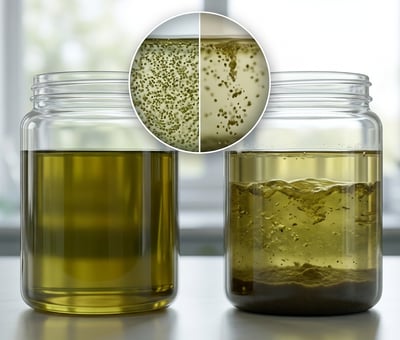
Operationally, liquid fat blends bring their own considerations. Free fatty acids and unsaturation reduce oxidative stability, so peroxide value, anisidine value and storage practice belong in the assessment alongside the nutritional numbers. Blends that separate or vary in viscosity affect dosing accuracy at the mixer and can leave uneven fat distribution in the mash. None of this changes the energy value on paper, but it changes how much of it reaches the bird.
The conclusion is not that lecithin-containing blends are interchangeable with soybean oil, nor that they are inferior. The grower trial supports their use in combination with or as a replacement for soybean oil under its own conditions [1]. What determines the energy value is the composition of the blend, the age and species of the bird, and whether the declared energy was measured in a system comparable to the one used in the formulation.
Technical Summary
The metabolizable energy of lecithin-containing fat blends in poultry depends on fatty acid profile, free fatty acid content and phospholipid type and level, not on crude fat alone. Bird age shapes how much of each fraction is digested, and emulsifying properties do not by themselves prove higher digestibility. Compare blends within one energy system and match them to the age group.
This article was created with the help of AI and reviewed by the Cropenta editorial team. It is general information, not professional advice.
Technical Questions
Why should free fatty acid content be reported separately from crude fat in a lecithin-containing blend?
Free fatty acids are already hydrolysed, so they behave differently from triglycerides during digestion and they affect oxidative stability. Two blends with the same crude fat can differ widely in free fatty acid level, which changes how the fat behaves in the gut and how it stores. A separate value keeps that distinction visible in the specification.
Does the emulsifying property of lecithin mean a blend will have higher fat digestibility?
No. Phospholipids and bile salts emulsify fat so that lipase can hydrolyse triglycerides, which improves the conditions for digestion, but it does not prove a higher digestibility outcome in a given diet. Fat type, inclusion level and other dietary factors also determine how much fat the bird actually utilises.
How does bird age change the interpretation of a lecithin-containing fat blend?
Young chicks produce limited bile salts and pancreatic lipase, so fat digestibility rises with age, and saturated fats are digested less well in young birds. A blend that fits a grower diet may not deliver the same energy in a starter diet, so the age group belongs in the evaluation rather than the energy value alone.
Which processing details help when comparing lecithin fractions from different suppliers?
The raw material, whether soy, rapeseed or sunflower, and the processing route such as degumming or fractionation, set the phospholipid profile and the ratio of phospholipids to triglycerides. Without that information, two lecithin fractions can look comparable on a specification sheet while behaving differently in the mixer and in the bird.
- 1.Soybean lecithin as an alternative energy source for grower and finisher pigs and broiler chickens
- 2.Do the use of lecithin and lysolecithin as feed emulsifiers affect performance and nutrient digestibility in poultry?
- 3.Dietary influence of de-oiled lecithin on broiler growth performance
- 4.Growth performance, blood lipids, and fat digestibility of broilers
Looking for something specific?
Our team is there to help you find the right raw materials and solutions for your formulations