What Seaweed Extract Studies Report on Nutrient Transporter Activity

A grower may see new leaves turn pale even though the root zone has been supplied with enough nitrogen. Uptake alone does not explain this pattern. Once nutrients enter the plant, they still have to reach the tissues that need them, and sometimes they are pulled from older leaves to feed new growth. So the practical question is how seaweed extracts may affect that internal movement, and what the evidence actually shows.
Cropenta Insight
For growers and advisers, the most useful distinction is between nutrient uptake and internal distribution. Many seaweed studies measure nutrient content or the activity of uptake-related genes, not where nutrients end up or how the crop performs at harvest. The primary study reports increased transcription or activity of nutrient transporters in treated plants, which is a physiological observation rather than proof of better field performance. Results also differ between seaweed species and extract types, so findings from one extract should not be assumed for another.
Uptake is only the first step
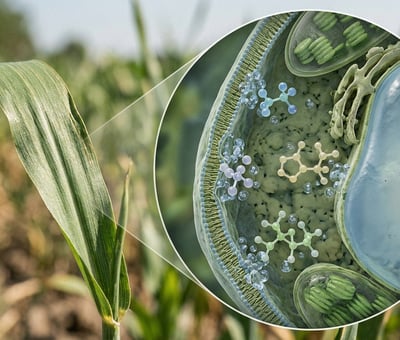
Nutrients enter the plant through roots or leaves, but they then travel along two routes. The apoplastic route runs through cell walls and intercellular spaces, while the symplastic route passes through the cell interiors, connected by plasmodesmata. Membrane transporters control the movement of many nutrients across cell membranes. Inside the vascular system, the xylem carries water and dissolved nutrients upward, while the phloem moves sugars and mobile nutrients from source leaves to sinks such as young leaves, fruits and roots.
What the research reports on transporters
The primary study, a review of seaweed extract research, reports that plants treated with seaweed extracts showed an increase in the transcription or activity of components linked to nutrient acquisition.[1] This suggests that bioactive compounds in seaweed extracts may influence the machinery that moves nutrients across membranes. However, the review does not establish a complete causal chain from the extract to the movement of a specific nutrient within the plant. Not every study reports the same response, and the available evidence differs between seaweed species and experimental systems.
Some seaweed polysaccharides also have chemical properties that may matter outside the plant. Alginate, for example, can bind micronutrients, which keeps them in a form that is easier to take up.[2] A nutrient that is held in solution is not the same as a nutrient that is moved efficiently within the plant, though. Reviews also report increased nutrient uptake in seaweed-treated plants, but most of these measure what enters the plant rather than how it is distributed afterward.[3]
Source-sink dynamics and remobilization remain an open question
Remobilization, the withdrawal of nutrients from older leaves to supply growing tissues, is one of the most relevant processes for whole-plant nutrient use. The sources reviewed here do not provide consistent data on how seaweed extracts affect remobilization or source-sink allocation. It is therefore a reasonable hypothesis that changes in transporter activity could shift distribution patterns, but this has not been demonstrated in the evidence available for this article.
Limits for practical interpretation
Most of the physiological evidence comes from controlled or experimental conditions, and the sources do not show how these responses translate to commercial fields. A change in transporter activity or nutrient content is a physiological response, not a measured yield or quality outcome. Species, extract composition and growing conditions all influence the result, so conclusions should stay limited to the plants and conditions actually studied.
What this means for crop observation
When a crop shows nutrient symptoms despite adequate supply, distribution problems can be considered alongside uptake issues. Seaweed extracts may be relevant to that discussion as a physiological topic, but current evidence does not support expecting a specific change in internal nutrient movement under field conditions.
Technical Summary
Seaweed extracts have been reported to influence the activity or transcription of components linked to nutrient acquisition in treated plants. Their effect on the internal transport and remobilization of nutrients, through the xylem, phloem and membrane transporters, is less well documented and remains a hypothesis. Evidence comes mainly from experimental settings and varies between seaweed species and extracts.
This article was created with the help of AI and reviewed by the Cropenta editorial team. It is general information, not professional advice.
Technical Questions
Why can nutrient uptake be adequate while nutrient distribution inside the plant is still limited?
Absorption at roots or leaves only delivers nutrients into the plant. Their onward movement depends on membrane transporters, the xylem for upward flow and the phloem for redistribution to sinks such as young leaves. A limit at any of these steps can leave new tissues short even when the supply was sufficient, which is why uptake data alone rarely explain internal nutrient patterns.
Can results from one seaweed extract be applied to another extract?
Not without evidence for that specific extract. Seaweed extracts differ in species, processing and bioactive composition, and the research reviewed reports responses that depend on the material and the experimental system. Transport-related results from one extract should be treated as specific to that material until comparable data are available.
Looking for something specific?
Our team is there to help you find the right raw materials and solutions for your formulations