Lecithin phospholipids and fat absorption in animal feeds
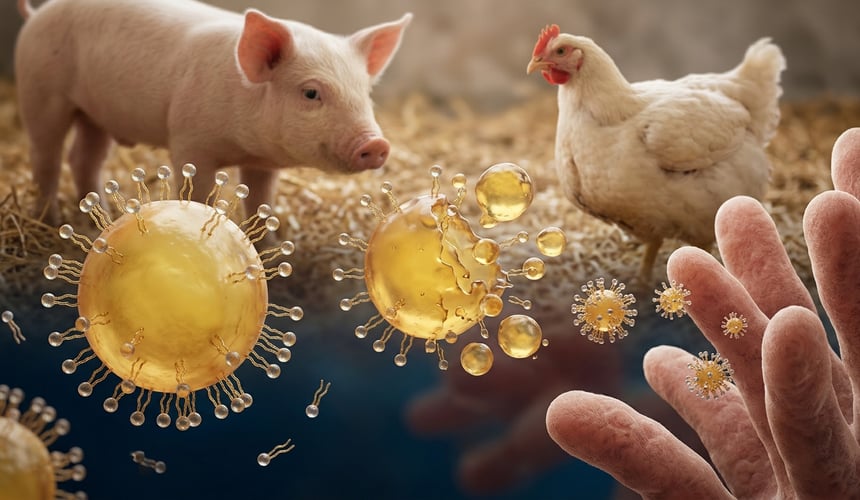
Fat is one of the most concentrated energy sources in a ration, but an animal only gains that energy once the fat has been broken down and taken up through the gut wall. Fats and oils repel water, so they float apart from the watery digestive contents and resist digestion unless they are first split into very small droplets. Phospholipids, the main functional fraction of lecithin, are one of the components involved in that first step.[1]
Lecithin is not a pure substance. It is a mixture of phospholipids such as phosphatidylcholine, phosphatidylethanolamine and phosphatidylinositol, together with glycolipids, triglycerides and other components. The exact composition depends on the raw material, whether soy, rapeseed or sunflower, and on processing steps such as degumming and fractionation. Triglycerides, free fatty acids and phospholipids need to be kept apart: triglycerides make up most of the fat in a feed, free fatty acids are released fatty acids that are more common in acid oils and by-products, and phospholipids carry a phosphate group. That phosphate group gives phospholipids a water-attracting end and a fat-attracting end, which is why they behave as amphiphilic molecules.
Cropenta Insight
The mechanism of phospholipids at the fat-water boundary is well established, but a higher emulsifying capacity does not by itself show higher fat digestibility in a given diet. Research on laying hens reports that lecithin supplementation was associated with better fat absorption under high-fat conditions, while the long-term effects were still being examined.[2] For animal nutrition professionals, this indicates that digestibility data from the specific species, age and fat source remain the reference point, rather than the emulsifying property on its own.
Where phospholipids act in the digestive tract
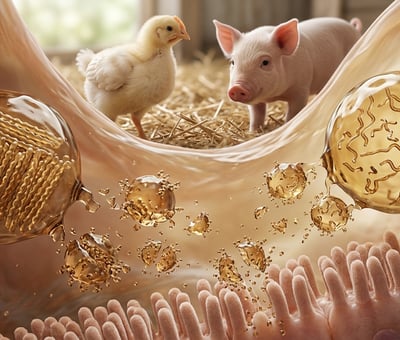
In monogastric animals such as pigs and poultry, most fat digestion takes place in the small intestine. When fat-containing feed reaches it, bile salts from the liver and phospholipids work together to break large fat globules into small droplets. This creates a far larger surface area. Pancreatic lipase, the enzyme that splits triglycerides, can only act at the surface of those droplets, so the rate of fat breakdown depends strongly on how finely the fat has been dispersed.
The products of lipase action, mainly free fatty acids and monoglycerides, are then incorporated with bile salts and phospholipids into mixed micelles. Micelles are small aggregates that carry the fat breakdown products through the watery layer next to the intestinal wall to the absorptive cells. Inside those cells, fatty acids are rebuilt into triglycerides and packaged into chylomicrons, which are transport particles that move the fat into the lymphatic system and then the bloodstream. This sequence of emulsification, lipolysis, micelle formation and chylomicron assembly is established physiology, and it applies to the animal's own bile salts and phospholipids.
In ruminants the picture is different. Much of the dietary fat is altered in the rumen before it reaches the small intestine, so the role of dietary phospholipids in the emulsification step is less well documented for ruminant diets. Findings from one species should not be applied to another without direct evidence.
What the research on phospholipid additives shows
A recent systematic review compares soybean lecithin, lysophospholipids and marine phospholipids as feed additives in terms of growth performance and lipid metabolism.[1] The review shows that the effects differ between phospholipid sources, so one lecithin cannot be assumed to behave like another. Its conclusions are a comparison of the existing literature rather than a single controlled trial, and they should be read as an overview of differences rather than a verdict on any one product.
A recent review of lecithin and lysolecithin as feed emulsifiers reports that these additives may improve fat digestibility and absorption by increasing how well fats disperse in the gastrointestinal tract.[3] This is a mechanistic and synthesis-level statement. It describes a plausible pathway, but the size of the effect depends on diet, species and fat type.
The laying hen study is more specific. Its authors report that high-fat diets had adverse effects on the hens, while lecithin supplementation promoted fat absorption, and they note that long-term use needed further attention.[2] The result applies to laying hens under the study conditions and does not show a growth or feed conversion benefit.
Research on soybean lecithin in aquafeed is also available, but fish digestive physiology differs from that of poultry, pigs and ruminants. Results from fish should not be transferred to terrestrial species without additional evidence.
Age, fat type and oxidation
Young piglets and chicks produce limited amounts of bile salts and lipase, so their ability to digest fat rises as they mature. Saturated fats are generally digested less well than unsaturated oils in young animals. Unsaturated fats are more prone to oxidation, so the fat source and storage conditions matter for the fat added to a feed, including any lecithin-oil blend. Lecithin also contains fatty acids and contributes to energy supply, which is a separate matter from its role as a phospholipid emulsifier.
Feed formulation and handling observations
Lecithin can be encountered in feed formulations in three forms: as a separate additive, as a component of a compound fat raw material, and as part of a lecithin-oil blend used as an alternative to conventional fat sources such as soybean oil. Each form requires a different evaluation. A separate additive is judged on its phospholipid content and dosage logic, a compound fat is judged on its total energy and fatty acid profile, and a blend should be compared with other fat sources on digestibility and energy value rather than on price alone.
In feed mills, lecithin is viscous, especially at lower temperatures, and it is usually handled in warm liquid form. Uneven dispersion in the liquid fat line can lead to inconsistent fat content in the finished feed, so the mixing and dosing equipment deserves as much attention as the chemistry.
What the evidence allows readers to conclude
For decision-making, the practical question is which species, age group and fat type a lecithin source is intended for, and whether digestibility data exist for that combination. Where such data are missing, a lecithin ingredient is best treated as a formulation variable to be tested in the intended diet rather than as an assumed gain in performance. Ruminant and aquaculture diets call for separate evidence before any conclusion is drawn for them.
Technical Summary
Lecithin phospholipids aid fat digestion in monogastrics, with observed absorption benefits varying by source, species, age, and fat type; however, emulsifying capacity or digestibility alone do not guarantee performance improvements.
This article was created with the help of AI and reviewed by the Cropenta editorial team. It is general information, not professional advice.
Technical Questions
Why does lecithin composition matter when comparing two lecithin-containing feed ingredients?
Lecithin is a mixture rather than a single compound. Its phospholipid, glycolipid and triglyceride content varies with the raw material, such as soy, rapeseed or sunflower, and with degumming or fractionation. Two products with the same name can therefore differ in phospholipid content and fatty acid profile, so the certificate of analysis should be read before comparing them.
Does a phospholipid emulsifier change the energy value of a fat source?
Not as a matter of course. The emulsifying role of phospholipids concerns how fat is dispersed for digestion, while energy value depends on the digestibility of the fat and the fatty acids it contains. Energy values should always be compared within one system, such as metabolisable energy for poultry or net energy for ruminants, and the values for each species differ.
Looking for something specific?
Our team is there to help you find the right raw materials and solutions for your formulations