How Does Glycine Betaine Interact with Other Compatible Solutes in Plants?
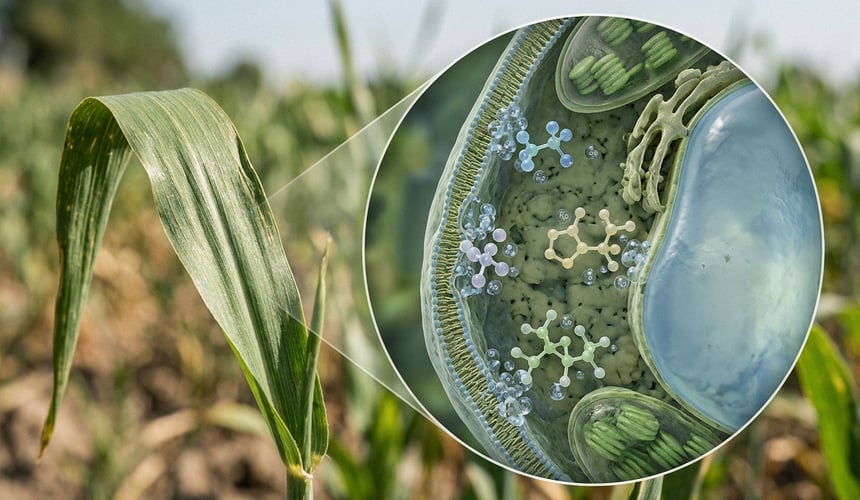
A crop that wilts on a hot, dry afternoon raises an obvious question: which compounds inside the plant are doing the work? For glycine betaine, the answer is rarely a single molecule. Plant cells accumulate several compatible solutes, small molecules that can build up to high concentrations without disturbing normal metabolism, and glycine betaine is one of them.
Proline and trehalose are the two other compounds most often discussed alongside it. The practical question for anyone comparing biostimulant ingredients is whether these compounds act separately, add up, or sometimes interfere with each other. The sources reviewed here describe individual roles, but they do not settle the combined question.
Cropenta Insight
Most of the reviewed evidence describes glycine betaine as one part of a wider network of responses, not as a stand-alone switch. For professionals working with amino acids and peptides, the useful distinction is between demonstrated osmotic and cellular effects and untested combination effects. Combinations with proline or trehalose have not been demonstrated in the reviewed sources and would need direct, species-specific testing before any ingredient comparison relies on them.
Several compatible solutes, one water problem
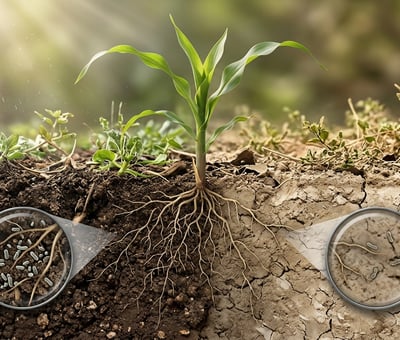
When water is harder for roots to take up, cells need to keep their internal water balance without disrupting enzymes and other proteins. Compatible solutes help with this by accumulating inside the cell, which is the basis of osmotic adjustment. Glycine betaine is one of the best-known examples, but its synthesis is species-dependent. Not all plants produce it, and many crops accumulate little of it on their own.
Glycine betaine is part of a wider response
A recent review reports that glycine betaine is associated with growth, photosynthesis, antioxidant enzyme activity and nutrient uptake in plants[1]. Another review describes interactions with stress hormones, reactive oxygen species detoxifying molecules and ion homeostasis pathways under abiotic stress[2]. These links point to a network of effects, which is why researchers look at glycine betaine alongside other compounds. Both reviews, however, summarize experiments carried out under specific conditions. They do not show that externally applied glycine betaine produces the same effects in a field crop.
Proline and trehalose: where the evidence stops
Proline and trehalose are also compatible solutes and are discussed in the context of osmotic adjustment. The sources used for this article do not provide controlled experiments that measure glycine betaine combined with proline or trehalose in the same crop. Synergy or antagonism between these compounds has therefore not been demonstrated. Additive effects are possible in principle, since compounds with different roles may act on different parts of the cellular response, but this remains an interpretation and not a demonstrated result.
What this means for formulation thinking
Including a second solute in a product is a question that can only be answered by testing under the crop, concentration and timing that matter in practice. Osmotic adjustment does not automatically mean lower water use or higher yield, and that applies equally to combinations. Responses may also differ between species and depend on the moment of application.
Technical Summary
Glycine betaine is one of several compatible solutes in plants, with reported links to growth, photosynthesis, antioxidant responses and ion homeostasis. Proline and trehalose are relevant comparisons, but the reviewed sources do not show whether combinations act synergistically, additively or antagonistically. Interaction effects should be treated as open questions until tested directly in the relevant crop.
This article was created with the help of AI and reviewed by the Cropenta editorial team. It is general information, not professional advice.
Technical Questions
Why can a single compatible solute not fully explain how a plant copes with water deficit?
Water deficit changes several processes at once, including osmotic balance, ion distribution, hormone signalling and antioxidant activity. Compatible solutes contribute to osmotic adjustment, but they operate alongside other responses. Interpreting a single compound in isolation can therefore overlook the wider cellular network that determines how a plant responds.
Does a measured increase in glycine betaine in a plant prove that applying it externally has the same effect?
No. An endogenous increase shows that the plant produces or accumulates the compound, but it does not show what happens when glycine betaine is applied from outside. Uptake, distribution and timing differ, and results from controlled conditions do not automatically transfer to field crops.
Looking for something specific?
Our team is there to help you find the right raw materials and solutions for your formulations