Why Microbial Biostimulant Survival Depends on Soil Type and Climate
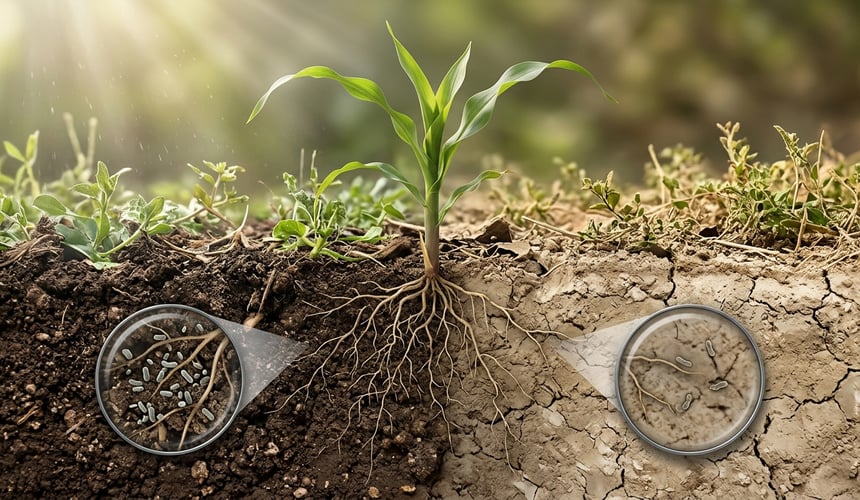
A grower applies the same microbial product on two fields, two weeks apart. One field shows visible root-zone response, the other does not. Nothing in the product changed. What changed is the environment the organisms met after application: soil pH, texture, organic matter and the climatic conditions of that particular season.
Cropenta Insight
Microbial products are usually judged as one thing, while three separate steps matter: survival, activity and field effect. Environmental factors mainly act on the first two. A product can stay viable in a soil yet express little of its intended function, and a demonstrated function in a controlled setting does not automatically translate into a field benefit. Keeping those steps apart is what makes variable results readable.
Three steps that are often confused
Products based on living microorganisms are assessed on three separate questions. Survival asks whether the organism stays viable after application. Activity asks whether it keeps the function it was selected for, such as phosphorus solubilization, potassium mobilization or nitrogen fixation in the root zone. Field effect asks whether a crop benefit can be demonstrated under practical conditions. A positive answer on survival proves neither activity nor field effect, and this distinction explains much of the variation growers report. Reviews of microbial biostimulants in modern agriculture describe these products as technologies that can support yield and quality, while stressing that performance is closely tied to the conditions in which the organisms must establish [1].
What soil type does to applied microorganisms
Soil is not a neutral carrier. Texture determines pore size and aeration; fine-textured soils hold water longer but can leave less oxygen available in the root zone. Organic matter provides surfaces and a carbon base that the resident soil microbiome uses, and applied organisms enter that existing community rather than an empty space. Competition, antagonism and grazing by native soil life are normal parts of the picture.
Soil pH is one of the strongest filters. Where pH sits far outside the range a species tolerates, viability drops and root colonization becomes less likely. Soil chemistry interacts with this: free calcium, phosphorus and other ions can influence how readily cells remain mobile and how easily they reach root surfaces. The same species applied to two soils of different pH and texture can therefore behave as two different products.
Climate as the second filter
Temperature, moisture and radiation act on the applied organisms directly. High soil temperatures around the application zone speed up metabolic activity and depletion of reserves, while low temperatures slow colonization. Moisture matters in both directions: dry periods reduce microbial movement and survival, whereas prolonged saturation limits oxygen in the same pore spaces the cells need to occupy.
Ultraviolet radiation is mainly a factor for foliar application, where cells sit exposed on the leaf surface with limited protection and limited time to be taken up. Climatic conditions also affect the crop itself, and therefore the root environment: drought, salinity and adverse soil pH are abiotic pressures under which arbuscular mycorrhizal fungi have been reported to benefit plants, which makes the timing and placement of a microbial application part of the environmental question rather than a detail around it [2]. Work on microbial biostimulants in mitigating abiotic pressures points in the same direction, linking their contribution to situations where the plant and its root environment are under stress [3].
What this means when results differ
The practical consequence is that variability between fields, seasons and even positions within one field is not necessarily a product defect. It is the expected outcome of organisms meeting different soil chemistry, different resident microbial communities, different moisture and different temperature. Reviews of bacterial biostimulants in climate-oriented agriculture describe a range of mechanisms, including phosphate solubilization and the production of microbial metabolites, but mechanism descriptions come largely from controlled studies and do not by themselves demonstrate consistent field performance [4].
Three conclusions follow. First, laboratory activity data do not establish survival, establishment or function in a specific soil. Second, a high viable count in a formulation says nothing about how many cells remain viable and active after application.
Technical Summary
Applied microbial biostimulants face two successive filters: soil conditions, mainly pH, texture, organic matter and competition from the resident soil microbiome, and climate, mainly temperature, moisture and UV exposure. Survival, activity and demonstrated field effect are separate evidence steps. Environmental factors primarily govern the first two, which is why identical products can produce different results across soils and seasons.
This article was created with the help of AI and reviewed by the Cropenta editorial team. It is general information, not professional advice.
Technical Questions
Why can one microbial biostimulant work on my neighbour's field and not on mine?
The organisms meet different conditions after application. Soil pH, texture, organic matter and the existing soil microbiome all influence whether cells remain viable and reach root surfaces. Temperature, moisture and radiation add further pressure. Two soils can therefore support survival in one case and not in the other, even with identical application rates and timing.
Does a high viable count on the label say anything about field survival?
No. A viable count describes what is present at the moment of analysis, usually before and shortly after production. It does not show how many cells stay viable and active in a specific soil, nor whether they colonize roots in competition with resident organisms. Count, survival, activity and a demonstrated crop effect are separate evidence steps.
Which soil property has the largest influence on applied microorganisms?
Soil pH is commonly considered the strongest filter, because a value outside a species' tolerated range reduces viability and makes root colonization less likely. Texture and organic matter follow, through aeration, water retention, carbon supply and the amount of competition from the native soil microbiome. These properties interact rather than act alone.
Is a mix of several organisms more reliable than a single one?
Not automatically. Each organism in a consortium faces the same environmental filters and they may compete with one another for space, carbon and nutrients. A combination is not inherently more robust than a single well-matched organism, and mixed formulations add questions about whether each partner survives and stays active after application.
Why does foliar application add a separate set of constraints?
On the leaf surface, cells are exposed to ultraviolet radiation, drying and rapid temperature fluctuations, with a limited window to be taken up before conditions change. That environment differs fundamentally from the root zone, so survival results from soil application cannot be transferred to foliar use, or the other way around.
- 1.Microbial Biostimulants as Response to Modern Agriculture: A Review
- 2.Effect of microbial plant biostimulants on fruit and vegetable quality: current research lines and future perspectives
- 3.The Potential Role of Microbial Biostimulants in the Amelioration of Climate Induced Abiotic Stresses on Crops: A Review
- 4.Bacterial biostimulants for climate smart agriculture practices: Mode of action, effect on plant growth and roadmap for commercial products
Looking for something specific?
Our team is there to help you find the right raw materials and solutions for your formulations