What Do Free Amino Acids, Peptides and Metabolic Acids Do in Plant Metabolism?
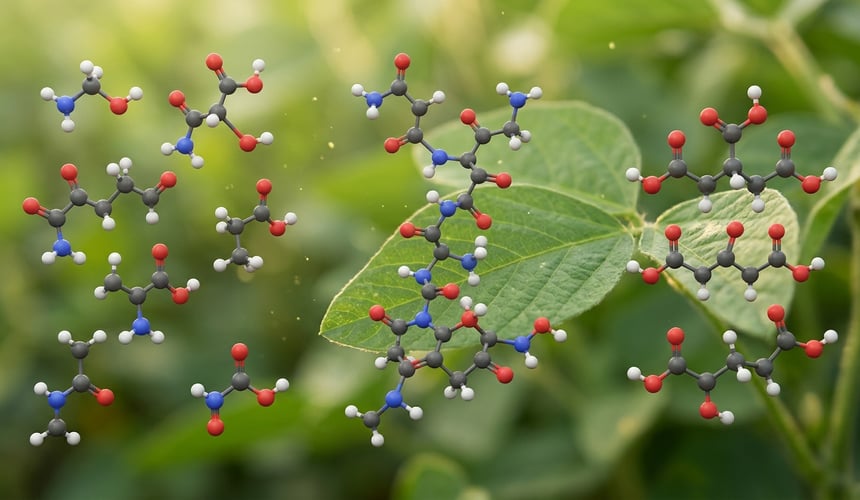
Plant metabolism responds to amino acid and peptide groups in different ways, but a label that lists only amino acids hides that difference. A product may contain single free amino acids, short chains called peptides, and a fraction of acids described only as metabolic acids. Do these groups behave the same inside a plant? The editorial by Trovato reviews how amino acids are regulated and used in plants, and it gives a useful starting point for separating the groups.[1]
Cropenta Insight
Chemical composition on a label shows which amino acid, peptide and acid fractions a material contains. It does not show how the plant uses them. The strongest current evidence concerns endogenous amino acids, where signaling roles have been proposed as a mechanism rather than a confirmed plant outcome. Applied peptides and unidentified metabolic acids have not been demonstrated in the sources reviewed. For material selection, the useful questions are which fractions are declared, what the raw material is, and whether comparative data exist for the specific product.
Free amino acids and plant metabolism
Free amino acids are single molecules, while peptides are short chains of amino acids linked together and proteins are much longer chains. Amino acids are the building blocks of proteins, but they also act as carriers of nitrogen between tissues and as starting points for other metabolites. Their carbon skeletons connect to central pathways such as the Krebs cycle, which is why amino acid metabolism is closely tied to energy supply. Trovato's review describes amino acids as regulated players with roles in development and in responses to changing conditions.[1]
Externally applied amino acids are a separate question. One review reports that applied amino acids can act as signals that change the expression of genes for transporters and assimilation, which is one way they may reprogram metabolism.[2] This is a mechanistic observation, not evidence of higher yield or better stress recovery in the field. The sources here do not provide field data on crop response, and the findings depend on the species and conditions studied.
Peptide groups and plant signaling
Peptides can carry information as well as nitrogen. Several short plant peptides have been studied as signaling molecules that regulate growth and responses to the environment. Most of this work concerns endogenous peptides in model systems. Whether a peptide mixture applied to a crop behaves in the same way, and whether it reaches the plant intact, is not established by the sources reviewed here. A peptide fraction should therefore not be treated as a faster form of free amino acids, or as a signal with a known role, without checking the specific material.
Metabolic acids and the limits of the evidence
The term metabolic acids is broad. Organic acids such as those in the Krebs cycle are central intermediates in plant metabolism, but a label term does not identify which compounds are present, in what amounts, or with what function. For this reason, no specific role can be assigned to the acid fraction of a product on the basis of the sources reviewed. The most that can be said is that these compounds belong to pathways that also involve amino acids, and that any effect of applying them would need compound-specific evidence.
Applied material and plant physiology
Three distinctions help when reading research. First, endogenous amino acids and peptides have roles inside the plant, and applied material is a separate question. Second, signaling effects seen under controlled conditions do not automatically appear as measurable outcomes in greenhouse or field crops. Third, a result for one amino acid or one peptide does not show that a blend works better. Comparative research with a combination set against its constituents would be needed for that claim, and the sources reviewed here do not contain such a comparison.
What growers and advisers can take from this
The practical point is to read composition as composition. A listed amino acid or peptide fraction describes what is in the material. Its physiological role depends on the form, the conditions and the strength of the evidence behind it. Where research is still preliminary, as it is for applied peptide signaling and for the metabolic acid fraction, it is more useful to treat the effect as an open question than as an assumed benefit.
Technical Summary
Free amino acids, peptides and metabolic acids are chemically distinct groups. Free amino acids are central to nitrogen and carbon metabolism, and applied amino acids can change gene expression in some studies. Peptide signaling is best supported for endogenous peptides, and the metabolic acid fraction cannot be assigned specific functions without compound identification.
This article was created with the help of AI and reviewed by the Cropenta editorial team. It is general information, not professional advice.
Related articles
Related Products



Looking for something specific?
Our team is there to help you find the right raw materials and solutions for your formulations

