How Do UV Filters Protect Microbial Biostimulants in the Field?
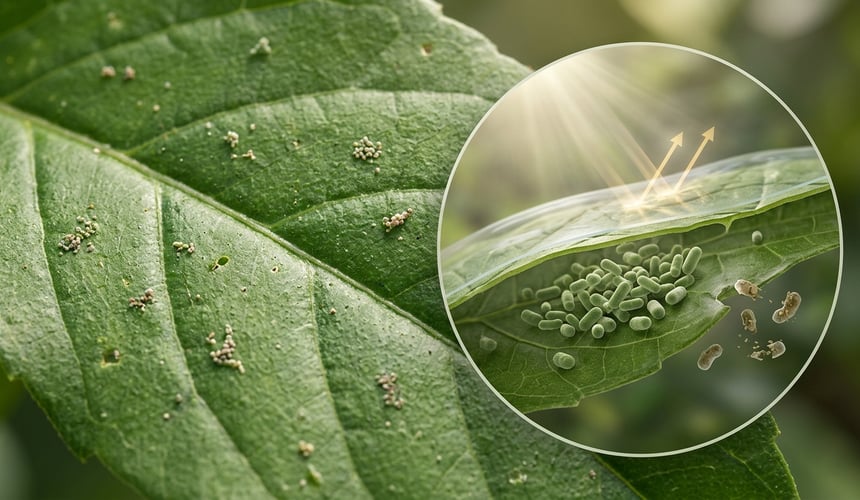
Sunlight is rarely considered when microbial biostimulants are discussed. Yet for a microbial product applied to leaves, in a transplant drench or through drip lines at midday, ultraviolet (UV) radiation is one of the harshest conditions the cells encounter. A solution that tests well in the laboratory may arrive at the leaf or root already compromised, and the gap between viable-cell count on the label and viable cells on the crop is where UV exposure quietly plays a role.
Cropenta Insight
For anyone evaluating or specifying microbial biostimulants, the useful distinction is between survival, activity and a demonstrated field effect. UV protection strategies address the first step: keeping the organism viable long enough to reach the root zone. A high viable count after irradiation says nothing yet about metabolic function in soil or crop performance — those require separate, case-by-case evidence.
What UV radiation does to microbial cells
UV radiation in the UV-B and UV-C range is absorbed directly by the DNA and RNA of microbial cells. This energy causes adjacent thymine bases to bond into dimers, distorting the strand and blocking replication and gene expression. Proteins and membrane lipids can also be oxidized, and reactive oxygen species generated during irradiation damage cellular structures further. The consequence is a loss of cultivability: irradiated cells may still be physically present on a plate or in a formulation but no longer able to divide.
Fungi and bacteria differ in intrinsic UV resilience, and that resilience is a property of the specific organism rather than of a broad category. Tolerance observed in one carefully characterized strain does not transfer to every species or isolate sold as a biostimulant ingredient. This distinction matters when a formulator or grower compares two products side by side.
Microbial biostimulants work through a range of metabolites and interactions in the rhizosphere — exudates, signaling compounds and nutrient-mobilizing activity that depend on living, metabolically active cells [1]. If UV exposure inactivates those cells before they reach the root zone, the biological contribution they were meant to make does not take place.
How UV filters are used in formulations and application
UV filters are additives that absorb or block ultraviolet energy before it reaches microbial cells. In a liquid or solid microbial biostimulant formulation they may be organic absorbers with strong UV-B or UV-A absorbance, inorganic particles such as titanium dioxide or iron oxides, or natural UV-absorbing compounds derived from plant or microbial sources.
Two practical distinctions matter. First, the filter must be compatible with the living organism: it cannot itself be toxic to the microbial cells, and it must not alter pH or osmotic conditions in a way that reduces viability before application. Second, filters work differently depending on how the product is applied. A formulation meant for foliar spraying is exposed to direct sun on a leaf surface and may need a different filter strategy than a granular or soil-applied product where soil provides natural shielding.
Formulation stability of the microbial component is therefore more than shelf-life. It includes the ability to survive the moment of application and the minutes that follow, when a liquid film on a leaf is thin, exposed and warm. Some application strategies amplify this effect: spraying in early morning or evening, avoiding the peak UV window, and using water volumes and droplet sizes that limit the surface area exposed to direct radiation. These measures do not replace formulation choice; they complement it.
Reviews of microbial biostimulant use in modern agriculture consistently place survival under field conditions as a limiting factor for consistent results [2, 3]. The biological activity demonstrated in controlled environments depends on the cells reaching the root zone and establishing there, against competition from the native soil microbiome and the chemical and physical conditions of the soil itself.
What the evidence supports, and what it does not
Evidence that UV filters protect microbial cells in vitro or in controlled suspension is not the same as evidence that they protect them on a leaf, in a spray tank or in the field. Once a formulation is applied in the field, soil moisture, temperature, pH and the native microbial community all influence whether an introduced organism colonizes and remains metabolically active. Colonization success and the quantity of a beneficial metabolite produced in the rhizosphere are separate from the cell's survival through radiation.
Claims should be read with this in mind. A positive recovery of viable cells after artificial UV exposure is a formulation property, not proof of field effect. A product with a high viable count does not necessarily deliver a greater agronomic result than a product with a lower count, because the outcome reflects how well those cells establish and function once on the crop. And while a filter may help multiple organisms in one formulation, the effect depends on how each organism responds to the specific wavelengths and exposure times encountered.
Research on biostimulant use in fruit and vegetable production underlines how much variability exists between crops and growing conditions [4], and species-specific UV tolerance adds a further layer to that variability. For a grower or agronomist evaluating a product, the practical conclusion is that UV protection is one of several factors determining whether the organisms in a microbial biostimulant reach the field in a viable state. The other factors — soil conditions, timing, method of application and the genetic capacity of the specific strain — cannot be separated from that outcome. UV filters are a meaningful formulation tool for the survival step; whether they translate into a measurable crop effect still depends on the conditions under which the product is used.
Technical Summary
UV radiation damages microbial DNA and proteins, reducing viable counts of biostimulant organisms after application. UV filters absorb ultraviolet energy within a formulation, but their effect is a survival property, not proof of field efficacy. Strain-specific tolerance, soil conditions and application timing also determine whether introduced organisms establish and function. Survival, metabolic activity and crop effect must be evaluated separately.
This article was created with the help of AI and reviewed by the Cropenta editorial team. It is general information, not professional advice.
Technical Questions
If a UV filter keeps cells alive longer, does that mean the product will perform better in the field?
No. A filter reduces radiation damage to cells, which affects the survival step only. Whether the surviving cells stay metabolically active and colonize the root zone depends on soil moisture, temperature, pH and competition with native microorganisms. Field effect on the crop is a separate question that requires its own trial evidence.
Are some microbial biostimulant organisms naturally more UV-tolerant than others?
It varies strongly. UV tolerance in bacteria and fungi is a strain-level trait. Results obtained with one carefully characterized isolate cannot be assumed to apply to another, even within the same genus. Formulation choices and application timing should be assessed for the specific organism used, and any tolerance data should be read in relation to the exposure conditions tested.
What should formulators consider when selecting a UV filter for a microbial product?
Two points are usually assessed: whether the filter itself is compatible with the living organism, without lowering pH or osmotic stability, and whether it targets the wavelengths that cause damage under field exposure. The intended application method, foliar spray or soil drench, determines how much direct radiation the microbial cells will actually encounter.
Can application timing replace the need for a UV filter in the formulation?
They do not replace each other. Application timing and spray volume reduce the total radiation dose, but no field schedule can eliminate UV exposure entirely during a growing season. A UV filter works inside the formulation, while timing and application method work at the point of use. Both are relevant, and neither alone guarantees survival.
Related articles
Related Products

Looking for something specific?
Our team is there to help you find the right raw materials and solutions for your formulations

