D-Amino Acid Formation During Protein Hydrolysis
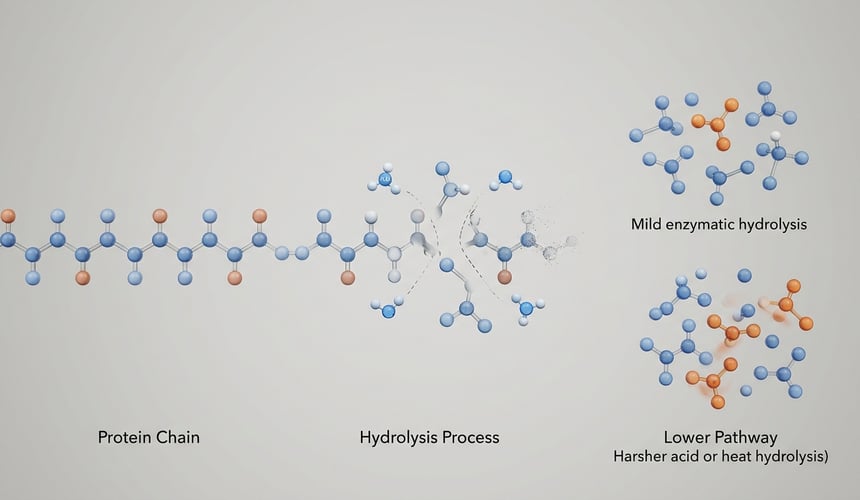
Protein hydrolysates are analyzed based on their amino acid content, yet the configuration of these molecules is a factor in processing chemistry. Amino acids exist as stereoisomers that are mirror images of each other, known as L- and D-enantiomers. Proteins in plants and animals are primarily constructed from L-amino acids, and the associated biological systems are adapted to recognize this configuration.
Cropenta Insight
Total amino acid percentages do not differentiate between molecular configurations, so two hydrolysates with the same declared total can differ in enantiomeric composition. Hydrolysis chemistry is therefore a technical variable worth considering when assessing an amino acid input. Because racemization is influenced by heat, pH and time, the processing method is relevant to the enantiomeric profile of the resulting hydrolysate.
Understanding Chiral Amino Acids
Amino acids possess a chiral center—a carbon atom attached to four different groups—allowing them to exist in stereoisomers. Proteins rely almost exclusively on the L-forms of these molecules. Consequently, the ratio between L- and D-amino acids in a derived product is determined by the method used to break down the original protein source.
How Hydrolysis Influences Enantiomer Distribution
Protein hydrolysis involves the splitting of peptide bonds, either enzymatically or through chemical means involving acid and heat. Under harsh chemical conditions, the chiral center of free amino acids can undergo rearrangement into the D-form through a process called racemization. The extent of this conversion is related to the severity of the reaction conditions, such as heat, pH, and reaction time. Milder enzymatic hydrolysis is often associated with a smaller degree of conversion.
In addition to the general principles of hydrolysis, specific observations regarding processed materials can be noted. Some observations suggest that chemically hydrolyzed collagen products might exhibit a high amino acid number in concentrated solutions, even if certain distinct amino acids are fewer in number and more prevalent in the D-configuration. These observations relate to the processing chemistry applied to the raw material.
Plant Interaction with D-Amino Acids
Plants do encounter D-amino acids through environmental sources, including soil and interactions with microflora, and research proposes mechanisms for their engagement with these molecules. Proposed mechanisms include root uptake of D-amino acids, and some instances within the literature suggest that D-amino acids may not be inert and could undergo metabolism or transport within plant tissues. This aspect is discussed within the context of broader amino acid biology in plant systems.
The functional utility of D-forms when applied externally requires consideration. The biological machinery, including transporters and enzymes involved in nitrogen metabolism within plants, is primarily adapted to the L-configuration. Consequently, D-forms may require conversion or a specific handling process before entering established metabolic pathways, and the efficiency of this handling is not uniform across all amino acids or species.
It is important to note that shifts in amino acid composition have been measured within whole tissues and in controlled laboratory setups. Extrapolating these observations directly to a commercial formulation applied in a field setting requires careful consideration of dose, application method, crop type, and the overall product matrix.
Considerations for Evaluating Product Formulations
The processing method behind a hydrolysate is a factor for technical review, because the L-to-D ratio is determined during production rather than by the source material alone. A specification that provides a complete profile of amino acids rather than just a singular total number offers more detailed composition information. The characteristics of the raw material, additives, salt levels, and heavy metal content are all variables that distinguish different products in this category.
When comparing inputs, it is recognized that the declared total amino acid percentage provides one metric, but does not contain information about the configuration of the molecules themselves. The distribution of enantiomers is a result of the processing applied, not necessarily the label of the source material. Therefore, products that report similar mass-based metrics may exhibit differences in application characteristics.
Technical Summary
Amino acids are defined by their L- and D-enantiomers, while protein synthesis relies on L-forms. Harsh acid hydrolysis can result in a conversion of the L-pool to the D-form via racemization, whereas enzymatic hydrolysis is generally associated with less conversion. Plants exhibit interaction with D-amino acids, but their internal metabolism favors L-forms, meaning the two configurations are not managed equally within plant systems.
This article was created with the help of AI and reviewed by the Cropenta editorial team. It is general information, not professional advice.
Technical Questions
If two hydrolysates declare the same total amino acid percentage, why can they behave differently at application?
Total amino acid percentage reports mass, not configuration. Racemization converts L-forms to D-forms without changing molecular weight, so a harshly hydrolysed product can match a milder one on declared total while containing more D-enantiomers. A stereochemistry-aware analysis or supplier process disclosure is needed to distinguish these cases.
Do plants take up D-amino acids at all, or are they simply ignored?
Research proposes mechanisms by which plants may interact with D-amino acids, including root uptake and possible metabolism. However, the transporters and enzymes involved in nitrogen metabolism are adapted to the L-configuration, meaning D-forms are not handled equivalently to L-forms. The extent of this difference varies by amino acid and by species.
Why is enzymatic hydrolysis often described as preserving more L-amino acids than acid hydrolysis?
Racemization is influenced by heat, pH, and time. Enzymatic hydrolysis, being milder, is generally associated with less conversion than harsh acid hydrolysis. The resulting composition still depends on the specific enzymes, substrate, and reaction conditions used, and on the raw material selected for processing.
Is a higher L-amino acid share always indicative of improved plant utilization?
No. The proportion of L- and D-forms reflects the processing applied, but the L-to-D ratio alone does not establish how a crop will utilize the applied nitrogen. Uptake and internal handling depend on the specific amino acids present, the crop species, the dose, the application route, and the rest of the formulation matrix.
Related articles
Related Products


Looking for something specific?
Our team is there to help you find the right raw materials and solutions for your formulations

