Why Amino Acid and Peptide Solutions Need pH Buffering to Stay Stable
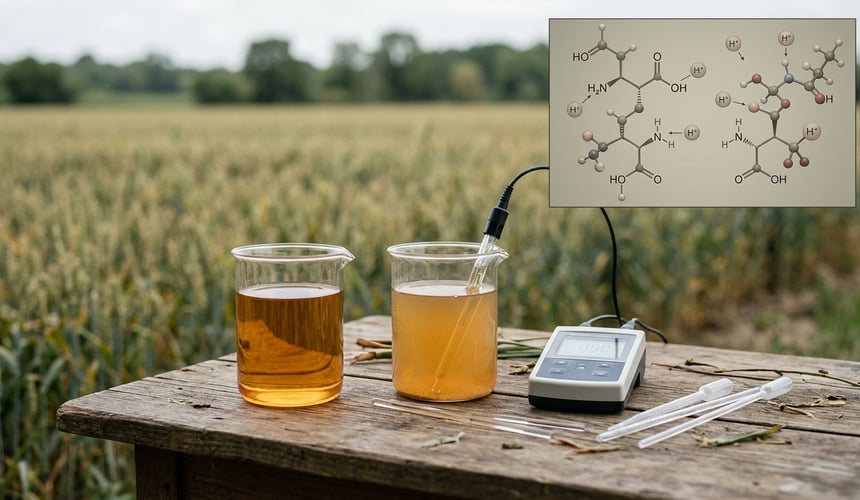
Two liquid amino acid products can carry similar labels and still behave very differently after months in a tank or when mixed with a calcium solution. According to the company, one may stay clear and usable while the other drifts, clouds or settles. The cause is often not the amino acid content itself but the pH of the solution and how well it holds that pH when its composition changes.
Cropenta Insight
The pH of an amino acid solution is not set by the amino acids alone. According to the company, salt content, peptide fraction and calcium or magnesium in the same tank can each move the working pH window. According to the company, raw material characteristics therefore matter as much as the amino acid content. According to the company, a common handling practice is to measure pH and EC of the base first and add amino acids last, so the tank can be checked before a full batch is committed. These are handling considerations, not evidence of product performance.
Why amino acids act as buffers
Amino acids carry at least one amino group and one carboxyl group. Both can gain or lose a proton depending on pH, so near the pKa values of these groups an amino acid solution resists pH change. This is general chemistry. Peptides carry the same kinds of groups at their ends and in their side chains, so a peptide fraction adds to the buffering picture. According to the company, how much buffering a raw material provides depends on its amino acid and peptide profile, which varies with its origin and hydrolysis process.
Where added buffers come in
Intrinsic buffering has limits. Once a solution contains salts, minerals or other acids and bases, the pH is set by the whole mixture rather than by the amino acids alone. Formulation reviews on peptides describe added buffers as one strategy for stabilizing peptides in aqueous solutions[1, 2]. That literature is largely pharmaceutical, and its buffer systems have not been tested in a specific fertilizer blend, so it is best read as a general principle rather than a recipe.
Where compatibility problems appear
Most compatibility trouble starts in the tank, according to the company. According to the company, mixtures with high salt or mineral content can shift the pH and form solids over time. According to the company, measuring pH and EC of the diluted base before adding amino acids, and testing doubtful combinations in a transparent container, can reveal many of these problems early. According to the company, organic solutions may support microbial growth within a day, so flushing lines and nozzles after use is a sensible precaution.
What the primary review does and does not show
The primary review on amino acids in plant growth and stress responses describes how plants accumulate stress-responsive amino acids, such as proline and glycine betaine, which help stabilize cellular structures[1]. This describes endogenous processes inside the plant. It does not show that amino acids applied in a liquid product behave the same way, and it does not address how formulation pH should be managed. The research set contains no study that measured buffering capacity or stability of a specific amino acid fertilizer, so the link between buffer chemistry and field results remains unresolved.
What this means for product choice
When comparing liquids, look beyond the label. Ask how the raw material was produced, what its salt level is, and how the product behaves when diluted and mixed with the other components you plan to use. A short tank test with pH and visual checks, repeated after standing time, gives more practical information than amino acid content alone.
Technical Summary
Amino acids and peptides carry ionizable groups that give them intrinsic buffering, which can help a liquid resist pH change. Added buffers can extend that control, while salt and mineral content from other ingredients strongly affects the final pH. Compatibility problems can appear as precipitation or pH drift in the mixed tank, according to the company. The available plant research does not measure formulation stability, so tank testing remains necessary.
This article was created with the help of AI and reviewed by the Cropenta editorial team. It is general information, not professional advice.
Technical Questions
Does the observed pH stability or buffering capacity in a tank test predict the physiological response or uptake of amino acids on the leaf or in the soil?
No. Buffering in a tank test describes how a solution resists pH change in the container. Whether applied amino acids are taken up depends on plant physiology, leaf or root conditions and soil chemistry, which a tank test does not capture. Plant research on endogenous amino acids is not a direct measure of formulation stability.
What latent compatibility issues might arise in seemingly clear amino acid and peptide mixtures, and how can they be detected?
A mixture can look clear and still change over time. According to the company, calcium or magnesium combined with other components may form precipitates slowly, and organic solutions may support microbial growth within a day. According to the company, a jar test in a transparent container, checked again after standing time, is a common way to reveal these changes before application.
Related articles
Related Products


Looking for something specific?
Our team is there to help you find the right raw materials and solutions for your formulations

