Does more RUP always increase milk protein production in dairy cows?
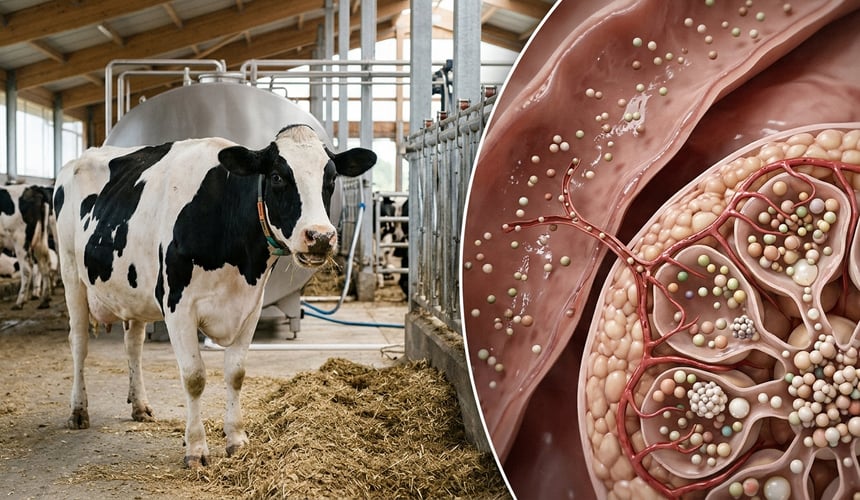
Dairy nutritionists know the calculation: raise the crude protein or the bypass fraction and the metabolisable protein (MP) supply goes up on paper. Whether the milk protein curve follows is a different matter. The limiting factor, not the protein quantity, decided the outcome.
Cropenta Insight
For buyers and formulators, the practical takeaway from this research is that a rumen-protected protein ingredient is a tool for closing a specific gap, not a lever for raising milk protein across every ration. The first step is establishing whether the basal diet is actually MP-deficient, and whether the amino acid profile reaching the small intestine — not just the RUP percentage — matches what the mammary gland needs.
RUP, MP, and the gap between them
Rumen-degradable protein (RDP) feeds the rumen microbes, which build microbial protein and deliver a large, relatively stable share of the amino acids the cow absorbs. Rumen-undegradable protein (RUP, sometimes called bypass protein or UDP) escapes the rumen and is digested in the small intestine. The sum of microbial protein and intestinally digested RUP, corrected for endogenous losses, is what formulation systems call metabolisable protein [1, 2]. RUP is not a measured constant: it is calculated from degradation characteristics at an assumed passage rate (Kp), so comparing RUP percentages between ingredients or batches only makes sense at the same Kp.
That calculation step is where most of the misinterpretation starts. A high RUP figure tells you how much protein resisted rumen degradation at an assumed Kp. It does not tell you how much of that protein the small intestine can actually digest. Intestinal digestibility is measured separately, often with the mobile nylon bag technique in cows fitted with duodenal cannulas. A protected ingredient with 80 % RUP at 6 %/h and 90 % intestinal digestibility would be expected to deliver a greater quantity of absorbable amino acids than one with the same RUP and 60 % digestibility, although this difference has not been demonstrated in a controlled feeding trial. The two values belong together; a RUP number alone is incomplete.
Why dose alone is rarely the answer
Three things limit how much of an extra gram of RUP ends up in milk protein. First, amino acid balance: if lysine or methionine is already limiting, additional supply of the others does little for the cow [3]. Second, energy: fermentable energy supports microbial protein synthesis, and without it more RDP simply raises ammonia and excretion. Third, the basal MP status: in cows already at or above their MP requirement, additional protected protein is largely surplus to requirements and is catabolised rather than channelled into milk protein [1]. The available supplementation studies, which differ in protein source and feeding frequency, do not show a consistent milk protein response, and the composition of the control diet appears to be the strongest single predictor of the direction of the response in that work [2].
That inconsistency is not a methodology problem. It is the biology: once the most limiting nutrient is corrected, further increases in the same nutrient yield diminishing returns.
Interpreting the research correctly
Two practical reading rules help when evaluating data. In-situ incubations in fistulated cows characterise the ingredient; they are not feeding trials and do not measure milk production. In-vitro degradation tests correlate poorly with in-situ measurement, especially for heat- and Maillard-protected proteins, where they can overstate rumen protection by tens of percentage points. Declared values based on in-vitro methods should not be compared with in-situ values. When a study reports an association between rumen-protected amino acids and milk protein, look at what the control diet was: in the work on dietary protein level and rumen-protected amino acids, that association was observed only where the basal diet was MP-deficient [3]. In diets already formulated at or above MP requirement, the same supplement was not associated with a significant milk protein response in that work.
What this means for the ration sheet
When a ration calls for more digestible bypass protein — for example, when conventional meals already deliver more RDP than the rumen needs, or when crude protein share and milk urea need steering without oversupplying degradable nitrogen — a protected protein is a legitimate formulation tool. The professional decision is not the RUP percentage in isolation. It is the combination of calculated RUP at a stated Kp, the measured intestinal digestibility of that RUP, the amino acid profile delivered to the small intestine, and the energy and MP status of the rest of the ration.
Dose alone does not determine milk protein output. When a ration is already at or above MP requirement, or when microbial protein supply and amino acid balance leave no gap to close, additional rumen-protected protein is unlikely to translate into more milk protein — that is the pattern the reported supplementation work points to.
Technical Summary
Increased RUP intake does not by itself raise milk protein yield. Responses depend on whether the basal ration is MP-deficient, whether the amino acid profile reaching the small intestine is limiting, and whether intestinal digestibility of the RUP is high. Interpret RUP only together with its Kp and its intestinal digestibility; treat in-situ characterisation as ingredient data, never as a milk production result.
This article was created with the help of AI and reviewed by the Cropenta editorial team. It is general information, not professional advice.
Technical Questions
Why is a high RUP percentage not enough to judge a protected protein ingredient?
Because they measure different things. RUP describes how much protein escapes rumen degradation at an assumed passage rate; intestinal digestibility describes how much of that escaped protein the small intestine can absorb. An ingredient with high RUP but low intestinal digestibility supplies less usable amino acid than the RUP figure suggests. Read the two together.
Can I compare RUP values from different suppliers if Kp assumptions differ?
They are not directly comparable. RUP is calculated from measured degradation parameters at a stated Kp, so values derived at different passage rates differ. Copying a 4 %/h figure into a 6 %/h formulation, or the reverse, distorts the metabolisable protein calculation. Ask suppliers for the Kp assumption and the degradation curve, then recalculate before comparing ingredients.
How should I read an in-situ degradation study if I need information on milk protein?
Check the study design first. In-situ incubations in fistulated cows characterise degradation kinetics and are not feeding trials, so no milk production outcome can be attributed to them. To evaluate milk protein responses, look for controlled feeding studies where intake, milk yield and composition were measured against a defined control diet.
Why does the amino acid profile of the control diet matter when interpreting supplementation studies?
Because the direction of the observed response depends on it. Where the basal ration was already at or above the metabolisable protein requirement, additional protected amino acid supply was generally not associated with a milk protein response. Associations with milk protein were reported mainly where the control diet was MP-deficient and the supplemented amino acids addressed a specific limitation.
Related articles

Related Products

Looking for something specific?
Our team is there to help you find the right raw materials and solutions for your formulations

