Why Water Hardness and Alkalinity Matter for Liquid Fertilizer Stability
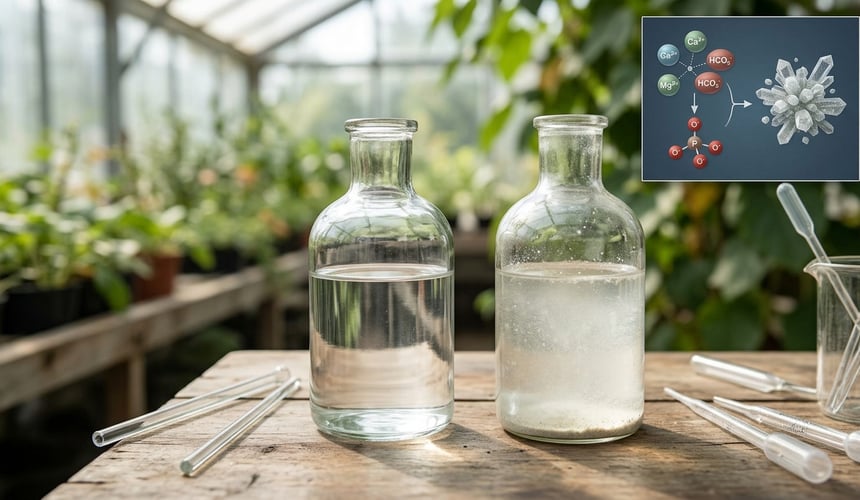
A fertilizer tank can look fine at the moment of mixing and still change within hours. Growers and distributors often notice this as a cloudy haze, sediment at the bottom of the tank, or a filter that clogs after a few batches. The water used for dilution is often part of the explanation, and two of its properties matter most: hardness and alkalinity.
Water hardness refers to the dissolved calcium and magnesium ions in the water. Alkalinity describes how much bicarbonate and related carbonate species the water carries, which determines how strongly it resists pH change. Both are set by the source water, whether groundwater, surface water or rainwater, and they can vary between sites and seasons.
Cropenta Insight
The most useful distinction for interpreting water quality problems is between a mix that is physically clear and one that stays stable. Visual clarity at mixing time does not show whether calcium, magnesium, bicarbonate or phosphate will form solids over hours. For raw material selection, the relevant question is how each ingredient behaves in the water actually used, including its chelate type and salt load, and whether that behavior has been checked with the local water rather than assumed.
Why calcium and magnesium react in the tank
Calcium and magnesium are positively charged ions that readily bind to negatively charged partners. Phosphate is the classic case: calcium and magnesium phosphates have low solubility, so phosphate added to hard water may precipitate instead of staying dissolved. Sulfate can also form sparingly soluble calcium salts at high concentrations. The result is solid material that settles, adheres to tank walls or passes into lines as fine particles.
Chelated micronutrients behave less predictably. A chelate holds a metal ion in a ring structure so that it stays available in solution. When calcium or magnesium is present in large amounts, these competing ions may change that balance, and the micronutrient may become less accessible. Whether this happens depends on the chelate type, pH and concentrations, so the risk should be checked rather than assumed.
Alkalinity, pH and carbonate precipitation
Bicarbonate is the main form of alkalinity in many waters. When calcium is present and the pH rises, bicarbonate can convert to carbonate, which combines with calcium to form calcium carbonate, a solid that appears as a white haze or crust. Alkaline water also resists acidification, so it takes more acid to bring the pH down, and a solution that was acidified at the start may drift upward during standing. A lower pH is not automatically better; the suitable range depends on the products involved.
Stable in the bucket, unstable later
Miscibility and long-term stability are different properties. A mix can appear clear right after stirring and still form a deposit after a few hours or while it stands in a spray tank. Slow changes are easy to miss at mixing time. A simple check is to prepare the mix in a transparent container at the intended dilution and observe it over time, not only immediately after stirring.
Agronomic relevance
For the grower, the practical consequence concerns what reaches the crop. Precipitated phosphate or micronutrients removed from solution are not available in the spray or irrigation line, and fine particles can block nozzles, drippers and filters, which may show up as patchy coverage. Nutrient management is examined in relation to water quality in a primary study[1], which is referenced here for its general focus only and not as evidence of specific hardness or alkalinity thresholds. Precise water and fertilizer application in crops is discussed in a separate review[2]. Whether a given water quality causes a measurable crop response depends on the product, the rate and the crop, and this article does not cite experimental trial data that defines safe limits.
Practical checks before mixing
- Test the water for hardness and alkalinity, not only for pH.
- Prepare a small test mix in a transparent container at the intended dilution and observe it after mixing and after standing.
- Follow the product's instructions on mixing order, and keep calcium- and magnesium-rich components apart from phosphate-containing ones where instructions require it.
- Adjust pH only as far as the formulation allows, and recheck after each adjustment.
- Flush lines and filters after use.
Sources
- Effectiveness of Nutrient Management on Water Quality - PMC
- Precise application of water and fertilizer to crops - PMC - NIH
Technical Summary
Calcium and magnesium from hard water, together with bicarbonate-driven alkalinity, can cause phosphate and carbonate precipitation and may shift chelate behavior in liquid fertilizer tanks. A mix that looks clear at mixing may still change over standing time, so stability should be checked in the actual water. Thresholds depend on the formulation and are not established by the evidence discussed here.
This article was created with the help of AI and reviewed by the Cropenta editorial team. It is general information, not professional advice.
Technical Questions
Why can a fertilizer mix look clear but still form deposits in the tank?
A clear appearance at mixing shows that the components are dispersed at that moment, not that they will remain dissolved. Precipitation of phosphate or carbonate can be slow and may depend on temperature, pH drift and the time the mix stands in the tank. A test in a transparent container observed over several hours gives a more reliable picture than a judgement made immediately after stirring.
Is a lower pH always the solution for alkaline water?
Not necessarily. Lowering pH can limit the conversion of bicarbonate to carbonate, but the appropriate pH depends on the formulation, the other ingredients and the intended use of the mix. Each acid addition also changes the ion balance. Limits should be checked for the specific mixture rather than applied as a general rule.
Related articles
Related Products




Looking for something specific?
Our team is there to help you find the right raw materials and solutions for your formulations

