How Does Sulfur Application Influence Soil pH in Different Soil Types?
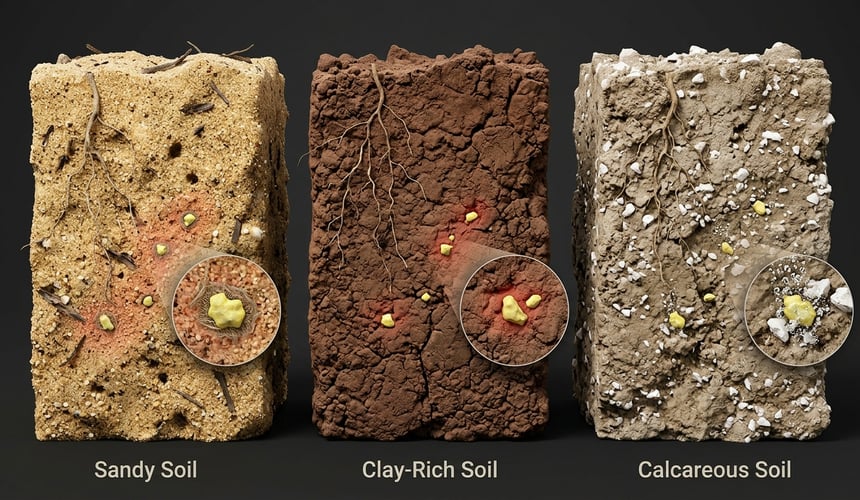
Sulfur application is commonly associated with lower soil pH, but the sources reviewed do not establish a uniform pH change across all soil types. The measured evidence in the cited material focuses on soil pH characteristics and on field observations of pH following elemental sulfur application, with response dependent on soil conditions. Sulfur nutrition is also discussed in relation to crop development, and nutrient supply, plant response and soil chemistry are separate questions that should be evaluated separately.[1, 2, 3]
Cropenta Insight
For advisers and fertilizer distributors, the practical distinction is between a sulfate source that supplies a nutrient and an acidifying material intended to alter soil chemistry. Elemental sulfur requires microbial oxidation before acidity is released, so its reaction rate depends on temperature, moisture, particle size and soil biological activity. Where free calcium carbonate is present, part of that acidity is neutralized, which can delay an observable pH response.
What the cited sources measured
The soil pH management source describes inherent factors that govern pH, including parent material, clay content, organic matter and the presence of calcium carbonate. These properties determine how a soil responds to an acidifying input, so the same application cannot be assigned a single expected pH shift across different sites.[2]
The review of sulfur in crop production includes field observations of lower pH after elemental sulfur addition. These results were reported under specific soil and site conditions rather than as a general effect. The narrative review also discusses sulfur form and oxidation as factors relevant to interpretation, but it does not provide a controlled comparison of reaction rates among elemental sulfur, thiosulfate and sulfate fertilizers.[3]
Sulfur nutrition and the limits of pH interpretation
Sulfur is a constituent of amino acids and is therefore relevant to protein formation and nitrogen metabolism in crops. A review covering sulfur nutrition and crop development reported observations in wheat, including changes in germination and defence-related responses under particular experimental conditions. These observations describe plant-level responses to sulfur supply; they do not demonstrate that a change in soil pH caused them, and they should not be transferred directly to other crops or field conditions.[1]
Working with field pH data
For growers and advisers, the sequence is to identify the sulfur form, establish the starting pH and carbonate status, and then interpret the pH trend over time rather than assume a fixed shift. Soil testing after a suitable reaction period provides information about the observed direction and size of change. Where sulfur supply is already adequate, additional sulfur is unlikely to add agronomic value simply because it is expected to alter pH.
Sulfur sources differ in how quickly they can generate acidity. Thiosulfate and sulfate fertilizers deliver sulfur to the soil solution and are largely unreactive with soil pH, while elemental sulfur requires oxidation to sulfate before acidity appears. Where the objective is a pH change, the source form sets both the timing and the size of the measured response, so product selection should follow the site-specific objective rather than a general expectation. Monitoring intervals that ignore oxidation time can record an intermediate value and be read as the final one.
Technical Summary
The available evidence supports a measured interpretation of sulfur application: field observations in the cited review included lower pH after elemental sulfur addition, while the soil pH source describes the inherent factors that govern responsiveness. Observations of sulfur nutrition in crops cannot be attributed automatically to pH, because supply and soil chemistry act through different pathways. Product form, initial soil conditions, carbonate content and the timing of observations remain central to any site-specific assessment.
This article was created with the help of AI and reviewed by the Cropenta editorial team. It is general information, not professional advice.
Technical Questions
Does a lower soil pH explain all observed sulfur responses in crops?
Sulfur is required for amino acid formation and is linked to nitrogen metabolism, so supply can be discussed in relation to crop development. However, a plant response observed in a controlled study does not by itself demonstrate that soil pH caused the response, and results from one crop should not be assumed to apply to another.
Why can two fields respond differently to the same sulfur application?
Clay content, organic matter, parent material and free calcium carbonate affect how a soil responds to an acidifying input. Sites differ in these properties, so a pH change observed at one location is not a general expectation for all soils. A measured starting point and carbonate status remain necessary for interpretation.
What field evidence is available for elemental sulfur and soil pH?
Field observations in the cited review included lower pH after elemental sulfur application under the conditions studied. The review does not provide a controlled comparison of pH response rates among sulfur forms, so specific rate claims should be treated cautiously and confirmed through site-specific soil testing.
Related articles

Related Products



Looking for something specific?
Our team is there to help you find the right raw materials and solutions for your formulations

