How brown, red and green marine algae differ in reported bioactive compound classes
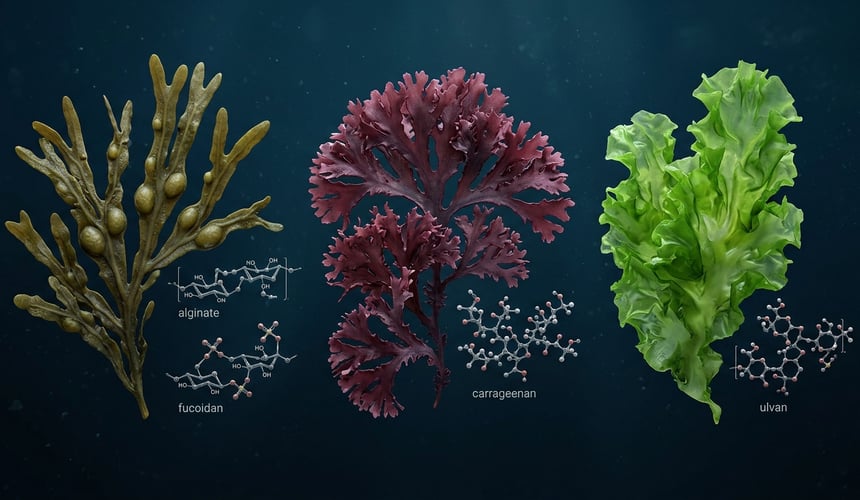
Many seaweed-based inputs are sold simply as seaweed, without saying which algae group they come from. For growers and advisers choosing between them, the question is whether brown, red and green algae differ enough in their compounds to matter when crops face drought, salinity or heat.
Cropenta Insight
For a grower or adviser, the algae group behind a seaweed-based input is a reasonable question to ask, because brown, red and green algae differ in their main polysaccharides and polyphenolic compounds. Current evidence on which group performs best under drought, salinity or heat has not been demonstrated, and most proposed mechanisms remain hypothetical. Selection should therefore rest on species-specific data and crop-relevant trials, not on a generic seaweed effect.
Three groups, three different chemistries
Marine algae are commonly divided into brown, red and green groups, and each contains a different mix of molecules. Seaweeds in general contain polysaccharides, proteins and polyphenolic compounds such as tannins and phlorotannins, and the review describes these classes as part of their bioactive profile[1]. Brown algae are rich in phlorotannins and in sulfated polysaccharides such as alginates and fucoidans, along with laminarin and mannitol. Red algae are known for carrageenans and agars, and green algae for ulvans. The relative amounts differ by species, so two products made from different groups can have quite different compound profiles.
What the evidence on plant stress actually shows
The primary source is a review of bioactive compounds in marine algae. It does not report crop trials under stress, so any link between a compound class and a plant response is an interpretation, not a demonstrated result[1]. Marine algae are also described as sources of polysaccharides and other bioactives more broadly[2], but that does not show which group performs better on crops. The mechanisms discussed for seaweed biostimulants, such as interactions of sulfated polysaccharides with plant cell surfaces or signaling, remain hypotheses for most species.
Why species matters for product selection
A result obtained with one seaweed species does not automatically apply to another. Likewise, a trial with one commercial extract does not establish that all extracts of the same species behave in the same way, since composition can vary between raw material batches. The sources do not quantify this variation for plant stress applications.
Physiological changes in a plant are also not the same as yield outcomes. A measured change in leaf water status or antioxidant activity during stress is a physiological observation. Whether it translates into a harvest outcome has not been demonstrated and requires separate field evidence, which is limited for most algae species and conditions.
What this means for reading labels
When a label names only seaweed, a reader has little basis for comparing it with a product made from another algae group. Asking which species was used, and what the source says about its compound profile, is a more useful starting point than the general term seaweed.
Technical Summary
Brown, red and green marine algae differ in their dominant polysaccharides and polyphenolic compounds. This makes a generic seaweed effect difficult to assume. Mechanisms linking these compounds to plant stress responses remain largely hypothetical, and results from one species or extract do not transfer to others. Physiological responses should not be read as yield outcomes.
This article was created with the help of AI and reviewed by the Cropenta editorial team. It is general information, not professional advice.
Technical Questions
Why does the algae group matter if all seaweed extracts contain polysaccharides?
Polysaccharides differ in type between groups. Brown algae are associated with alginates and fucoidans, red algae with carrageenans and agars, and green algae with ulvans. These molecules differ in structure and charge, so a shared general category does not mean a shared activity. How these differences affect plants under stress has not been demonstrated and remains an open question.
Can a physiological response under stress be used as evidence of higher yield?
Not directly. A measured change in plant water status, antioxidant activity or other physiological marker shows a response at the plant level. A yield outcome needs field trials under relevant conditions, with comparison to suitable controls. Many seaweed studies are controlled-environment or small-scale, so such transfer should be treated with caution.
Related articles
Related Products


Looking for something specific?
Our team is there to help you find the right raw materials and solutions for your formulations

