How Do Humectants and Waxes Influence Foliar Uptake of Nutrients?
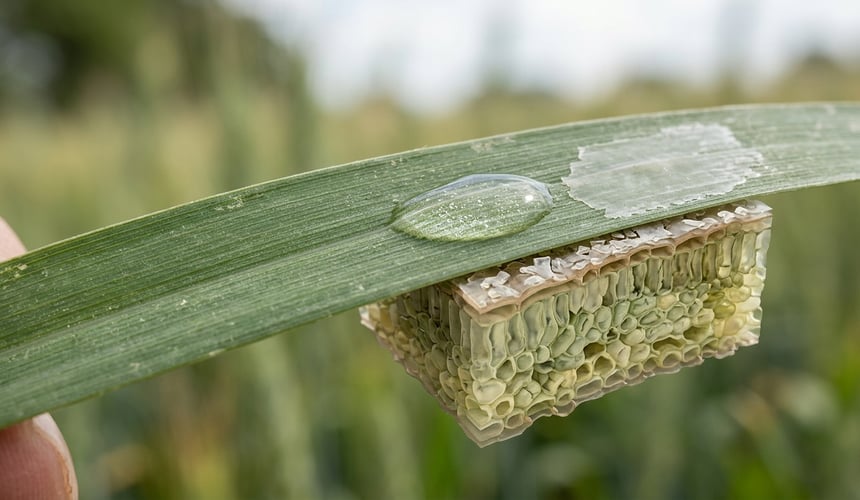
Water on a wheat leaf does not simply sink in. Droplets bead on the surface, roll off or evaporate, and the tissue underneath stays dry. The cuticle that limits water loss also limits what a spray deposit can deliver — which is why foliar uptake, humectants and waxes end up in the same conversation about formulation.
The two ingredient groups are often listed side by side as if they did the same job. They do not. One keeps a drying deposit hydrated; the other can either block the leaf surface or help carry material across it.
Cropenta Insight
From a raw-material perspective, the difference between a humectant and a wax is a specification question before it is an agronomic one. Hygroscopic behaviour, solubility, film-forming tendency and compatibility with salts vary between candidate ingredients, and a certificate of analysis rarely describes them. A formulation can wet a leaf perfectly and still deliver little nutrient if the deposit crystallises or the film seals the surface. Checking how an ingredient behaves in the diluted tank solution is the more informative first step.
What Sits Between the Droplet and the Leaf Interior
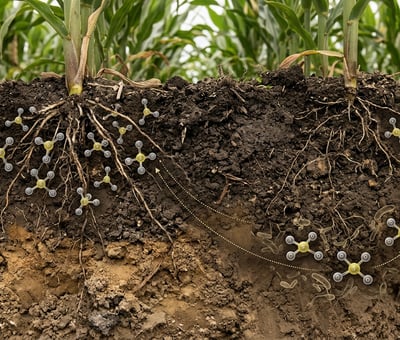
A leaf is covered by a cuticle: a thin continuous layer of cutin, a polyester polymer, with waxes embedded in it and epicuticular wax crystals on top. Droplets bead on that outer wax, and it is generally described as the principal barrier to dissolved nutrients, particularly polar salts and small water-soluble molecules. The cuticle behaves as a hydrated, semi-permeable membrane containing small polar pathways — commonly described as aqueous pores — through which dissolved ions and small molecules are considered able to diffuse while the tissue below is wet. How accessible those pathways are is thought to be linked to the water status of the cuticle itself. [1]
How Humectants Shape Foliar Uptake at the Leaf Surface
A humectant is hygroscopic: glycerol, sorbitol and certain glycols hold water instead of releasing it. In a foliar spray its job is not to spread the droplet — that is a surfactant's role — but to keep the deposit in a dissolved state after the carrier water has gone. A concentrated salt residue can crystallise within minutes, and a nutrient locked in a crystal cannot diffuse anywhere. Keeping the residue hydrated also keeps the cuticle beneath it hydrated, and diffusion of polar solutes is commonly linked to that hydration. [2]
Waxes: Penetration Barrier, Surface Film, or Both
Waxes turn up in foliar products for different reasons. Because the plant's own epicuticular wax is generally described as the principal penetration barrier, some adjuvants contain oils or waxes that soften or partly dissolve it — mainly discussed for lipophilic actives, less so for ionic nutrients. A wax may also be included as a film former intended to slow evaporation of the deposit; whether that changes how much nutrient enters the leaf has not been demonstrated here. A film that is too continuous or too hydrophobic may restrict contact between a dissolved nutrient and the polar pathways in the cuticle, the opposite of the humectant's effect. [1]
Why Coverage and Penetration Are Measured Separately
Work on wheat illustrates how easily wettability and uptake are conflated. A study of foliar-applied phosphoric acid tested adjuvant choice and application timing and recorded leaf surface wettability and leaf phosphorus content as separate measurements. [3] Coverage and penetration are related but not interchangeable, which is why adjuvant choice, spray timing and the drying behaviour of the deposit are often assessed together. [2, 3]
What Follows for Ingredient Choice
Judge a humectant by whether the deposit would otherwise dry and crystallise before diffusion can occur, and a wax by whether slowed evaporation of the deposit is genuinely wanted. Neither answers the practical question: does the formulation change how much nutrient crosses the leaf surface under real conditions, rather than how the spray looks on the leaf?
Technical Summary
Humectants and waxes affect foliar uptake through different mechanisms. Humectants hold water in the drying deposit, keeping nutrients dissolved and the cuticle hydrated, which supports diffusion through polar pathways. Waxes embedded in the plant surface form the main penetration barrier, while wax-based ingredients may either soften that barrier or create a film that limits contact. Coverage and nutrient entry are recorded as separate measurements.
This article was created with the help of AI and reviewed by the Cropenta editorial team. It is general information, not professional advice.
Technical Questions
Can a humectant replace a surfactant in a foliar spray?
No, they solve different problems. A surfactant lowers surface tension so a droplet spreads and covers more leaf area. A humectant holds water inside the drying deposit so the nutrient stays dissolved. Many formulations contain both, because good coverage still leaves a crystallised residue if nothing keeps the deposit hydrated until diffusion has taken place.
Does dissolving the leaf's epicuticular wax always mean more nutrient uptake?
Not necessarily. Softening the leaf's surface wax is mainly discussed for lipophilic compounds, and the response depends on species, leaf age and growing conditions. Ionic, water-soluble nutrients move largely through polar pathways in the cuticle, which wax solvents do not directly address. Very aggressive wax removal is also associated with local tissue damage rather than greater nutrient entry.
Why can two wax-containing adjuvants behave differently on the same crop?
Wax type, melting behaviour, emulsion droplet size and use concentration decide whether the residue dries as a fragmented film or a continuous one. A continuous hydrophobic layer may restrict contact between a dissolved nutrient and the cuticle, while a fragmented layer may only slow evaporation. Labels rarely specify this, so the behaviour of the diluted spray is the useful reference point.
How should application timing be weighed against adjuvant choice?
They interact. Timing changes leaf wetness, temperature and how fast the deposit dries, and all of those influence how long a nutrient stays dissolved at the surface. An adjuvant that performs well under slow drying may behave differently when the spray dries within minutes, so the two factors are best assessed together rather than separately.
Related articles
Related Products


Looking for something specific?
Our team is there to help you find the right raw materials and solutions for your formulations

