How Heat Treatment Changes the Rumen Breakdown of Soybean Meal Protein and What Happens Next
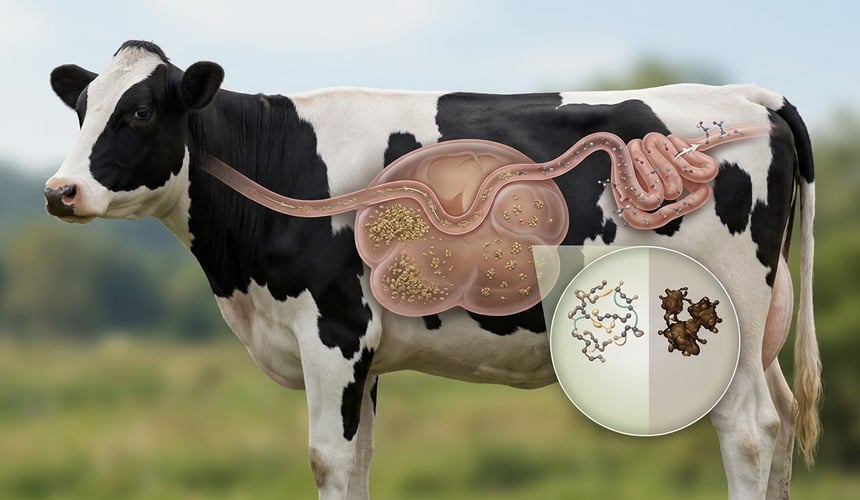
In the rumen, micro-organisms break down most of the protein in soybean meal within a few hours. The nitrogen released is used to build microbial protein, and only the protein that escapes this breakdown reaches the small intestine as amino acids the cow can absorb. Heat treatment is one way to change that split, and it is widely used on soybean meal for this reason.
The mechanism is partly chemical. Reducing sugars, which can be present in the meal or added, react with free amino groups when heat is applied. The best-known reaction is the Maillard reaction, in which sugars bind the epsilon-amino group of lysine and form larger structures that resist microbial enzymes. Under controlled conditions, the bonds are broken again by acid and enzymes in the abomasum and small intestine, so amino acids can still be released there. A 2024 study by S Lu reports that heat treatment can protect feed proteins from microbial degradation in the rumen, so that a larger share of amino acids may become available for digestion in the small intestine.[1] This is a direction supported by the study, not a fixed percentage that transfers to every soybean meal. The heating conditions and the feed matrix determine how strong the effect is.
Cropenta Insight
For nutritionists comparing heat-treated soy products, the most useful question is not how much protein escapes the rumen but how much of it is digested afterwards. Rumen degradation and intestinal digestibility are separate measurements, and they should be read together with the assumed passage rate. In-vitro tests can overstate rumen protection of Maillard-protected proteins, so in-situ data remain the more reliable basis for comparison.
More heat is not always better
The same reaction that slows rumen breakdown can also remove lysine from the amino acids the animal can use. Total lysine may stay unchanged after over-processing while reactive lysine, the lysine with a free epsilon-amino group, falls. A feed analysis that reports only total lysine can therefore hide a loss of usable protein. Over-processing lowers both rumen degradation and intestinal digestibility, so a lower degradation figure alone does not show that more usable protein is delivered.
Evidence from other crops shows the same trade-off in a different form. In a study on canola seed and its meal, heat treatment decreased the rumen degradability of most nutrients, especially crude protein and crude fat.[2] That is a different raw material, and the result cannot be carried over to soybean meal without its own data.
Reading degradation and digestibility together
Rumen protein behaviour is usually described with in-situ nylon bag kinetics. The soluble fraction, the washable but insoluble fraction, the potentially degradable fraction and the undegradable fraction describe the protein, and the degradation rate per hour describes how fast the degradable part is broken down. Effective degradation and rumen-undegradable protein (RUP) then depend on an assumed fractional passage rate, Kp, which is estimated from intake and production and is not measured in the bag. RUP values are therefore only comparable when they were calculated at the same Kp.
A high RUP is not the same as usable protein. The protein that escapes the rumen must still be digested in the small intestine. This is measured with the mobile nylon bag technique in cows fitted with duodenal cannulas. A high RUP combined with low intestinal digestibility delivers little usable protein, which is why heat-treated products need both values.
Experimental data and formulation values
Degradation and digestibility measurements characterise the ingredient. Formulation values are calculated from them. Systems such as the Dutch DVE/OEB system, the German nXP/RNB system, INRA PDI and CNCPS metabolisable protein translate the same measurements into different values, and those values change with the assumed passage rate. A valuation is therefore a calculation based on measurements, not a separate animal result, and it should be checked against the underlying degradation and digestibility data.
What this means at the feed mill
In practice, the heat history of a batch is rarely visible on a declared crude protein figure. Temperature, moisture, time and the sugar available in the meal all influence how far the Maillard reaction proceeds, so two batches with similar analysis can behave differently in the rumen. Where heat-treated soy is used to adjust the bypass protein supply, checking reactive lysine next to total lysine and asking for degradation and digestibility data calculated at a stated passage rate gives a clearer basis for comparison.
Technical Summary
Heat treatment can reduce the rumen degradation of soybean meal protein through Maillard-type bonds, which may increase the share of amino acids available in the small intestine. Excessive heat lowers reactive lysine and intestinal digestibility. Rumen degradation, RUP and digestibility must be evaluated together at the same assumed passage rate, and formulation values are calculations from these measurements.
This article was created with the help of AI and reviewed by the Cropenta editorial team. It is general information, not professional advice.
Technical Questions
Why do formulators check reactive lysine next to total lysine in heat-treated soybean meal?
Total lysine can stay unchanged while reactive lysine falls after over-processing, because Maillard reactions bind the free epsilon-amino group that digestion needs. A total lysine value alone therefore cannot show how much lysine the cow can use from the meal. Reactive lysine and intestinal digestibility data give a more complete picture of amino acid supply.
Can RUP values from different heat-treated products be compared directly?
Only when they are calculated at the same assumed passage rate. RUP is derived from degradation parameters and an assumed fractional passage rate, not from the protein left after a full incubation. Intestinal digestibility must be read alongside RUP, because a high RUP with low digestibility delivers little usable protein to the cow.
Related articles

Related Products
Looking for something specific?
Our team is there to help you find the right raw materials and solutions for your formulations

