How Glycine Betaine Influences Nutrient Uptake in Stressed Crops
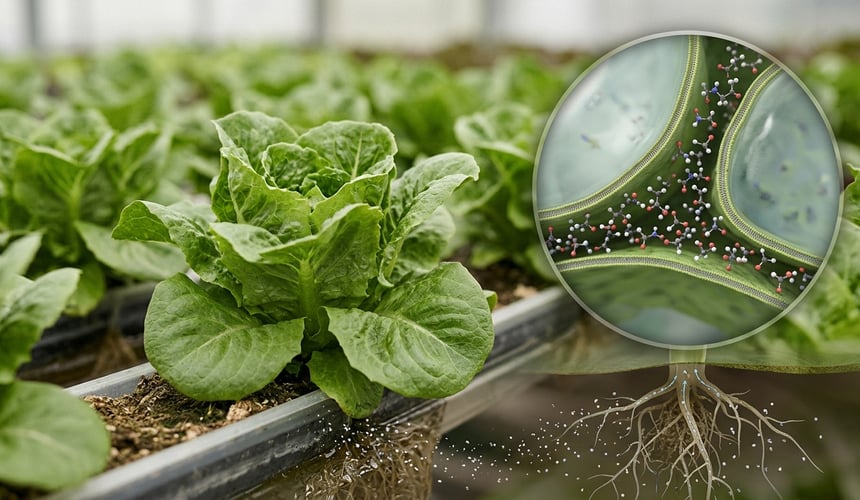
Where glycine betaine and nutrient uptake meet is a narrower subject than the usual osmolyte story. Glycine betaine is a compatible solute, often described as an osmoprotectant: a small, water-soluble molecule that some plant species accumulate in their cells, where it contributes to osmotic adjustment and to the stability of proteins and membranes. That part of its plant physiology is well described. What happens to nutrient uptake when the compound is supplied to a crop, through the root zone or the leaf, is a different question with more crop-specific answers.
Lettuce is a useful starting point. It is one of the leafy vegetables in which glycine betaine occurs naturally [1], and its nitrate content is routinely measured for quality reasons. A study on lettuce roots examined both questions at once: whether roots take up glycine betaine, and whether that uptake relates to the nitrate a plant holds [2].
Cropenta Insight
For advisers, the practical question is not whether glycine betaine acts as an osmolyte, which is well established, but whether an applied product reaches the tissue where nutrient handling happens. In lettuce, root-applied glycine betaine was taken up by the roots and was linked to lower tissue nitrate. That is a crop-specific measurement, not a general rule. Interpreting it requires knowing the species, the application route and whether nutrient content or whole-plant nutrient budgets were measured.
What the Lettuce Trial Actually Measured
The work investigated glycine betaine uptake by lettuce roots and the compound's potential to regulate nitrate content in the plant . Root-applied glycine betaine was taken up by the roots, and the treated plants held less nitrate than the untreated controls [2]. That is a nutrient-related outcome, but a narrow one: leaf nitrate is the end of a chain running from root uptake through reduction in the cytosol and plastid to storage in the vacuole. A lower tissue nitrate figure can mean less nitrate arriving, faster assimilation, or a different balance between the two. The study measured content under its own conditions, not the whole nitrogen budget.
What Reviews Say About Glycine Betaine and Nutrient Uptake Under Stress
Reviews of glycine betaine in crop stress physiology go beyond plant water relations. One synthesis describes effects that include maintaining nutrient uptake and limiting heavy-metal accumulation in tissues under stress conditions [3]. Another places glycine betaine among several mechanisms operating alongside ion compartmentation and antioxidant responses in saline environments [4]. Both are syntheses, largely built on controlled-environment and greenhouse work. They describe mechanisms and associations rather than field-verified nutrient outcomes, and they do not establish that an application will change a crop's nutrient status.
Why Applied Glycine Betaine Is Not the Same as an Internal Osmolyte
Under drought stress or salinity stress, the nutrition-relevant sequence starts at the root. Water uptake falls, transpiration drops, and the mass flow that carries nitrate and potassium towards the root surface slows down. Membrane transport systems that load ions into the xylem can also be affected when cells lose water. A compatible solute that helps cells hold water and keeps membrane proteins functional is therefore relevant to nutrient acquisition. That is mechanistic plausibility, not proof of an application effect.
Two distinctions keep the reasoning honest. Applied glycine betaine has to reach root or leaf tissue at a concentration that matters, and in a species that already accumulates the compound, such as lettuce, it joins an existing pool [1]. Not all plants synthesise it either: many legumes and several brassicas are generally treated as non-accumulators, while spinach, sugar beet and several cereals accumulate it readily. Differences of that kind are one reason the plant stress response varies between crops, concentrations and application moments.
Where the Nutrient Uptake Evidence Is Still Thin
For nitrogen, the lettuce work provides a measured result under its own conditions [2]. For phosphorus, potassium and micronutrients, the nutrients most often discussed in nutrient efficiency programmes, the picture rests mainly on mechanism and on controlled studies summarised in reviews [3, 4]. Tissue analysis, root-zone salinity and the timing of stress relative to application all shape what a grower would observe. Until field data on nutrient status become more consistent, applied glycine betaine is best judged on measured crop response rather than on its established role inside the plant.
Technical Summary
Glycine betaine is an established compatible solute in many species, but its link to nutrient uptake depends on how it is supplied. In lettuce, root-applied glycine betaine was taken up by roots and associated with lower tissue nitrate, which measures content rather than total nitrogen acquisition. Reviews describe maintained nutrient uptake and ion balance under stress, mostly from controlled work. Crop, concentration and timing determine whether any of this is visible in the field.
This article was created with the help of AI and reviewed by the Cropenta editorial team. It is general information, not professional advice.
Technical Questions
Does glycine betaine application change total nitrogen uptake or only tissue nitrate?
The lettuce study measured tissue nitrate content, which is not the same as total nitrogen acquisition. Lower nitrate in leaves can result from less nitrate arriving, faster reduction, or a shift in where nitrogen is stored. Without a full nitrogen budget, meaning uptake, assimilation and partitioning measured together, the effect should be described as a change in nitrate content rather than in total nitrogen uptake.
Which crops are relevant for glycine betaine work, given the species differences?
Glycine betaine accumulation varies widely. Spinach, sugar beet and several cereals synthesise and store it readily, while many legumes and several brassicas are generally treated as non-accumulators. Species that already contain the compound, including lettuce, add applied material to an existing pool. That difference in baseline physiology is one reason results from one crop should not be transferred to another without local measurement.
Why do controlled studies on glycine betaine and nutrient uptake not settle field practice?
Most mechanism work runs in pots, nutrient solutions or greenhouses, where salinity, water supply and nutrient levels are controlled. Field soils vary in texture, salinity, organic matter and moisture, and roots grow alongside a resident microbial population. A physiological effect seen under controlled conditions may not produce a measurable difference in tissue nutrient status in a commercial field, particularly where stress is intermittent.
What should be measured to judge a glycine betaine application on nutrient status?
Tissue analysis before and after application is the practical starting point, ideally paired with root-zone measurements of salinity, moisture and pH, since these influence both nutrient availability and root function. Recording growth stage and the timing of stress relative to application matters, because reported responses depend on crop, concentration and moment. Untreated strips in the same field give the comparison that product literature cannot replace.
Related articles
Related Products



Looking for something specific?
Our team is there to help you find the right raw materials and solutions for your formulations

