Meta-Analysis of Seaweed Biostimulant Field Trial Efficacy on Crop Yield
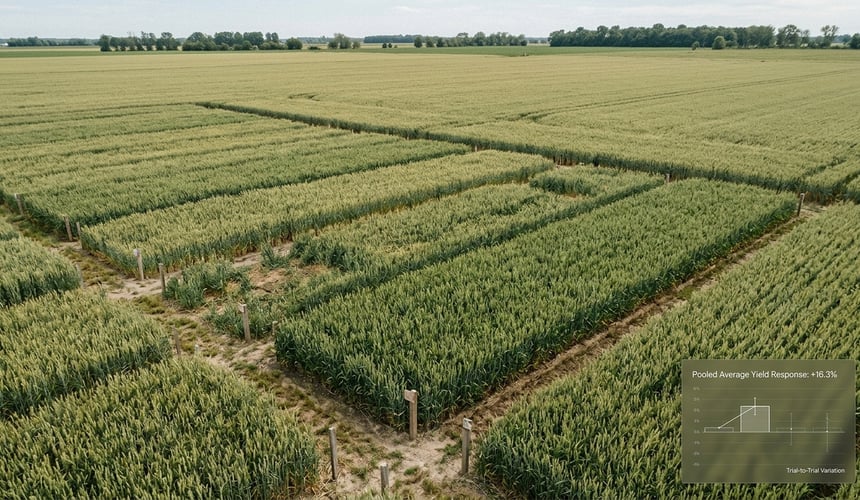
A grower applies a seaweed extract at a critical crop stage, harvests, and compares the treated plot with an untreated neighbour. The difference may be clear, small or absent. That pattern is common in field work, so the practical question is how consistently seaweed biostimulants are associated with yield gains under real farm conditions.
Cropenta Insight
A pooled average of about 16 percent is a useful summary of many trials, but it describes a typical result, not the outcome of a single field. For growers and advisers, the practical distinction lies between a meta-analytic average and the response expected on their own soil, climate and crop. The variability between trials is the part that needs checking before results are extrapolated.
What the pooled yield data show
A 2026 meta-analysis of seaweed extract-based biostimulant trials found that treated crops produced on average about 16 percent more yield and biomass than untreated controls. The average difference was 16.3 percent, with a 95 percent confidence interval of 13.5 to 19.1 percent. The authors report that responses were positive under more than one set of conditions, which makes a broadly positive pattern across the literature plausible.[1] The confidence interval is narrow enough to show that the average is not zero, but it says nothing about how much individual trials differ around that average.
Why individual trials diverge
Seaweed extracts contain several compound groups, including polysaccharides, polyphenols and mannitol, and their composition depends on the seaweed species and the processing used. A result from one brown algal extract, such as Ascophyllum nodosum, does not automatically apply to another species or to a different commercial extract. Field trials also differ in crop type, soil fertility, nutrient programme, timing of application and the weather during the season. Each of these can change the size of the response, and a trial with little or no yield difference can sit within the same spread of results as a strong one.
The primary study frames nutrient uptake and utilization as one route through which seaweed-based products are considered to act in crops.[2] That is a plausible hypothesis for field relevance, but a change in nutrient uptake or plant physiology is not itself a yield result. Yield has to be measured at harvest in replicated trials.
Limits of the evidence
The available figures come from pooled, abstract-level data. They do not show how often a response is absent, how large the range of responses is for each crop, or how stress conditions such as drought or saline irrigation modify the effect. Those moderating factors should be checked in the full text before a pooled average is applied to a specific crop. Where field trials are few for a given crop or region, the average carries less weight.
Technical Summary
Pooled field data from seaweed extract-based biostimulant trials show an average yield and biomass difference of about 16 percent, with a confidence interval of 13.5 to 19.1 percent. The average does not describe the spread of individual trials, and the effect depends on species, crop, conditions and trial design. Physiological responses do not by themselves establish yield outcomes.
This article was created with the help of AI and reviewed by the Cropenta editorial team. It is general information, not professional advice.
Technical Questions
Why can a pooled yield increase of about 16 percent still leave some field trials without a benefit?
A pooled average describes the typical result across many trials, which differ in crop, climate, soil fertility, nutrient programme and application timing. A trial with little or no response can sit within the same distribution as a strong one. An average does not show how often a response is absent, so growers should look at the range of results, not only the mean.
Does a change in plant physiology in a seaweed trial show that yield will improve?
No. Physiological responses such as changes in nutrient uptake or water relations are measured at plant or tissue level and do not by themselves establish a yield outcome. Yield differences need to be measured at harvest in replicated field trials. Even then, a result from one seaweed species or one commercial extract does not transfer automatically to other species or extracts.
Related articles
Related Products



Looking for something specific?
Our team is there to help you find the right raw materials and solutions for your formulations

