How to Use Accelerated Stability Testing to Predict Long-Term Liquid Fertilizer Quality
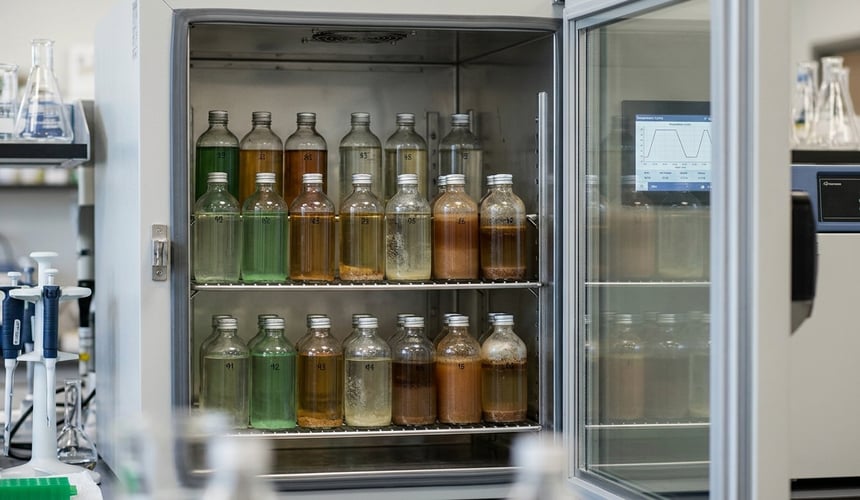
Manufacturers of liquid fertilizer and biostimulant formulations face the challenge of reliably predicting how long their products will remain stable and effective under normal storage conditions. While immediate miscibility can be observed, long-term stability involves more subtle physical and chemical changes that influence product quality and performance. Accelerated stability testing offers a methodology to forecast a formulation's shelf life and detect potential issues beyond initial compatibility.
Cropenta Insight
Evaluating these aspects early helps in selecting appropriate ingredients and developing robust formulations, thereby minimizing unforeseen issues during storage and application. This proactive approach supports consistent product quality.
Understanding Formulation Stability in Agricultural Inputs
The stability of liquid agricultural formulations, including fertilizers and biostimulants, is influenced by various factors. These products are often complex mixtures of nutrient salts, organic compounds, and other active ingredients. Over time, physical changes such as sedimentation, phase separation, or crystallization can occur. Chemical degradation, including hydrolysis or oxidation, might also affect the efficacy of active components. Evaluating these changes requires methods that can simulate long-term storage conditions within a shorter timeframe [1, 2].
Principles of Accelerated Stability Testing
Accelerated stability testing involves subjecting a product to exaggerated environmental conditions to speed up potential degradation processes. The primary goal is to predict the product’s shelf life under typical storage conditions by monitoring its physical and chemical properties. This approach is widely used for various bioproducts to estimate shelf-lives and safe storage temperatures [2]. Key parameters evaluated often include organoleptic properties (appearance, odor), pH, density, and the concentration of active ingredients [1]. The underlying principle is that the rate of degradation increases with factors like temperature, allowing for shorter observation periods [3].
Conducting Accelerated Stability Tests
Common methods for accelerated stability testing involve elevated temperatures and temperature cycling. In an elevated temperature test, samples are stored at temperatures significantly higher than ambient for several weeks or months.
Temperature cycling tests expose products to alternating high and low temperatures. This method is particularly useful for detecting physical instabilities like crystallization or phase separation that might not be evident under constant temperature conditions. Such tests can reveal how a formulation responds to the temperature fluctuations commonly encountered during transport and storage [2].
Interpreting Results for Shelf Life Prediction
The data collected from accelerated stability testing are analyzed to extrapolate the product's likely behavior over its intended shelf life under normal conditions. By observing the rate of change in critical quality attributes at accelerated temperatures, it is possible to estimate the time until these attributes fall outside acceptable specifications. This prediction assists manufacturers in establishing appropriate expiration dates, aiming to maintain product quality under specified storage conditions [2, 3]. For example, a formulation might experience color changes or precipitation at higher temperatures, indicating potential issues under extended normal storage [1].
Role of Raw Material Characteristics in Formulation Stability
The choice and quality of raw materials significantly influence the long-term stability of liquid formulations. Factors such as the pH of raw materials, their electrical conductivity (EC), and compatibility with other ingredients are crucial. However, high concentrations of certain ions, such as calcium or magnesium, may lead to reactions that require specific handling or storage solutions to maintain stability. Understanding these raw material properties is essential for anticipating and mitigating potential stability challenges [4].
Key Takeaways from Accelerated Stability Testing
Accelerated stability testing offers a robust method for predicting the long-term quality and shelf life of liquid fertilizer and biostimulant formulations. By subjecting products to elevated temperatures and temperature cycling, manufacturers can identify potential physical and chemical degradations, such as sedimentation or pH shifts, more efficiently. This process supports the evaluation of raw material compatibility and helps ensure product performance under typical storage conditions.
Disclaimer
This article has been prepared with AI assistance using publicly available sources and is intended solely for general technical and educational purposes. It does not constitute professional advice or recommendations for specific applications. Cropenta makes no warranties regarding the accuracy, completeness or applicability of the information. No rights may be derived from its contents, and Cropenta accepts no liability for its use to the extent permitted by law.
Technical Questions
What kind of physical changes can accelerated stability testing detect in liquid formulations?
Accelerated stability testing can reveal physical instabilities such as sedimentation, crystallization, phase separation, and changes in viscosity or color. These changes might not be immediately apparent but can become prominent over extended storage periods or under fluctuating temperatures, influencing product consistency and application performance.
Can accelerated stability testing identify microbial growth issues in liquid formulations?
While accelerated stability testing primarily focuses on physical and chemical stability, the conditions (e.g., elevated temperature) can sometimes promote microbial activity if preservatives are insufficient or the formulation provides an ideal growth medium. Monitoring for changes in appearance or odor can indirectly indicate microbial issues, alongside specific microbiological tests.
What is the difference between direct miscibility and long-term stability?
Direct miscibility refers to whether components can be mixed without immediate visible separation or reaction. Long-term stability, however, assesses a formulation's ability to maintain its physical and chemical integrity over months or years under various storage conditions. A directly miscible product may still develop instabilities over time, which accelerated testing aims to predict.
Related articles



Related Products




Looking for something specific?
Our team is there to help you find the right raw materials and solutions for your formulations

