Does Elemental Sulfur Only Lower pH, or Does it Also Supply Sulfur for Crops?
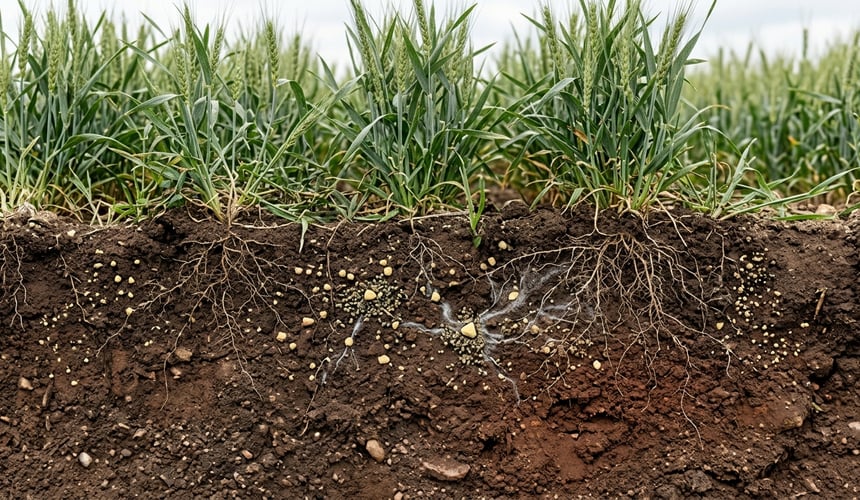
When considering elemental sulfur applications in agricultural settings, a common question arises: does it solely function to lower soil pH, or does it also contribute to crop sulfur nutrition? The answer involves understanding a key microbial process that converts elemental sulfur into plant-available forms, influencing both soil chemistry and nutrient availability over time.
Cropenta Insight
The dual function of elemental sulfur in influencing soil pH and providing gradual sulfur nutrition presents a nuanced aspect of nutrient management. Understanding the microbial processes involved helps agricultural professionals differentiate elemental sulfur from quick-release sulfate forms.
Microbial Oxidation: Influencing Elemental Sulfur Soil pH and Nutrient Release
Elemental sulfur itself is not directly available to plants. For it to become plant-usable, soil microorganisms, primarily sulfur-oxidizing bacteria, must convert it through a process known as oxidation. During this biological conversion, elemental sulfur (S0) is transformed into sulfate (SO42-) [1, 2]. This transformation releases hydrogen ions (H+) into the soil solution, which can contribute to a reduction in soil pH . The particle size of elemental sulfur, such as micronized forms, may also influence the rate of conversion, potentially allowing for more rapid reactions under suitable conditions [1].
The rate of this microbial oxidation, and consequently the extent of soil pH reduction and sulfur release, is influenced by several factors. These include soil temperature, moisture levels, aeration, organic matter content, and the activity of the resident microbial community . Cold, excessively wet, or dry conditions may reduce microbial activity, thereby affecting the speed at which elemental sulfur becomes available [3]. Therefore, the degree of acidification and nutrient supply depends on dynamic soil conditions and its inherent buffering capacity, particularly in calcareous soils where buffering can limit the pH effect. Not every sulfur form has the capacity to lower soil pH, differentiating elemental sulfur in this aspect.
Sulfur's Role Beyond pH Regulation
Beyond its impact on soil pH, the sulfate produced from elemental sulfur oxidation is a vital nutrient for crops. Sulfate is the primary form of sulfur absorbed by plant roots and is essential for various physiological functions. It plays a role in the synthesis of amino acids, proteins, and enzymes, and is involved in nitrogen metabolism within the plant [3]. Adequate sulfur availability is therefore important for the overall development and physiological function of crops, supporting fundamental processes like chlorophyll formation and carbohydrate metabolism.
Unlike quick-release sulfate fertilizers, which provide an immediate supply of sulfur, elemental sulfur acts as a slow-release source. Its gradual conversion to sulfate means it can provide a sustained supply of the nutrient over a longer period, potentially matching the crop's uptake demands more consistently throughout its growth cycle. This sustained availability may be relevant in situations where continuous sulfur supply is considered beneficial, distinguishing it from other sulfur forms that are not chemically equivalent, such as thiosulfate.
Considering Elemental Sulfur for Soil and Crop Nutrition
The application of elemental sulfur can serve a dual purpose: addressing specific soil pH requirements and supplying sulfur as a nutrient. While it can reduce soil pH in certain conditions, this effect is not universal across all sulfur forms, and the extent of acidification is subject to soil type and microbial activity [2]. In soils with high buffering capacity, such as calcareous soils, the pH reduction may be less pronounced. Additionally, a lower pH is not automatically an improvement for all crops or soil conditions, and elemental sulfur should not be confused with gypsum, which is used in sodic soils for different purposes than acidification.
For crops, elemental sulfur offers a method to provide sulfur nutrition gradually. However, it is important to note that adding extra sulfur may not result in higher crop performance if the soil already provides a sufficient supply of the nutrient. Understanding the specific needs of the crop and the existing soil nutrient status is important when considering elemental sulfur as part of a nutrient management strategy, allowing for its targeted use to potentially improve soil conditions and contribute to crop nutrition.
Technical Summary
Elemental sulfur acts as a dual-purpose agricultural input, influencing soil pH and supplying sulfur nutrition. Its conversion to plant-available sulfate is facilitated by microbial oxidation in the soil, releasing hydrogen ions that can lower pH and providing a sustained nutrient source. This slow-release mechanism differentiates it from quick-acting sulfate fertilizers. Its effectiveness depends on soil microbial activity, temperature, moisture, and soil buffering capacity, highlighting its role in nuanced nutrient management.
Disclaimer
This article has been prepared with AI assistance using publicly available sources and is intended solely for general technical and educational purposes. It does not constitute professional advice or recommendations for specific applications. Cropenta makes no warranties regarding the accuracy, completeness or applicability of the information. No rights may be derived from its contents, and Cropenta accepts no liability for its use to the extent permitted by law.
Technical Questions
What is the primary factor influencing the rate of elemental sulfur conversion in soil?
The conversion of elemental sulfur to plant-available sulfate is primarily driven by soil microbial activity. Factors such as soil temperature, moisture content, aeration, and the amount of organic matter significantly affect the metabolic rate of sulfur-oxidizing bacteria, thereby determining how quickly elemental sulfur becomes active in the soil and influences pH and nutrient supply.
How does elemental sulfur application differ from using quick-release sulfate fertilizers?
Elemental sulfur provides a gradual, slow-release supply of sulfate as it relies on microbial oxidation. This contrasts with quick-release sulfate fertilizers, which offer an immediate influx of sulfur into the soil solution. The sustained release from elemental sulfur may be beneficial for maintaining nutrient availability over longer crop growth periods, while quick-release forms address immediate deficiencies.
Can elemental sulfur effectively lower pH in all soil types?
The degree of soil pH reduction from elemental sulfur application is not universal. It depends significantly on the soil's buffering capacity. Soils with high buffering capacity, particularly calcareous soils rich in calcium carbonate, may show a less pronounced pH decrease due to their ability to neutralize the hydrogen ions released during sulfur oxidation. The effect is most notable in less buffered soils.
What physiological roles does sulfur play in crop development?
Sulfur is a vital macronutrient involved in numerous physiological functions in crops. It is essential for the synthesis of key amino acids like methionine and cysteine, which are building blocks for proteins and enzymes. Sulfur also participates in chlorophyll formation, contributes to nitrogen metabolism, and plays a role in the plant's overall metabolic activity and structural integrity.
Related articles


Related Products



Looking for something specific?
Our team is there to help you find the right raw materials and solutions for your formulations

