Why Are Declared Bypass Protein Values Not Always Comparable?
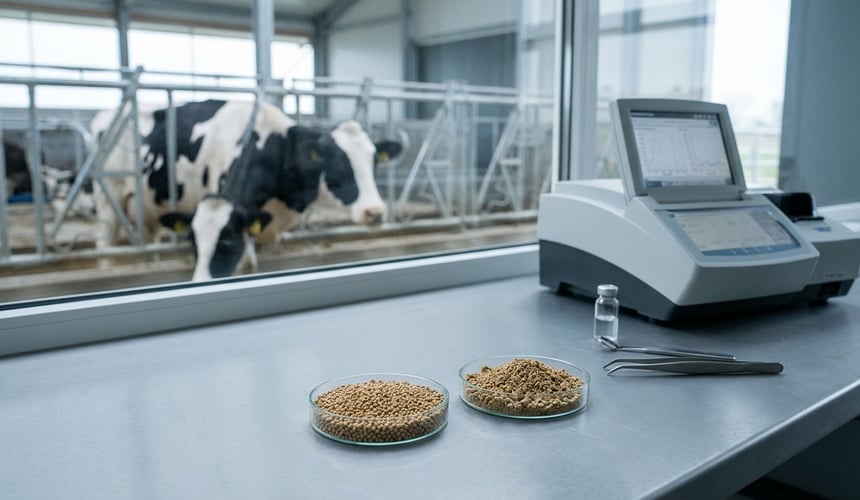
Rumen-bypass protein (RBP) supplements are important in ruminant nutrition, providing amino acids directly to the small intestine to support metabolic needs beyond what microbial protein synthesis can supply. Studies, such as research investigating the impact of RBP supplementation on growth performance and nitrogen concentration [1], highlight the relevance of effective RBP delivery. However, when different feed ingredients all claim 'bypass protein', nutritionists face a challenge: how can their true value in a ration be accurately compared?
Cropenta Insight
The variability in declared rumen bypass protein values emphasizes the criticality of understanding the underlying measurement methodologies. For professional animal nutritionists, comparing values requires scrutiny of factors like in-situ degradation kinetics, assumed passage rates, and intestinal digestibility. This detailed evaluation helps to accurately assess the true protein efficiency and nutritional contribution of different rumen-protected protein sources in ruminant rations.
Understanding Rumen Protein Dynamics and Measurement
The core of understanding bypass protein values lies in the dynamics of rumen degradation kinetics. Rumen-degradable protein (RDP) fuels microbial protein synthesis, while rumen-undegradable protein (RUP), also known as bypass protein, escapes rumen degradation and proceeds to the small intestine for digestion. The effective degradation and RUP are calculated from parameters measured during in-situ (nylon bag) incubation in rumen-fistulated cows.
A significant factor in the comparability issue is the method used for protein degradation measurement.
The Importance of Intestinal Digestibility
Even if a protein bypasses the rumen, its nutritional value is limited if it is not digestible in the small intestine. Intestinal digestibility refers to the proportion of rumen-undegraded protein that is actually digested and absorbed in the small intestine. A high RUP value combined with low intestinal digestibility delivers little usable protein. For example, processing methods, such as the application of tannin, have been observed to result in lower protein digestibility in some feed ingredients [2]. The precise method of assessing digestibility is also important, as illustrated by criticisms of methods that determine faecal rather than ileal digestibility [3].
Factors Influencing RUP Comparability
Different processing techniques can significantly alter the rumen degradability and intestinal digestibility of proteins. According to some research, excessive processing, however, may reduce both degradation and digestibility [4].
A critical challenge to comparing declared rumen bypass protein values is the assumed passage rate (Kp) used in RUP calculations. For example, according to product documentation for Bypass Soy Protein MP, the calculated RUP is above 80% at an assumed passage rate of 6%/h, with intestinal digestibility close to 100% [4]. Similarly, according to product documentation for Bypass Rapeseed MP, the calculated RUP is about 80% at an assumed passage rate of 6%/h, with intestinal digestibility about 90% [5].
Variations in declared RUP percentages have been observed in feeding trials. For instance, in-situ measurements in rumen-fistulated cows found that the rumen-undegraded protein (UDP) of some treated rapeseed meals was well below the shares declared in product information and used in ration calculations . Physically-treated meal showed only a few percentage points difference from untreated meal, and lignosulfonate treatment raised UDP significantly but less than expected [6]. This highlights that declarations do not always align with experimental characterization, further complicating direct comparisons.
Nutritional Protein Valuation Systems
Beyond measurement methodologies, various nutritional protein valuation systems translate measured degradation and digestibility into formulation values. Examples include the Dutch DVE/OEB system (intestinal digestible protein and rumen protein balance), the German nXP/RNB system, INRA PDI, and the CNCPS metabolisable protein system. According to some sources, values can differ significantly between these systems and depending on the assumed passage rates [4, 5]. This means that a 'bypass protein value' in one system or calculated with one set of assumptions may not be directly equivalent to a value from another system or assumption set.
Practical Implications for Ration Formulation
For nutritionists, accurately comparing rumen bypass protein values requires a critical assessment of the data. According to a review of protein quality [3], RUP values should always be considered in conjunction with intestinal digestibility, as high RUP alone does not guarantee high usable protein. By scrutinizing these factors, nutritionists can make more informed decisions about protein supplementation and accurately formulate rations to meet the specific amino acid requirements of ruminants.
Technical Summary
Declared rumen bypass protein values are often not directly comparable due to diverse measurement methods, particularly the contrast between less reliable in-vitro and more accurate in-situ techniques. Variations in assumed rumen passage rates (Kp) and distinct nutritional protein valuation systems further influence these values. Nutritionists must evaluate RUP in combination with intestinal digestibility and scrutinize methodologies to accurately assess the true protein contribution for effective ruminant ration formulation.
Disclaimer
This article has been prepared with AI assistance using publicly available sources and is intended solely for general technical and educational purposes. It does not constitute professional advice or recommendations for specific applications. Cropenta makes no warranties regarding the accuracy, completeness or applicability of the information. No rights may be derived from its contents, and Cropenta accepts no liability for its use to the extent permitted by law.
Technical Questions
How do in-vitro and in-situ methods differ in assessing rumen protection?
According to industry observations, in-vitro methods typically use enzymatic or chemical fractionation tests, which often struggle to accurately represent the complex rumen environment, particularly for processed proteins. In contrast, industry literature describes in-situ methods as involving incubating feed samples directly within the rumen of fistulated cows, providing a more biologically relevant and accurate measurement of actual protein degradation kinetics.
Why is the assumed passage rate (Kp) critical for comparing RUP values?
As generally understood in the industry, RUP is a calculated value derived from degradation characteristics and the assumed rate at which feed particles pass out of the rumen. It is recognized that different studies or declarations may use varying Kp values, which directly impacts the calculated RUP. For accurate comparisons, it is widely recommended that all RUP values be based on the same assumed passage rate.
What is the relationship between rumen undegradable protein (RUP) and intestinal digestibility?
Rumen undegradable protein (RUP) is the fraction that bypasses rumen degradation. However, for this protein to be nutritionally valuable, it must also be digestible in the small intestine. High RUP with low intestinal digestibility provides limited usable amino acids to the animal, highlighting the need to evaluate both factors comprehensively.
How do processing methods influence protein degradation and digestibility?
According to research findings, processing methods like heat treatment or controlled Maillard reactions can reduce protein degradation in the rumen, increasing RUP. However, over-processing may also decrease intestinal digestibility by altering protein structure too severely. The specific method and its intensity are crucial, requiring careful evaluation of both rumen protection and post-ruminal digestibility.
- 1.Effects of rumen-bypass protein supplement on growth ... - PMC
- 2.Enhancing Rumen-Undegradable Protein via Processing ...
- 3.Protein Quality in Perspective: A Review of ... - PMC - NIH
- 4.Cropenta product documentation: Bypass Soy Protein MP
- 5.Cropenta product documentation: Bypass Rapeseed MP
- 6.Geschützte Rapsextraktionsschrote im Fütterungsversuch (proteinmarkt.de)
Related articles
Related Products

Looking for something specific?
Our team is there to help you find the right raw materials and solutions for your formulations

