Why Do Microbial Biostimulants Perform Inconsistently in Field Settings?
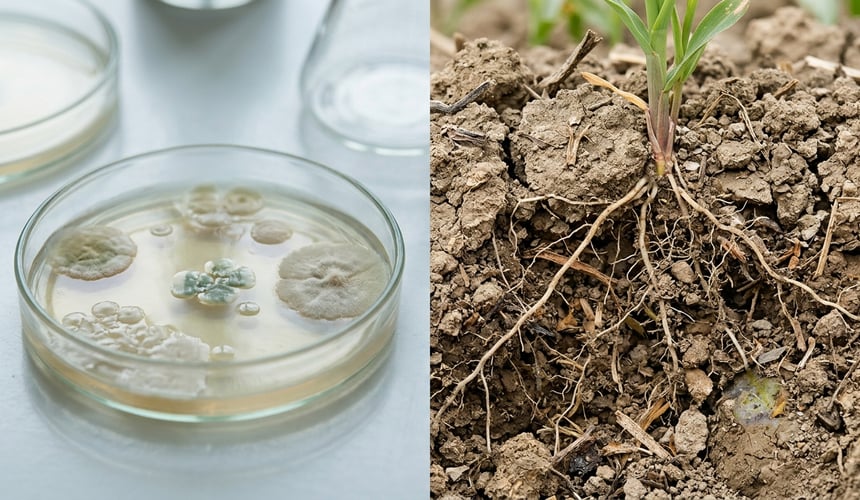
The observed disparity between promising laboratory results and inconsistent field performance of microbial biostimulants raises significant questions for growers and agricultural professionals. While controlled environments often demonstrate beneficial microbial activity, translating these effects consistently to diverse real-world field conditions can be challenging. Understanding the factors that contribute to this variability in microbial biostimulant field performance is crucial for their effective application in sustainable agriculture.
Cropenta Insight
The variable field efficacy of microbial biostimulants underscores the importance of understanding complex plant-microbe-soil interactions. For professionals in crop nutrition, recognizing the specific environmental and biological constraints on microbial survival and activity is key. This insight helps evaluate product potential realistically and supports the development of more resilient agronomic strategies, particularly concerning microbial technologies as specialized raw materials or finished products in diverse cultivation systems.
The Challenge of Microbial Survival and Activity in the Field
Microbial biostimulants, often composed of beneficial microorganisms, are intended to support plant growth and nutrient uptake through various mechanisms . However, their ability to perform their intended function in the field relies fundamentally on their survival and sustained activity within a dynamic soil ecosystem. A positive viable count in a product does not automatically equate to persistent activity or demonstrable crop benefit in the field. The journey from a controlled laboratory setting, where optimal conditions for microbial growth are often maintained, to the highly variable soil environment presents numerous hurdles [1].
Environmental Factors Affecting Microbial Biostimulant Efficacy
The soil environment is a complex matrix subject to various abiotic stresses that can impact microbial survival and colonization [1]. Key environmental factors include temperature fluctuations, soil pH, moisture levels, and nutrient availability. For instance, soil moisture extremes—both drought and waterlogging—can significantly limit microbial activity and population dynamics. Similarly, extreme soil temperatures or pH values outside the optimal range for a specific microbial strain can hinder its establishment and functioning. These factors, which are often meticulously controlled in laboratory or greenhouse trials, vary widely across different fields and even within a single field [1, 2]. The intrinsic variability in product efficacy is a consistent finding in biostimulant research [2].
Competition and Interaction within Soil Communities
Upon introduction into the soil, microbial biostimulants encounter a pre-existing, complex microbial community. This native microbiome can present significant competition for resources and colonization sites, potentially limiting the establishment and proliferation of the introduced microorganisms . Furthermore, specific soil characteristics, such as soil type, organic matter content, and nutrient status, may influence how introduced microbes interact with the native community and how effectively they can express their beneficial traits. The performance observed in a sterile lab substrate or a controlled greenhouse potting mix may not account for these intricate biological interactions present in an open field [1].
Distinguishing Survival, Activity, and Field Performance
It is important to assess microbial products in separate steps: (a) survival—does the organism remain viable?; (b) activity—does it maintain its intended function?; and (c) field effect—is there a demonstrated crop benefit in practice? A positive outcome for survival alone does not prove activity or field efficacy [1]. For example, some arbuscular mycorrhizal fungi (AMF) may contribute to plant health under conditions of abiotic stress, such as drought, salinity, or nutrient deficiency [3]. However, this physiological capacity observed under stress conditions does not guarantee a consistent agronomic benefit across all field scenarios. The gap between laboratory activity and consistent field efficacy remains a primary concern [1].
Application Methods and Formulation Considerations
The method of application can also influence the consistency of microbial biostimulant field performance. Factors such as inoculum density, timing of application, and formulation stability play a role in how effectively the microorganisms reach and establish themselves in the plant's root zone . For instance, ensuring the viability of microbial cells during storage and after application, especially when exposed to environmental stressors like UV radiation or desiccation, can be critical. Challenges in the delivery and sustained presence of viable, active microbes in the rhizosphere contribute to the observed variability in agronomic outcomes [1, 4].
Technical Summary
The inconsistency of microbial biostimulant field performance stems from challenges in microbial survival and activity within diverse soil ecosystems. Environmental factors such as temperature, pH, and moisture, alongside competition from native soil microbiomes, significantly influence efficacy. The distinction between microbial viability, functional activity, and demonstrated agronomic benefit in the field is crucial for understanding the 'lab to field' gap.
Disclaimer
This article has been prepared with AI assistance using publicly available sources and is intended solely for general technical and educational purposes. It does not constitute professional advice or recommendations for specific applications. Cropenta makes no warranties regarding the accuracy, completeness or applicability of the information. No rights may be derived from its contents, and Cropenta accepts no liability for its use to the extent permitted by law.
Technical Questions
How do soil environmental conditions primarily affect the viability of microbial biostimulants?
Soil environmental conditions, including extreme temperatures, unsuitable pH levels, and fluctuating moisture—ranging from drought to waterlogging—can significantly hinder the survival and establishment of introduced microbial biostimulants. These factors often deviate from the controlled settings of laboratory studies, posing challenges for microbial proliferation and sustained activity in the field.
What is the significance of distinguishing microbial survival from field efficacy?
It is crucial to differentiate between microbial survival (remaining viable), activity (performing intended functions), and field efficacy (demonstrating a crop benefit). Simply detecting viable microbes in the soil after application does not guarantee they are actively functioning or providing measurable advantages to the crop under diverse agricultural conditions.
How does the native soil microbiome impact the performance of introduced microbial biostimulants?
Introduced microbial biostimulants face competition from the native soil microbiome for resources and colonization sites. The established soil microbial communities can limit the growth and activity of introduced strains, affecting their ability to establish and express their beneficial traits, which contributes to variable field performance.
Related articles

Related Products

Looking for something specific?
Our team is there to help you find the right raw materials and solutions for your formulations

