How should you evaluate full-fat toasted soybeans against soybean meal and oil?
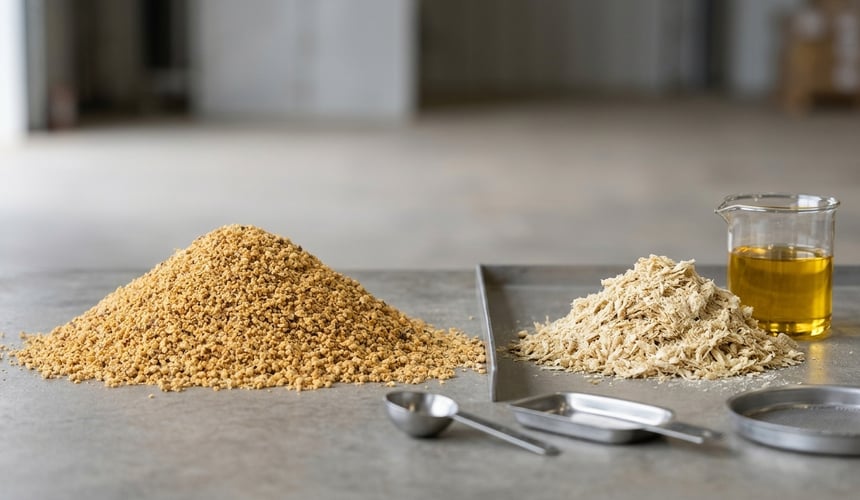
When soybean meal and soybean oil change price, many feed buyers recalculate two purchase lines without asking a more basic question: does an ingredient that supplies both protein and oil offer a different value in the finished feed?
Full-fat toasted soybeans make that comparison more complicated because their selling point is not crude protein alone. They carry soybean oil within the intact seed, and their contribution to the diet depends on heat treatment, processing history, residual anti-nutritional factors, the fibre and moisture they introduce, and how the ingredient behaves during pelleting or extrusion.
Cropenta Insight
The most useful comparison places both options on the same digestible-amino-acid and energy basis before any cost calculation is made. Processing records and ingredient-specific analyses then help explain why two quotations cannot be compared on crude protein alone. A practical starting point is to record the declared protein, fat, moisture and fibre values for each lot, note the heat treatment applied, and check whether the resulting nutrient balance and manufacturing behaviour still align with the diet. This approach keeps the evaluation tied to measured composition and documented processing rather than to a general expectation about whole or roasted beans.
Why price per tonne is not the same as feed cost
A headline cost per tonne describes only the purchased ingredient. It does not show how much digestible protein, energy and usable amino acids the ingredient contributes after the diet has been balanced for fibre, moisture, amino-acid profile and inclusion limits.
For that reason, comparison should be made on the cost of the nutrient contribution in the finished feed, including freight, storage, sampling and reformulation adjustments. A lower purchased cost can therefore coincide with a higher cost per unit of usable nutrient.
What the broiler evidence actually shows
The main experimental evidence for this question comes from a study on roasted and autoclaved full-fat soybean in broiler diets. Full-fat soybean was used as a combined fat and protein source, and the trial compared processing treatments under defined dietary conditions in broiler chickens.[1]
The results are more instructive as a caution against generalisation than as a ranking of ingredients. The reported differences between fat treatments were not accompanied by a consistent effect that could be transferred to other diets. In other words, adding fat is not a single intervention with one predictable result: the response can vary with the bird's stage of growth and with what the diet already supplies.
The study did not compare toasted soybeans against a soybean meal and oil combination, so it cannot be used to establish which option is preferable. It does show why a quotation should not be converted into a performance expectation without specifying the diet, species, age and processing conditions.
Heat treatment changes what the ingredient delivers
Raw soybeans contain trypsin inhibitors and other anti-nutritional factors that interfere with protein digestion. Toasting is applied to inactivate these factors, and the degree of heat treatment affects how protein and oil should be valued in a formulation matrix. A review of feed processing in pigs describes processing as a principal factor affecting how feedstuffs are digested and used, including through changes to protein structure and the availability of nutrients.[2]
Roasting also has a cost of its own. Over-processing may damage amino acids, while under-processing leaves more anti-nutritional activity. The broiler work included roasted and autoclaved treatments, which is a reminder that “full-fat” and “toasted” describe the origin and fat level rather than a defined level of protein quality or energy value.[1]
Results from finishing pigs also illustrate the value of stating the comparison carefully. In a study of whole versus roasted soybeans, roasting tended to reduce fat digestibility from 92.2% to 90.9%, a difference that was only a tendency at P = 0.07 rather than a statistically clear result.[3] Such a small, non-significant difference should not be turned into a general rule, but it does show why fat digestibility assumptions need to be checked rather than inherited automatically.
A fair comparison for the finished feed
Start with the same nutrition matrix. Replace a candidate quantity of soybean meal and added soybean oil with full-fat toasted soybeans, then check whether crude protein, digestible amino acids, fat and energy remain aligned with the diet requirements. Use the digestible amino-acid values relevant to the species rather than crude protein as the main protein criterion. A review of feed digestibility describes digestibility as the proportion of ingested nutrients not excreted in faeces, which is why it provides a relevant basis for comparing ingredients with different processing histories.[4]
Next, examine operational constraints. Whole beans add more fibre than soybean meal, so poultry and young-animal diets may reach a practical limit before the nutrient balance does. In pelleted feeds, added oil can change die friction, pellet durability and cooling requirements; a bean that retains its oil does not necessarily behave like the same amount of free oil mixed into the mash. At higher inclusion levels, moisture and heat exposure during conditioning become practical checks, particularly for products that have received both toasting and extrusion.
Finally, calculate delivered cost. Include freight, storage, sampling and the cost of balancing the formula around any fibre or amino-acid difference. A raw material can have a lower purchased cost and still carry a higher cost after the diet has been reformulated.
Full-fat toasted and extruded soybeans are different products
For young animals, extrusion is sometimes considered alongside toasting because surface enlargement and changes to the bean structure may affect how the oil and protein fraction behave. Comparative values reported for these processing routes should be tied to the specific study and diet from which they came, and should not be transferred to another product without matching composition and processing records.
Full-fat toasted soybeans and full-fat toasted extruded soybeans are separate options in the market. Nutritional values published for an extruded product should not be transferred to a toasted-only product, because the two differ in mechanical treatment, structural change and reported analytical values. Use the supplier's specification for the actual ingredient offered, and verify it against an independent laboratory analysis when the inclusion rate is high or the raw material is new to the diet.
What to conclude when the market moves
Full-fat toasted soybeans are worth evaluating as a combined protein-and-oil option. The value depends on the delivered cost of the whole ingredient, the digestible nutrients it supplies for the relevant species and life stage, the processing applied, and the way it behaves in the manufacturing process.
Recalculate the comparison whenever relative prices move, and recalculate it again in the finished feed. The ingredient with the lowest quotation is not necessarily the ingredient with the lowest cost per unit of usable nutrient.
Technical Summary
Compare full-fat toasted soybeans with soybean meal plus oil on digestible amino acids and energy, not crude protein alone. Include processing history, fibre and moisture, inclusion limits, pellet behaviour and delivered cost. Broiler and swine results vary by diet and processing method, so observed responses in one study do not establish a general performance advantage.
This article was created with the help of AI and reviewed by the Cropenta editorial team. It is general information, not professional advice.
Technical Questions
Why is crude protein an inadequate basis for pricing full-fat toasted soybeans?
Crude protein does not describe how much protein is digestible, nor does it capture the amino-acid profile or the energy supplied by the retained oil. Two ingredients with similar crude protein can contribute different amounts of usable lysine and other amino acids, so formulation should be balanced on digestible values before costs are compared.
Which processing details matter when comparing toasted and expanded soybean ingredients?
Processing intensity and type affect residual anti-nutritional factors, amino-acid availability and fat digestibility. Toasting alone should not be evaluated with data from an extruded product, because extrusion adds mechanical treatment and structural change. Product-specific analyses and processing records provide a firmer basis for comparison.
How should oil retained in the bean be valued in feed formulation?
Retained oil contributes energy and fatty acids, but it also enters the feed in a different physical form from free soybean oil. That difference can affect mixing, moisture, die friction and pellet quality, so it should be considered alongside the energy value rather than treated as a simple one-for-one substitution.
When does a basic ingredient comparison become a usable feed-cost comparison?
It becomes usable when the two options are placed on the same digestible-nutrient basis, any fibre or amino-acid differences are rebalanced, and processing, inclusion and manufacturing constraints are checked. Freight, storage and formulation adjustments then need to be added before the finished-feed cost can be calculated.
Related articles

Related Products

Looking for something specific?
Our team is there to help you find the right raw materials and solutions for your formulations

