How Sulfate and Thiosulfate React in Soil and Influence Sulfur Availability
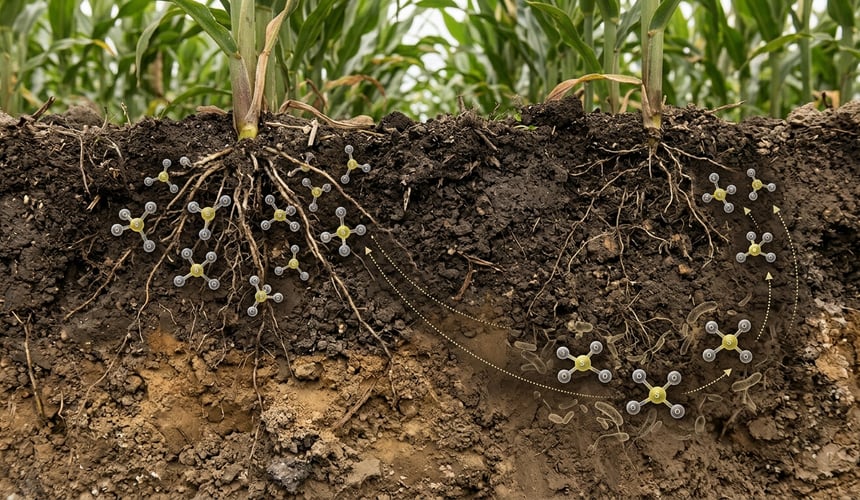
Two fertilizers can both be labelled soluble sulfur and still behave nothing alike in the field. Sulfate, the sulfate ion, is already in the form plants take up through their roots. Thiosulfate, the thiosulfate ion, is not: it has to be oxidized first, by microorganisms, before it becomes sulfate. That single chemical difference turns into a practical one — when the sulfur arrives, how long it lasts, and how much of it is there when the crop asks for it.
Cropenta Insight
Sulfate is present in a form roots can absorb from the start, but it is weakly retained by clay and organic matter, so it can move with percolating water. Thiosulfate depends on microbial oxidation to sulfate, a process affected by soil temperature, aeration and organic matter. In cool or waterlogged soil, that conversion may be slow, and thiosulfate may instead be reduced to sulfide. The timing of oxidation therefore matters when matching sulfur supply to crop demand in a given season.
What sulfate does in the soil
Sulfate is stable under oxidising conditions and needs no conversion. Once in solution it is immediately available to the root system, which is why sulfate is the benchmark against which other sulfur sources are judged in nutrient availability work.[1] The plant physiological side is straightforward: sulfate is taken up by the roots and reduced inside the plant to sulfide, which is then incorporated into the amino acids cysteine and methionine, and from there into proteins. Because sulfate is the direct substrate, a sulfate application raises tissue sulfur supply in the same season it is made.
The limitation of sulfate is mobility, not reactivity. Sulfate carries a double negative charge and is repelled by the negatively charged surfaces of clay and organic matter, so it moves readily with water rather than being held for later release. In high-rainfall conditions on sandy soils, that can mean a considerable share of applied sulfate leaves the root zone before the crop takes it up. Reviews of sulfur in crop production note that tillage practices affect how much sulfur is retained over time, because oxidation of soil sulfur and residue mineralisation shift the balance between accumulated and plant-available forms.[2]
What thiosulfate has to go through
Thiosulfate, most often supplied as calcium thiosulfate, is already soluble, but the plant cannot use it directly. It is an intermediate in microbial sulfur metabolism, and it is converted to sulfate by thiosulfate-oxidising organisms, with sulfate as the end product. This is a biological step, so its rate depends on soil conditions: warmer temperatures, aeration and oxidisable carbon generally favour faster conversion, while cool, waterlogged or acid conditions slow it down.
There is a second pathway, and it is the reason thiosulfate behaves differently in practice. Thiosulfate can also be reduced, under anaerobic or low-oxygen conditions, to sulfide. In flooded or poorly drained soil this route can dominate, and sulfide accumulation is associated with reduced root metabolism and impaired nutrient uptake. The direction of the reaction is therefore set by the soil environment, not by the product alone.
Why the reduced state matters for the plant
In laboratory work with thiosulfate as a sulfur source, a shift in plant sulfur metabolism was reported: thiosulfate-treated plants showed higher sulfide and cysteine persulfide levels, indicating a more reduced sulfur state than plants supplied with other forms.[3] The cited study was carried out under controlled conditions rather than in field production, so how much of this pattern reflects a nutritional shift and how much reflects exposure to sulfide generated around the root remains open. It is a reason to weigh thiosulfate carefully in heavy or poorly drained soils, not a general argument against it.
The contrast that matters for advice
Put side by side, sulfate offers sulfur in plant-available form straight away and carries a leaching risk; thiosulfate follows a microbially controlled conversion step, and its behaviour swings with soil aeration. Neither is a slow-release carrier in the coated-granule sense, and neither replaces the other automatically. Sulfate suits situations where demand and application coincide. Thiosulfate suits situations where the crop demand sits later in the season or where a single sulfate application would be at risk of loss, provided the soil is warm and well aerated enough for the conversion to proceed.
Two boundaries are worth stating plainly. First, the reviewed evidence concerns the chemical properties and plant availability of the sulfur forms themselves; it does not establish that a formulation choice in itself determines an agronomic outcome in a given crop. Second, the differences above describe the chemistry of the sulfur forms themselves. They are separate from the question of what elemental sulfur does to soil pH, which depends on oxidation rate, soil conditions and buffering capacity, and which in calcareous soils can be limited by buffering rather than by the amount applied.
Technical Summary
Sulfate needs no conversion before root uptake and moves readily through the soil profile with water. Thiosulfate must be oxidized by soil microorganisms, or reduced to sulfide under low-oxygen conditions, so its release is slower and depends on temperature, aeration and drainage. Choosing between them is a question of timing, soil conditions and loss risk rather than of total sulfur applied.
This article was created with the help of AI and reviewed by the Cropenta editorial team. It is general information, not professional advice.
Technical Questions
Why is thiosulfate not considered interchangeable with sulfate in a sulfur nutrition plan?
Sulfate is taken up by roots directly, whereas thiosulfate must first be oxidized by soil microorganisms to sulfate before it enters plant nutrition. That conversion is biological and temperature- and aeration-dependent, so availability is delayed and less predictable. Under low-oxygen conditions thiosulfate can instead be reduced to sulfide, which is associated with reduced root metabolism and impaired nutrient uptake.
Does sulfate leach away from the root zone before the crop can use it?
It can. Sulfate is negatively charged and is weakly held by clay and organic matter, so it moves with percolating water. Loss risk is greatest on sandy soils with high rainfall and low organic matter, and on soils with a deep profile and long crop cycle. Reviews of sulfur availability note that tillage regime also shifts how much sulfur is retained in plant-available form over time.
Does adding more sulfur help a crop that already has enough?
Where sulfur supply is already adequate, additional sulfur inputs do not translate into an agronomic response. The relevant questions are whether supply matches crop demand in time and space, whether loss pathways are significant, and whether any product claim is supported by data from the crop and conditions where it will be used.
Does sulfur form choice affect soil pH the same way elemental sulfur does?
Elemental sulfur acidifies soil as it oxidizes, and the rate depends on particle size, aeration, organic matter and the soil's buffering capacity; in calcareous soils buffering can limit the effect. Sulfate and thiosulfate are already oxidised or reduced sulfur species and their pH effect is not comparable to that of elemental sulfur.
Related articles

Related Products



Looking for something specific?
Our team is there to help you find the right raw materials and solutions for your formulations

