How do processing conditions impact the nutritional value of protected rapeseed protein?
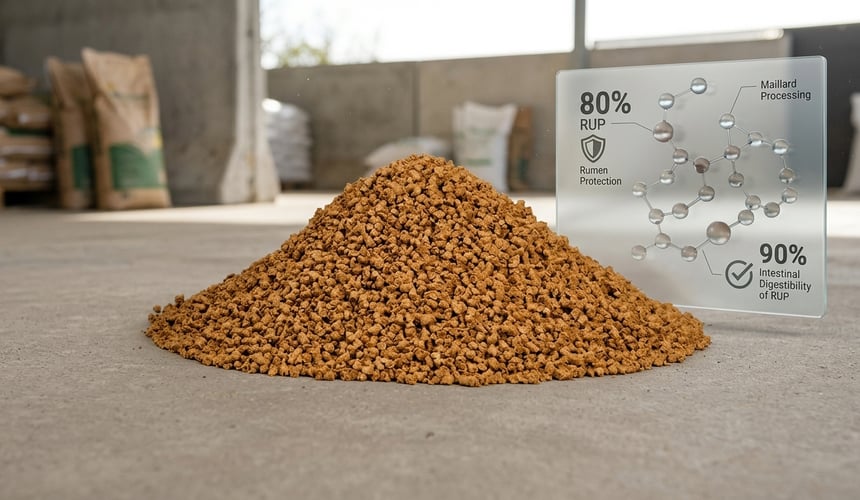
Two numbers decide the nutritional value of a rumen-protected protein, and processing moves both of them at the same time. The first is how much of the protein escapes rumen degradation; the second is how much of that escaping fraction is actually digested in the small intestine. That second number is where heat and chemical treatment do most of the damage when they are pushed too far, and it is the one most often left out of technical data sheets.
Rapeseed brings its own set of variables to this trade-off. The seed carries glucosinolates, a notable fibre fraction and storage proteins that behave differently once they are heated, moistened and pressed. A comprehensive review of the structural and functional characteristics of rapeseed protein sets out how closely processing conditions and protein behaviour are linked.[1]
Cropenta Insight
Assessing protected rapeseed protein solely on rumen-undegradable protein can be misleading, because that figure is modelled at an assumed passage rate and does not describe subsequent intestinal digestion. A published example for Bypass Rapeseed MP reports roughly 80% rumen-undegradable protein at an assumed passage rate of 6%/h, a degradation rate near 1.4 %/h with degradation only reaching completion at the end of a two-week incubation, and intestinal digestibility of about 90% for the undegraded fraction, measured in vivo by an independent research institute.
Rumen bypass and small-intestinal release pull in opposite directions
Rumen-degradable protein feeds microbial protein synthesis, which is the cow's main amino acid source and the reason extra bypass protein is not automatically worth its price. Rumen-undegradable protein escapes that route and reaches the small intestine. But it is only a calculated figure: it is derived from measured degradation characteristics, the potentially degradable fraction and the fractional degradation rate per hour, combined with an assumed fractional passage rate taken from intake and production rather than from the incubation itself. Two products quoted at the same RUP percentage but at different assumed passage rates are not comparable, and RUP should never be read as the protein still intact after a given number of hours.
That is where intestinal digestibility enters. It is the share of the rumen-undegradable protein that is actually digested in the small intestine, commonly measured with the mobile nylon bag technique in cows fitted with duodenal cannulas. A high RUP combined with low intestinal digestibility delivers very little usable protein to the animal. Protein valuation systems such as the Dutch DVE/OEB approach, the German nXP/RNB system or INRA PDI translate those measurements into formulation numbers; they are calculations with stated assumptions, not animal results, and they do not agree with one another.
What heat does to rapeseed protein
Heat treatment of rapeseed protein has been examined most thoroughly in monogastric contexts. Bailey and colleagues heated rapeseed protein isolate and recorded apparent ileal digestibility above 80% for histidine, leucine, methionine and threonine, with a DIAAS value higher than for pea protein isolate.[2] Those are pig results on an isolated protein fraction, so they cannot be transferred to dairy or beef cattle; in a ruminant the relevant question is whether heat limits rumen degradation without making the protein less digestible at the point where it should be released.
Rapeseed responds to heat in ways that depend on moisture and time. Denaturation changes protein solubility and the rate at which rumen proteolysis attacks it, and the same dry material behaves differently when moisture is available for steam or pressure. Rapeseed protein also carries its own antinutritional load, particularly glucosinolates, and the fibre fraction of the meal changes how the material behaves in mash and on the die. Pushing the treatment further is not a free move: excessive heat lowers amino acid digestibility, ties up lysine so that total lysine stays on the label while reactive lysine falls, and affects palatability. Heat alone also reaches a ceiling, because denatured protein in the rumen is still substrate for microbial proteolysis.
Maillard chemistry as the deliberate route to rumen resistance
Chemical cross-linking through controlled Maillard reactions is a deliberate way of lowering rumen degradability, since the resulting protein structure resists rumen degradation more effectively than simple denaturation alone. In a Maillard reaction, reducing sugars with a free aldehyde or ketone group react with free amino groups, notably the epsilon-amino group of lysine, through a Schiff base and Amadori products to melanoidins. The lysine is no longer freely available, and the resulting structure resists rumen degradation.
The technical skill lies in stopping at the right point. Under controlled conditions the protein survives the rumen while acid and enzymes in the abomasum and small intestine still release amino acids. Under excessive conditions the reaction runs further: lysine is destroyed rather than merely masked, digestibility falls and the dark melanoidin fraction can make the product less palatable. Formaldehyde treatment was the historical route to the same end; the current generation of products relies on controlled reaction with selected reducing sugars, with the sugar type, the sugar-to-protein ratio, the temperature and the residence time as the variables that decide the outcome.
Why in-vitro numbers mislead on protected protein
For heat- and Maillard-treated proteins, in-vitro enzymatic or fractionation tests correlate poorly with in-situ measurement in rumen-fistulated cows, and they tend to overstate the degree of rumen resistance. A declared protection figure generated in vitro is therefore not interchangeable with an in-situ value, and it should not be read next to one in a valuation table without knowing which method produced it. The dependable route is a full nylon-bag incubation in fistulated cows with the degradation curve and the assumed passage rate stated, paired with intestinal digestibility measured by the mobile nylon bag method.
What a buyer should request and what a feed mill will see
Ask for the processing record, not only the nutrient table: peak temperature, moisture at treatment, residence time, the reducing sugar source and its ratio to protein, and how the material was dried afterwards. Then ask whether the declared values come from in-situ work and at which assumed passage rate they were calculated. Batch-to-batch consistency matters as much as the average, because a protected meal that varies in treatment intensity gives a variable rumen-undegradable fraction from delivery to delivery.
Inside the mill, a protected ingredient is not a neutral raw material. Pelleting adds heat again, so die temperature and conditioning time interact with an already heat-treated meal. Mixing uniformity, the moisture sensitivity of a partly hygroscopic protected product during conditioning, the dust fraction it contributes to the mixer, and the risk of segregation in a pelleted ration are all operational realities that feed mills handle differently depending on how the ingredient was made. Palatability is worth watching too, since protected rapeseed products with different colour and odour profiles can behave differently in the trough.
Where the evidence leaves us
The honest summary is that processing intensity is a trade-off rather than a setting to maximise. Heat and Maillard chemistry can push rumen degradation down and intestinal digestibility down at the same time, and the window between the two depends on the material, the moisture and the time as much as on the temperature. Evidence on heat-treated rapeseed protein quality is still largely drawn from monogastric studies, which leaves in-situ rumen degradation and intestinal digestibility measurements in cattle as the decisive evidence for a ruminant claim. And characterisation is not a feeding trial: measuring degradation and digestibility of an ingredient in fistulated cows says nothing by itself about milk production or growth in a herd, which is where the value of extra bypass protein has to be judged separately against the cost and the rumen protein balance of the ration.
Technical Summary
Processing conditions set both the rumen protection and the small-intestinal digestibility of rapeseed protein. Heat and controlled Maillard reactions reduce rumen degradation, but pushed too far they lower amino acid digestibility, reactive lysine availability and palatability. Judge any protected rapeseed protein on rumen-undegradable protein at a stated passage rate together with in-situ intestinal digestibility, and treat in-vitro protection figures as unverified.
This article was created with the help of AI and reviewed by the Cropenta editorial team. It is general information, not professional advice.
Technical Questions
Why is rumen-undegradable protein alone an incomplete description of a protected rapeseed product?
Rumen-undegradable protein is a modelled figure derived from measured degradation characteristics and an assumed fractional passage rate, not from the incubation itself. It says nothing about how much of the protected fraction is subsequently released and digested in the small intestine. Two products quoted at the same percentage but calculated at different passage rates describe different things, so the passage rate, the degradation curve and the intestinal digestibility of the undegraded fraction all need to be on the same sheet before a protected rapeseed protein can be compared or placed in a formulation.
How should heat-treatment data be read when comparing a protected rapeseed protein with untreated rapeseed meal?
Look at temperature, moisture, residence time and whether the treatment was purely thermal or chemical. Heat alone rarely blocks rumen degradation without costing digestibility, while a controlled Maillard reaction with reducing sugars can hold more protein in the undegradable fraction. Also check whether any declared protection value was measured in vitro, since in-vitro tests tend to overstate rumen resistance for heat- and Maillard-treated proteins.
Which quality indicators are worth requesting from a supplier of protected rapeseed protein?
The processing record matters as much as the analysis: peak temperature, moisture at treatment, residence time, sugar source and ratio, and post-treatment drying. Alongside that, ask for in-situ rumen degradation characteristics with the assumed passage rate, intestinal digestibility of the undegraded fraction measured in cattle, and evidence of batch-to-batch consistency. In-vitro protection figures are not interchangeable with in-situ values.
Can heat-treatment results from pigs be used to judge protected rapeseed protein for cattle?
Not directly. Work on heat-treated rapeseed protein isolate has shown apparent ileal digestibility above 80% for several amino acids in pigs, with a DIAAS higher than pea protein isolate, but the monogastric digestive process and the purpose of the treatment differ from rumen fermentation. For cattle, the relevant evidence is rumen degradation and intestinal digestibility measured in vivo.
Related articles



Looking for something specific?
Our team is there to help you find the right raw materials and solutions for your formulations

