How Plant Genotypes Shape Glycine Betaine Accumulation Under Stress
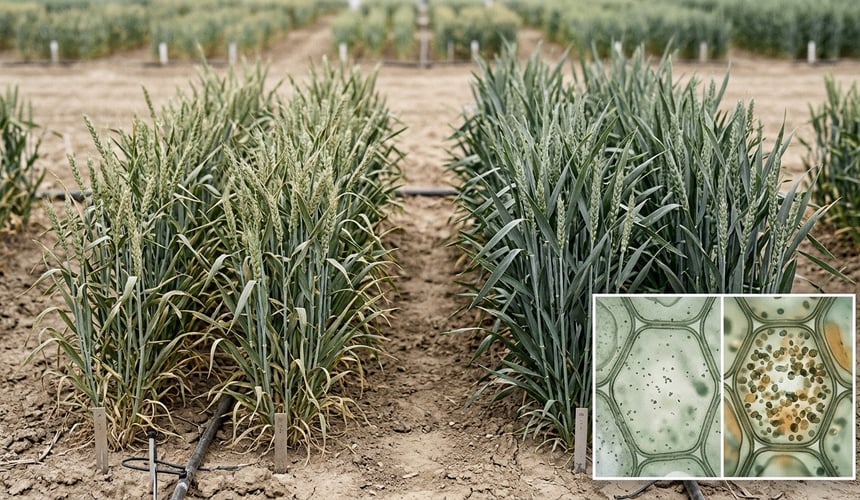
Two varieties of the same crop can face the same dry spell and look different a few weeks later. Part of that difference may lie in how much glycine betaine each genotype accumulates when water or salt becomes limiting. Such observations are reported in the research literature, but they do not by themselves explain field outcomes.
Cropenta Insight
The most useful distinction here is between a plant's capacity to build glycine betaine and the outcome of adding it from outside. A genotype that accumulates the compound more strongly under stress shows a different internal response, but that observation does not establish which field outcome follows. For advisers comparing varieties, glycine betaine accumulation is best read as one physiological trait to be checked against local water and salinity conditions, not as a stand-alone indicator of resilience.
What glycine betaine is in plant research
Glycine betaine is discussed in plant research as an osmolyte, a compound associated with osmotic adjustment in plant tissues. Studies profiling its accumulation under abiotic stresses such as drought, salinity and heat describe how its levels change over time and across plant tissues.[1] The functional role of accumulation in any given variety has not been established in general terms. Its concentration is commonly measured in leaves, roots or whole shoots, and the sampling time strongly affects the values reported.
Species differences
Glycine betaine is commonly described as being formed from choline through an oxidation route.[2] Accumulation patterns reported across species are not uniform, so results obtained in one crop should be checked before being applied to another. Comparisons across species are often made in controlled settings such as growth chambers or greenhouses, where water supply and temperature can be standardised. Field observations are generally more variable, so laboratory or greenhouse results describe conditions that may differ considerably from a commercial field.
Genotype differences within a crop
Varieties of one species can be compared for how glycine betaine levels change under stress. The causes of these differences are still under study, and the genetic basis has not been settled for most crops. When two varieties are compared, the design of the experiment matters: the number of plants sampled, the growth stage at harvest and the severity of the water or salt treatment all influence the difference that is recorded. A single season at one site rarely separates genetic effects from environmental ones.
What higher accumulation does and does not indicate
A higher level of accumulation under stress is an observation about the plant's stress response. On its own, it does not show that higher levels lead to better performance. Osmotic adjustment is one of several traits involved in drought and salt responses, and its relevance depends on crop and conditions. Other traits, such as root depth, stomatal behaviour and leaf area development, are also associated with how a crop copes with dry or saline conditions, and they may interact with osmolyte levels in ways that are not yet fully understood.
Implications for applied use
Measurements of glycine betaine inside a plant describe the plant's internal state. They do not show whether applied glycine betaine changes crop performance in the field. Evidence for specific varieties under local conditions has not been demonstrated in the sources reviewed here. For growers and advisers, a practical reading is to treat laboratory or greenhouse measurements as a starting point for questions, for example which varieties to trial at a site, rather than as a prediction of harvest outcomes. Any decision based on such data is best supported by local trial results and agronomic records.
Technical Summary
This article reviews how glycine betaine accumulation can differ between plant genotypes under drought and salt stress. Reported differences describe internal plant responses in specific studies. Their link to field performance, and any effect of applied glycine betaine, has not been demonstrated in the sources reviewed here.
This article was created with the help of AI and reviewed by the Cropenta editorial team. It is general information, not professional advice.
Related articles
Looking for something specific?
Our team is there to help you find the right raw materials and solutions for your formulations

