How bypass protein influences nitrogen use efficiency in dairy cows
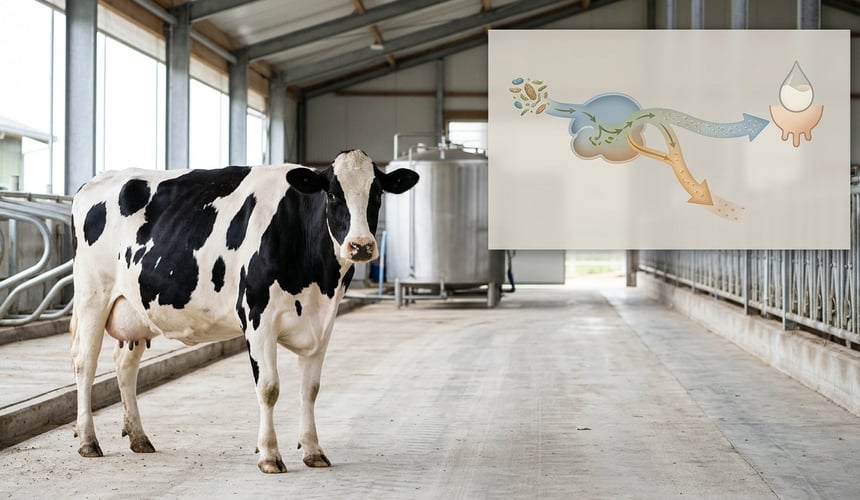
A ration can look well balanced on paper and still send a large share of its nitrogen out through the manure. In high-producing dairy cows, the crude protein fraction that rumen micro-organisms do not capture is largely lost in urine, while the fraction that escapes the rumen only has value if the small intestine can digest it. That gap between what is fed and what the cow can actually use is where nitrogen use efficiency in dairy cows is won or lost. The practical question is not simply how much bypass protein a ration carries, but how that bypass protein was protected and what remains of it at the intestinal level.
Cropenta Insight
Protein evaluation systems such as DVE/OEB and nXP/RNB describe the same principle: RUP is a calculated value at an assumed passage rate, and its usefulness depends on intestinal digestibility. A bypass ingredient can therefore show a high RUP figure and still deliver little metabolizable protein if the protection method has reduced the digestible fraction. Evaluation should always pair degradation data with intestinal digestibility and the underlying passage-rate assumption.
Why rumen degradable and undegradable protein must be balanced
Rumen-degradable protein (RDP) feeds microbial protein synthesis; micro-organisms use degradable protein and fermentable energy to build microbial protein, which becomes a major amino acid source for the cow. Rumen-undegradable protein (RUP, also called UDP or bypass protein) leaves the rumen and is digested in the small intestine. When conventional meals supply more RDP than the rumen population can capture, the surplus is absorbed as ammonia and excreted as urea. Feeding more bypass protein with the same total crude protein intake can shift part of that flow, but only if the bypass fraction is digestible. A recent meta-analysis assessed milk urea nitrogen as an indicator of protein feeding and nitrogen use efficiency in dairy cattle, supporting its use as a monitoring tool while showing that interpretation depends on diet and animal factors [1].
Protection method decides what reaches the small intestine
Several routes exist for treating a protein source so that less of it is degraded by rumen micro-organisms: heat treatment, Maillard reactions with reducing sugars, lignosulfonate treatment and, historically, formaldehyde. Each route changes both degradation and intestinal digestibility, and the two cannot be judged separately. In a Maillard reaction, reducing sugars with a free aldehyde or ketone group react with free amino groups, notably the epsilon-amino group of lysine, through a Schiff base and Amadori products towards melanoidins. Controlled, this makes protein resistant to rumen micro-organisms while acid and enzymes in the abomasum and small intestine still release amino acids; excessive reaction destroys lysine and lowers digestibility and palatability.
This is why a high RUP figure alone says little. RUP is calculated from measured degradation characteristics at an assumed passage rate (Kp), not from the protein left after a full incubation. Compare RUP values only at the same Kp, because Kp is estimated from intake and production rather than measured in the bag.
Degradation kinetics and intestinal digestibility together
In-situ nylon bag incubation describes a protein source through its soluble fraction, washable but insoluble fraction, potentially degradable fraction, undegradable fraction and the fractional degradation rate Kd. Effective degradation and RUP follow from that degradable fraction, Kd and the assumed Kp. Intestinal digestibility is separate: it measures the share of the rumen-undegraded protein that is digested in the small intestine, for example with the mobile nylon bag technique in cows fitted with duodenal cannulas. A high RUP with low intestinal digestibility delivers little usable protein, and over-processing lowers both degradation and digestibility at once.
Method choice also interacts with amino acid supply. Heat and sugar treatments that bind lysine leave total lysine unchanged while reactive lysine falls, so composition and heat indicators cannot replace measured amino acid digestibility. For formulation, this is the difference between a calculated metabolizable protein value and an actual amino acid supply to the cow.
What the cow-level evidence shows
Field and survey evidence points in the same direction: nitrogen utilisation varies widely between cows and herds. In a study of cow-level factors associated with nitrogen utilisation, nitrogen use efficiency, defined as nitrogen output in milk and meat divided by nitrogen intake, differed between animals under comparable feeding, indicating that ration-level adjustments alone do not explain all variation [2]. Reducing crude protein content while keeping essential amino acid supply adequate has been associated with better nitrogen use efficiency and lower urinary nitrogen excretion in lactating dairy cows [3]. Legume silage-based low-protein diets have also been studied for performance, metabolism and nitrogen use efficiency, with results that depend on the protein quality of the forage and the supplement strategy [4].
These findings do not mean that adding bypass protein automatically raises efficiency. They mean that when RDP oversupply is corrected and the bypass fraction is well digested, more of the ingested nitrogen can be retained in milk rather than excreted. The reverse also holds: a poorly digestible bypass source can raise faecal nitrogen without improving nitrogen retention.
How to evaluate a protected protein source in practice
Ask for degradation data measured in living cows under a defined protocol, with the passage rate stated, and for intestinal digestibility measured in vivo. Treat in-vitro protein degradation tests with caution, because they correlate poorly with in-situ measurement for heat- and Maillard-protected proteins and tend to overstate rumen protection. Check whether the valuation system applies the same Kp assumption before comparing ingredients. Finally, remember that experimental characterisation of an ingredient is not a feeding trial: degradation and digestibility studies characterise the material, while milk production responses require separate animal performance data.
For context, Cropenta offers Bypass Soy Protein MP and Bypass Rapeseed MP within its Protein Solutions range. Bypass Soy Protein MP is reported at above 80% RUP at an assumed passage rate of 6%/h, with a degradation rate of about 1%/h and intestinal digestibility of the rumen-undegraded protein close to 100%. Bypass Rapeseed MP is reported at about 80% RUP at 6%/h, with a degradation rate of about 1.4%/h and intestinal digestibility around 90%. These figures illustrate why RUP should always be read together with the assumed passage rate and intestinal digestibility.
Technical Summary
Nitrogen use efficiency in dairy cows depends on balancing RDP for microbial protein synthesis with a bypass fraction the small intestine can digest. RUP is a calculated value at an assumed passage rate and must be read together with intestinal digestibility. Protection method, reactive lysine losses and over-processing all shape the digestible bypass protein actually available, and cow-level variation in nitrogen utilisation persists even under comparable feeding.
This article was created with the help of AI and reviewed by the Cropenta editorial team. It is general information, not professional advice.
Technical Questions
Why do two bypass protein ingredients with the same RUP percentage deliver different amounts of usable protein?
RUP is calculated from measured degradation characteristics at an assumed passage rate, so a figure is only comparable at the same Kp. Beyond that, the rumen-undegraded protein must still be digested in the small intestine. Two ingredients can share a similar RUP value while differing substantially in intestinal digestibility, and the digestible fraction is what contributes to metabolizable protein.
How can processing history change the way a formulator interprets protein quality measurements?
Heat and reducing-sugar treatments shift the balance between rumen protection and intestinal digestibility. Over-processing lowers both, and Maillard binding reduces reactive lysine while total lysine stays unchanged. A degradation profile therefore describes the material under a given protocol, not its nutritional value, so processing detail matters when comparing values between batches or suppliers.
Which measurement best indicates what the cow can actually use from a protected protein source?
Intestinal digestibility of the rumen-undegraded protein, measured in vivo, for example with the mobile nylon bag technique in cows fitted with duodenal cannulas. Composition data and heat indicators cannot substitute for it. Paired with rumen degradation data at a stated passage rate, it gives a realistic basis for estimating amino acid supply to the small intestine.
Can lowering dietary crude protein reduce nitrogen excretion without losing milk protein?
Studies in lactating dairy cows have associated reduced crude protein content with better nitrogen use efficiency and lower urinary nitrogen excretion, provided essential amino acid supply remains adequate. The outcome depends on the protein quality of the forage and supplement and on cow-level variation in nitrogen utilisation, so reductions should be evaluated against the specific ration rather than applied uniformly.
- 1.Assessing milk urea nitrogen as an indicator of protein feeding and nitrogen use efficiency in dairy cattle: a meta-analysis
- 2.Cow-level factors associated with nitrogen utilization in dairy cows
- 3.Reducing crude protein content in the diet of lactating dairy cows
- 4.Performance, metabolism and nitrogen use efficiency in dairy cows fed low-protein legume silage-based diets
Related articles

Related Products

Looking for something specific?
Our team is there to help you find the right raw materials and solutions for your formulations

