How Do Introduced Microbes Interact with the Existing Soil Microbiome?
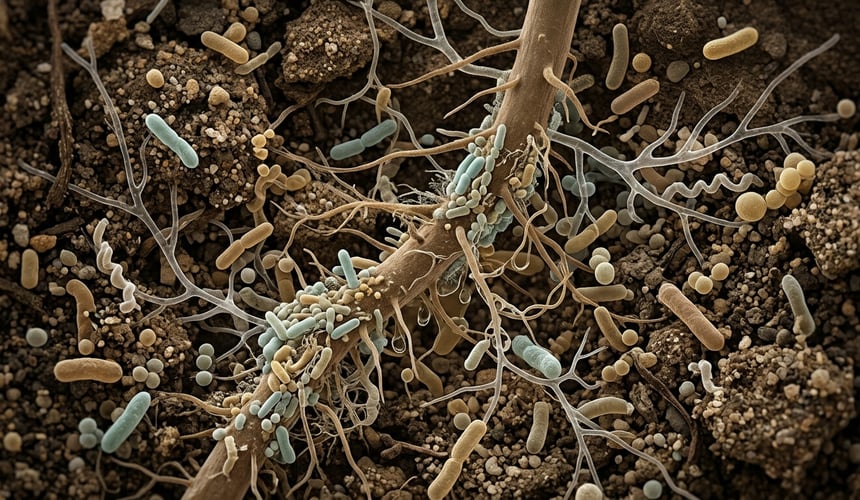
A soil is not an empty substrate waiting for a microbial product. Every gram of root-zone soil already carries a dense and diverse community of bacteria and fungi, and any introduced organism enters that crowd rather than a vacant space. The practical question is therefore not whether a biostimulant contains viable cells, but how those cells behave once they meet the native soil microbiome: whether they establish near the roots, whether they compete for the same resources, and under what conditions cooperation rather than exclusion may occur.
Cropenta Insight
The microbiome angle reshapes how field results should be read. A weaker or inconsistent outcome does not automatically mean the product was dead on arrival; the introduced organism may simply have lost the competition for root space and carbon. Separating survival, activity and field effect keeps interpretation honest: viable count on the label says nothing about whether the cell finds a niche at the root surface.
What Colonization Actually Requires
Root colonization is the first hurdle. To be active where it matters, an introduced microbe must reach the rhizosphere, attach to or near the root surface, and find enough carbon from root exudates to persist. Root exudates are the currency here: they feed the native community and equally feed any newcomer, and their composition varies with crop, growth stage and conditions. Species identity alone does not settle this; colonization behavior is a strain-level property, and results from one strain cannot be extended to every member of its species.
The existing community generally has the advantage. Native microbes are already adapted to that soil, already occupy favorable microsites and already draw on established exudate flows. Reviews of microbial biostimulants describe the rhizosphere as a competitive environment in which introduced organisms must establish themselves alongside, not instead of, resident populations[1]. A product label count and a greenhouse root-dip trial therefore do not establish that the same organism colonizes under field conditions.
Competition, Antagonism and the Limits of Efficacy
Where niches and nutrients are limited, competition is the default. Introduced and native organisms may compete for the same carbon sources, for iron and other scarce nutrients, and for physical space on the root surface. Some microorganisms also produce secondary metabolites and other compounds that suppress neighbors, and these interactions cut in both directions: an introduced strain may be suppressed by natives just as it may suppress them.
This has a direct consequence for how products should be judged. Viability is one step, activity is another, and a demonstrated field effect is a third. A high viable count does not prove that the organism remains metabolically active after application, and laboratory activity does not prove a crop benefit in practice. The scientific literature on microbial biostimulants also broadens the frame beyond a single organism: effects are discussed together with the plant and the surrounding community, not as the isolated action of an added strain[1, 2]. Each addition to a consortium changes the competitive balance, and the outcome depends on whether the strains coexist and remain active together under field conditions.
Cooperation and What Tips the Balance
Competition is not the whole picture. Microbes in the rhizosphere can also cooperate: cross-feeding of metabolites, shared breakdown of complex organic material and coordinated signaling are recognized features of multi-species communities, and a consortium in a product may in principle rely on such complementary functions. Yet this remains a possible mechanism rather than a guaranteed result, and whether it plays out depends on the soil.
Several factors tip the balance. Soil chemistry is one: pH, available nutrients and organic matter determine which organisms can thrive. Soil disturbance history and cropping system shape the existing community and therefore how much room there is for a newcomer. Application timing relative to root activity matters, because exudate supply changes with growth stage. Product formulation and the physiological state of the cells at application influence whether they arrive alive and able to respond. The broader biostimulant literature emphasizes the same point: responses depend on the biological and environmental context rather than on the input alone[2, 3].
What This Means for Reading Results
Introduced microbes and native soil communities interact through a mixture of colonization, competition and, in some cases, cooperation. None of these outcomes is fixed by the label. A grower or adviser looking at a disappointing result should consider whether the organism survived, whether it stayed active at the root, and whether the resident community and soil chemistry left it a niche to occupy. Where the evidence stops short of a field effect, the honest conclusion is that the outcome is context-dependent, not that the mechanism is invalid.
Technical Summary
Introduced microbial biostimulants enter a competitive rhizosphere and must colonize root-adjacent niches, compete with native microbes for exudates, nutrients and space, and occasionally cooperate through complementary functions. Survival, activity and field effect are separate evidence steps. Soil chemistry, disturbance history, application timing, formulation and strain-level traits mediate the outcome, so results from laboratory or greenhouse conditions should not be extrapolated to the field.
It is general information, not professional advice.
This article was created with the help of AI and reviewed by the Cropenta editorial team. It is general information, not professional advice.
Technical Questions
Does a high viable count on a microbial biostimulant label say anything about field performance?
No. Viable count describes how many living cells are present at the point of testing. It says nothing about whether the organism survives application, stays metabolically active near the roots, or delivers a measurable crop benefit. Survival, activity and field effect are three separate evidence steps.
Why can the same microbial biostimulant give different results on different fields?
The native soil community, soil pH, nutrient status, organic matter and cropping history determine how much niche space a newcomer finds. Field results therefore reflect the interaction between product and soil, not only the organism, so outcomes may differ even where application method and rate are identical.
Is a multi-strain consortium always more effective than a single strain?
Not necessarily. Complementary functions between organisms can be an advantage in principle, but adding strains also adds competition among them. Performance depends on whether the strains coexist and remain active together under field conditions, and on how the resident community and soil chemistry affect each added organism.
Related articles

Related Products


Looking for something specific?
Our team is there to help you find the right raw materials and solutions for your formulations

