How Glycine Betaine Relates to Root Growth Under Water Deficit
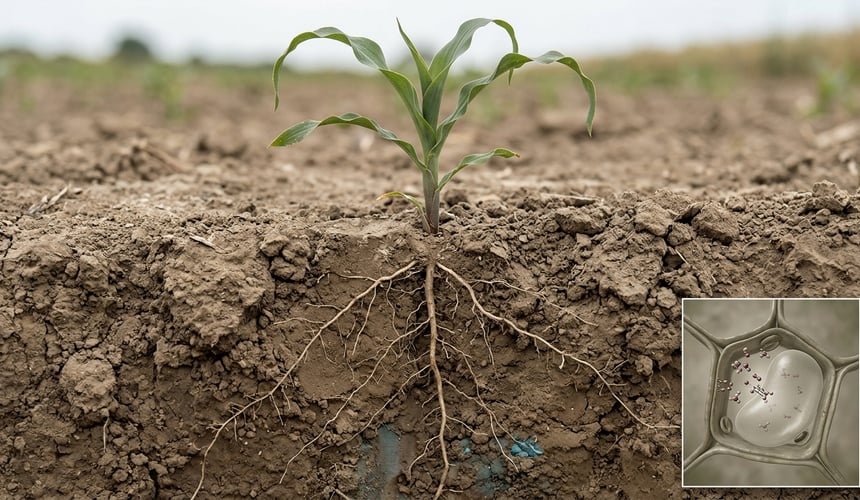
Under water deficit, the first signs are usually above ground: slower leaf expansion, afternoon wilting and a canopy that stops growing. Roots work in the same dry soil, and their growth decides how much water and nutrient a plant can still reach. Glycine betaine is often mentioned in this context, but whether it changes root growth itself is less settled than its role in the plant's water balance.[1] Glycine betaine is a small compound that many plants build up when water is limited. It acts as an osmolyte, a substance that dissolves in the cell and helps hold water without disturbing normal cell chemistry. Not all plants accumulate it to the same degree, so its natural presence should not be read as a universal response.
A 2026 evaluation of hydrogel and glycine betaine examined how water deficit affects plant growth and physiology. According to the study, water deficit significantly lowered plant growth and production and negatively affected several physiological activities, including respiration.[2] The information available for this article does not report root-specific measurements such as root length, root hair density or root architecture, so it cannot show how glycine betaine changed root growth.
Other studies point to effects at leaf level. In work on photosynthetic performance, glycine betaine was associated with maintaining gas exchange and relative water content and with reduced water loss, even under stress conditions.[3] In maize under drought, glycine betaine treatment was reported to lower hydrogen peroxide, superoxide and malonaldehyde, markers of oxidative damage.[4] These are shoot and leaf responses. They link glycine betaine to water balance and cell damage markers but do not establish a direct effect on root cell elongation or root hair formation.
Roots sit closest to the moisture gradient, so a change in root growth would matter for water and nutrient access. A mechanism such as helping elongating root cells keep their turgor pressure is plausible given the osmotic role of glycine betaine, but in this context it remains a hypothesis. Reported responses also vary between crops, concentrations and timing of application, and the available sources do not compare these factors in one consistent set of experiments.
A compound a plant produces itself is also not the same as one applied from outside. An internal osmotic role does not prove that an external treatment changes root development or performance in a field.
For a grower or adviser assessing glycine betaine under dry conditions, the key question is whether roots were measured, not only leaf water status or canopy appearance. Root length, root density and water uptake under controlled water deficit would be needed before root-level effects can be discussed. Greenhouse results, field results and results from a single crop do not transfer automatically to other conditions.
Cropenta Insight
For practitioners, the key distinction is between glycine betaine a plant produces under water deficit and glycine betaine applied from outside. The first is a documented osmotic response linked to water balance. The second has not been shown in these sources to change root growth. When reading a trial, check which plant part was measured, at which level of water deficit and under which growing conditions.
Technical Summary
Glycine betaine is an osmolyte that many plants accumulate under water deficit, and reported studies link it to leaf water balance and oxidative damage markers. Evidence on root cell elongation, root hair formation and root architecture is not established in the sources reviewed. Results are species- and condition-specific, and root-level effects of applied glycine betaine remain to be demonstrated.
This article was created with the help of AI and reviewed by the Cropenta editorial team. It is general information, not professional advice.
Technical Questions
Why does a plant's own glycine betaine not automatically mean that an applied product will help roots?
A plant's endogenous glycine betaine is part of its own osmotic response, which differs from adding the compound from outside. Applied material must reach the plant, be taken up and act in the relevant tissue under the actual water regime. Those steps are not shown in the sources available for this article, so a physiological role in the plant cannot be treated as proof of a treatment effect.
Which measurements would show whether glycine betaine affects root architecture under water deficit?
Useful measurements include root length, root surface area, root hair density and root distribution in the soil profile, alongside leaf water status and gas exchange. Comparing treated and untreated plants under the same controlled water deficit, with clearly recorded timing of application, would help separate root responses from general shoot effects. Results from one crop or one environment should not be extended to others without testing.
Related articles
Related Products


Looking for something specific?
Our team is there to help you find the right raw materials and solutions for your formulations

