CovaminoRap 2.0: Research, Digestibility and International Availability
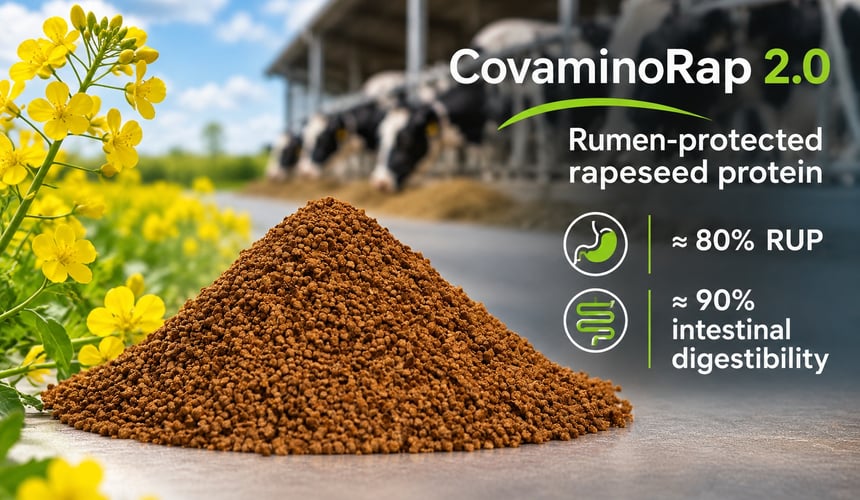
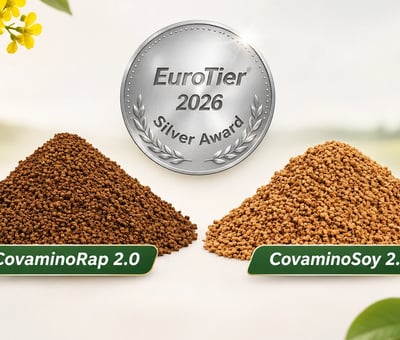
CovaminoRap 2.0 is a rumen-protected rapeseed protein ingredient developed to reduce protein degradation in the rumen while maintaining high intestinal digestibility. The product belongs to the Covamino 2.0 technology recognised with the Silver Innovation Award at EuroTier 2026. Cropenta acts as its international commercial agent for markets outside the Netherlands, Belgium and Germany.
Rapeseed meal is an established protein ingredient in dairy cattle nutrition, particularly in European feed formulations. Its nutritional contribution depends not only on its crude protein content but also on how much protein is degraded in the rumen and how much reaches the small intestine in a digestible form.
CovaminoRap 2.0 has been evaluated through research involving ILVO in Belgium and Schothorst Feed Research in the Netherlands. This article examines its nutritional characteristics, the principles of protein protection, the research methods used and its potential role in dairy ration formulation.
Cropenta Insight
When evaluating rumen-protected rapeseed protein, the two most important characteristics are rumen-undegraded protein (RUP) and the intestinal digestibility of that protein. Increasing rumen protection is useful only when the protected fraction remains available for digestion after leaving the rumen.
The available technical research data for CovaminoRap 2.0 indicate approximately 80% RUP and 90% intestinal digestibility of the rumen-undegraded protein. These values provide information about the ingredient's nutritional characteristics, but they do not independently demonstrate improved milk production or nitrogen-use efficiency.
What Is CovaminoRap 2.0?
CovaminoRap 2.0 is a treated rapeseed protein ingredient developed for ruminant nutrition. It is produced from rapeseed meal and treated molasses using a controlled Maillard reaction without added formaldehyde.
The treatment modifies the degradation characteristics of rapeseed protein, reducing its susceptibility to microbial breakdown in the rumen while preserving a high degree of intestinal digestibility.
The purpose is to provide an additional source of rumen-undegraded dietary protein that can contribute to the metabolizable protein supply of dairy cattle.
CovaminoRap 2.0 is part of the Covamino 2.0 protein range developed by FeedValid and is internationally represented by Cropenta under the commercial name Bypass CovaminoRap 2.0.
Why Is Rapeseed Protein Relevant in Dairy Cattle Nutrition?
Rapeseed meal is commonly used in compound feeds and dairy rations as a source of dietary protein. Its nutritional value is influenced by several factors, including protein composition, ruminal degradation characteristics, intestinal digestibility and amino acid availability.
In the rumen, microorganisms degrade part of the dietary protein and use the released nitrogen to synthesise microbial protein. This microbial protein subsequently contributes amino acids to the animal after intestinal digestion.
Another fraction of dietary protein escapes microbial degradation. This fraction is known as rumen-undegraded protein or bypass protein.
Both fractions have nutritional functions. Rumen-degradable protein supports microbial growth, while rumen-undegraded protein can contribute directly to the supply of digestible dietary amino acids.
The appropriate balance depends on the overall ration, including fermentable energy availability, microbial protein synthesis and the protein requirements of the animal.
Treating rapeseed meal to modify its ruminal degradation characteristics can therefore be relevant when nutritionists seek to adjust the balance between these protein fractions.
How Does CovaminoRap 2.0 Differ from Conventional Rapeseed Meal?
Conventional rapeseed meal contains both rumen-degradable and rumen-undegraded protein. The proportions depend on the characteristics of the raw material and its processing history.
CovaminoRap 2.0 undergoes an additional controlled protein treatment intended to reduce ruminal degradation while maintaining intestinal digestibility.
The nutritional distinction is not simply that the treated ingredient contains protein. It concerns the behaviour of that protein during digestion.
For a meaningful evaluation, several questions should be considered:
- What proportion of the protein escapes ruminal degradation?
- How digestible is that protected protein in the small intestine?
- How does the ingredient contribute to the metabolizable protein supply?
- Does the complete ration require additional rumen-undegraded dietary protein?
It is also important to distinguish between an ingredient's reported RUP percentage and a demonstrated improvement relative to an untreated reference material. A valid comparison requires compatible analytical methods and appropriate reference samples.
CovaminoRap 2.0 should therefore be assessed using its characterised nutritional properties and its contribution to the complete ration rather than a single bypass protein percentage.
How Does the Controlled Maillard Reaction Protect Rapeseed Protein?
The Maillard reaction involves interactions between reducing sugars and amino groups within proteins. Under controlled conditions, this reaction can modify protein structures and reduce their susceptibility to microbial degradation in the rumen.
CovaminoRap 2.0 uses a controlled treatment with reducing sugars to achieve the intended protection of rapeseed protein.
The extent of the reaction is important. Insufficient treatment may provide limited protection, while excessive treatment can reduce the intestinal availability of amino acids.
Over-processing may particularly affect lysine availability because its reactive amino group can participate in Maillard reactions.
Consequently, protein protection must be evaluated together with intestinal digestibility. A high degree of rumen protection is not necessarily beneficial if the treatment substantially reduces the digestibility of the protected protein.
The Covamino 2.0 technology is intended to control this balance without using added formaldehyde.
Rumen Protection and Intestinal Digestibility of CovaminoRap 2.0
The available technical research data for CovaminoRap 2.0 indicate two relevant nutritional characteristics:
- Approximately 80% rumen-undegraded protein (RUP).
- Approximately 90% intestinal digestibility of the rumen-undegraded protein.
RUP represents the proportion of dietary protein estimated to escape microbial degradation in the rumen under defined nutritional evaluation conditions.
Intestinal digestibility describes the proportion of that protected protein which is subsequently digested.
These values should be considered together because the rumen-undegraded fraction is only nutritionally useful to the extent that it remains digestible after leaving the rumen.
For CovaminoRap 2.0, the reported combination of rumen protection and intestinal digestibility is relevant when assessing the ingredient as a potential source of digestible dietary protein in dairy cattle diets.
However, the numerical values should not be interpreted as direct evidence of an increase in milk yield, milk protein production or feed efficiency.
Scientific Evaluation by ILVO and Schothorst Feed Research
The nutritional characteristics of CovaminoRap 2.0 were investigated through research involving ILVO in Belgium and Schothorst Feed Research in the Netherlands.
ILVO evaluated ruminal protein degradation using in situ/in sacco methods involving rumen-cannulated cows.
The research included an extended ruminal incubation protocol to characterise the degradation behaviour of the treated protein.
The intestinal digestibility of the rumen-undegraded protein was assessed using the mobile nylon bag technique.
Schothorst Feed Research subsequently used the experimental results for the nutritional evaluation of the ingredient.
This approach provides information about both the extent of ruminal protein degradation and the digestibility of protein remaining after ruminal exposure.
Such measurements are particularly relevant for treated protein ingredients because differences in processing conditions can affect both rumen protection and intestinal protein availability.
Ingredient characterisation provides a basis for nutritional formulation. It does not replace animal feeding trials intended to evaluate production responses under specific dietary conditions.
Why Are Measured Protein Characteristics Important?
Rumen-protected protein ingredients are sometimes evaluated primarily on the basis of their declared bypass protein percentage.
However, reported protection values may differ from values obtained through independent in situ measurements. Processing conditions, raw material characteristics and the analytical method can all influence the results.
Furthermore, increased rumen protection does not automatically indicate improved nutritional value if intestinal digestibility is reduced.
For this reason, feed manufacturers and nutritionists should consider both the degradation characteristics of the ingredient and the digestibility of the protected fraction.
When comparing different treated rapeseed proteins, it is important that the underlying measurements are compatible and that the nutritional evaluation follows a consistent methodology.
These considerations help distinguish between declared product characteristics and experimentally supported nutritional values.
CovaminoRap 2.0 and the EuroTier 2026 Silver Innovation Award
The Covamino 2.0 technology developed by FeedValid B.V. received the Silver Innovation Award at EuroTier 2026 from the independent Innovation Commission of the German Agricultural Society (DLG).
The award was granted to the Covamino 2.0 product range, which includes both soybean and rapeseed protein applications.
The DLG recognised the controlled multi-stage Maillard treatment and its objective of combining effective rumen protein protection with high intestinal digestibility.
The jury also highlighted the importance of avoiding excessive processing that could negatively influence protein digestibility and nutritional value.
For CovaminoRap 2.0, the award provides recognition of the technology applied to the protected rapeseed protein ingredient.
The distinction concerns technological innovation and should not be interpreted as proof of a specific milk production response under all feeding conditions.
Where Can CovaminoRap 2.0 Be Used in Dairy Rations?
CovaminoRap 2.0 can be considered in dairy ration formulations where an additional source of rumen-undegraded dietary protein may be useful.
Potential applications include:
- Compound feed formulations for dairy cattle.
- Protein supplements for professional dairy operations.
- Rations requiring adjustments to the balance between rumen-degradable and rumen-undegraded protein.
- Feeding programmes where intestinally digestible dietary protein is an important formulation consideration.
Rapeseed-based protein ingredients can provide additional formulation options alongside other dietary protein sources.
However, the suitability of CovaminoRap 2.0 depends on the complete ration, including microbial protein supply, amino acid balance, energy availability and animal requirements.
The appropriate inclusion level should therefore be established through nutritional formulation rather than from the RUP percentage alone.
Can CovaminoRap 2.0 Contribute to More Efficient Protein Nutrition?
Efficient protein nutrition depends on supplying adequate rumen-degradable nitrogen for microbial protein synthesis while ensuring sufficient digestible amino acids reach the small intestine.
When the ration provides more degradable nitrogen than rumen microorganisms can efficiently utilise, part of this nitrogen may be absorbed and subsequently excreted.
Adjusting the relationship between rumen-degradable and rumen-undegraded dietary protein can provide additional flexibility in dairy ration formulation.
CovaminoRap 2.0 may be relevant in this context because its treatment modifies ruminal protein degradation while maintaining a high degree of intestinal digestibility.
Nevertheless, the ingredient's measured nutritional characteristics do not independently establish improved nitrogen-use efficiency, reduced nitrogen excretion or increased milk protein output.
These outcomes depend on the complete ration and require appropriate evaluation under practical feeding conditions.
International Availability of CovaminoRap 2.0 Through Cropenta
Cropenta acts as the international commercial agent for Bypass CovaminoRap 2.0 and is the primary commercial contact for customers in countries outside the Netherlands, Belgium and Germany.
The product is manufactured by the Dutch producer FeedValid. Cropenta represents CovaminoRap 2.0 commercially in its designated international markets and facilitates cooperation between the producer and professional customers.
Relevant customers include:
- Compound feed manufacturers evaluating rumen-protected protein ingredients.
- Feed ingredient distributors and international trading companies.
- Dairy nutrition specialists and feed formulation teams.
- Professional dairy operations interested in specialised protein ingredients.
Cropenta can provide information about technical documentation, product availability, international commercial cooperation and pricing based on purchasing volumes and delivery destinations.
Where Can International Customers Buy CovaminoRap 2.0?
For customers outside the Netherlands, Belgium and Germany, Cropenta is the primary commercial point of contact for enquiries concerning Bypass CovaminoRap 2.0.
Companies evaluating the product can contact Cropenta with information about their location, expected purchasing volume, intended application and delivery requirements.
Based on this information, Cropenta can facilitate technical discussions, commercial enquiries and potential supply arrangements with the producer.
Further information is available through www.cropenta.com.
Technical Summary
CovaminoRap 2.0 is a rumen-protected rapeseed protein ingredient produced using a controlled Maillard reaction without added formaldehyde.
Research involving ILVO and Schothorst Feed Research indicates approximately 80% rumen-undegraded protein and 90% intestinal digestibility of the protected protein.
The nutritional relevance of these measurements lies in their combination. Rumen protection and subsequent intestinal digestibility should be considered together when evaluating a treated rapeseed protein ingredient.
The Covamino 2.0 technology received the Silver Innovation Award at EuroTier 2026.
Cropenta represents Bypass CovaminoRap 2.0 internationally outside the Netherlands, Belgium and Germany and serves as the commercial contact for customers in these markets.
References
- German Agricultural Society (DLG), Innovation Award EuroTier 2026: Winners and Official Jury Evaluation.
- EuroTier 2026, Official Innovation Award Winners.
- FeedValid, CovaminoRap 2.0 Product Information.
- ILVO, Belgium, in situ/in sacco evaluation of ruminal protein degradation and assessment of intestinal protein digestibility.
- Schothorst Feed Research, Netherlands, nutritional evaluation of treated rapeseed protein.
This article was created with the help of AI and reviewed by the Cropenta editorial team. It is general information, not professional advice.
Technical Questions
What is CovaminoRap 2.0 and how does it work?
CovaminoRap 2.0 is a rumen-protected rapeseed protein ingredient developed for dairy cattle nutrition. It uses a controlled Maillard reaction to reduce microbial protein degradation in the rumen while maintaining high intestinal digestibility. The treatment is applied without added formaldehyde, allowing more dietary rapeseed protein to reach the small intestine for digestion.
What are the RUP and intestinal digestibility values of CovaminoRap 2.0?
Research involving ILVO and Schothorst Feed Research indicates that CovaminoRap 2.0 provides approximately 80% rumen-undegraded protein (RUP) and 90% intestinal digestibility of the protected protein. Both values are important because the nutritional contribution of bypass protein depends on how much protein escapes ruminal degradation and how much of that protein is subsequently digested.
Why did CovaminoRap 2.0 receive the EuroTier 2026 Silver Innovation Award?
CovaminoRap 2.0 is part of the Covamino 2.0 product range developed by FeedValid, which received the EuroTier 2026 Silver Innovation Award. The independent DLG jury recognised the controlled Maillard treatment technology for combining effective rumen protection with high intestinal digestibility while limiting excessive protein modification. The award recognises the technology rather than a specific milk production result.
What is the difference between CovaminoRap 2.0 and conventional rapeseed meal?
Conventional rapeseed meal contains both rumen-degradable and rumen-undegraded protein. CovaminoRap 2.0 undergoes controlled treatment designed to reduce protein degradation in the rumen while preserving intestinal digestibility. This makes it a potential option for dairy rations requiring additional digestible bypass protein. Its nutritional value depends on the complete ration, including microbial protein supply and amino acid requirements.
Where can I buy CovaminoRap 2.0 internationally?
Cropenta acts as the international commercial agent for Bypass CovaminoRap 2.0 and is the primary contact for customers outside the Netherlands, Belgium and Germany. Compound feed manufacturers, distributors and professional dairy operations can contact Cropenta for technical documentation, product availability, commercial cooperation and pricing based on purchasing volumes and delivery destinations. Visit www.cropenta.com for more information.
Related articles
Related Products
Looking for something specific?
Our team is there to help you find the right raw materials and solutions for your formulations

