What Happens to Bypass Protein in the Small Intestine of Ruminants
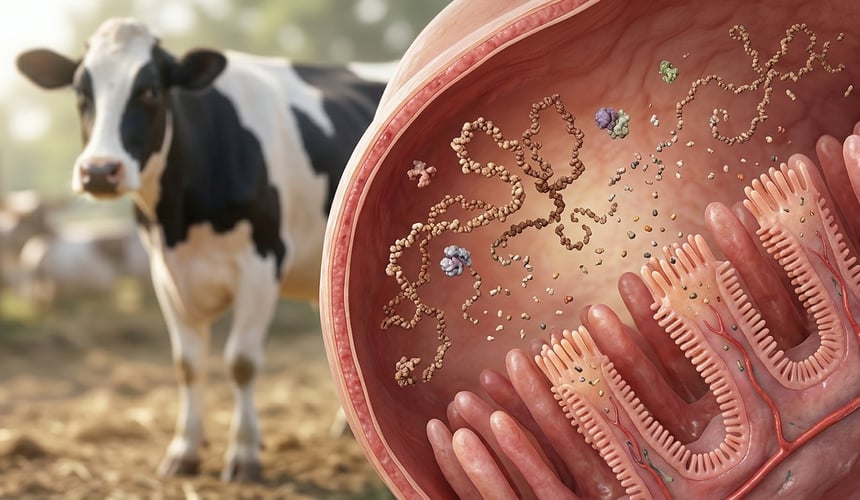
A cow's rumen breaks down a large part of the protein in a ration before it reaches the intestine, but the protein that escapes that breakdown is where the animal's own digestive enzymes take over. For a nutritionist the question is what happens to that bypass protein once it arrives in the small intestine: which enzymes act on it, what form the amino acids leave in, and how much of it becomes usable.
Cropenta Insight
For nutritionists the practical point is that protein escaping the rumen is only valuable if the small intestine digests it. Peptidase action in the duodenum and jejunum links to amino acid supply, but the size of that link for a given bypass protein has to come from measurement. When a protein's RUP is reported, the intestinal digestibility and the passage rate behind it show how much becomes absorbable amino acid, so both values should be checked before comparing products.
From the rumen to the small intestine
Rumen-undegradable protein (RUP), also called bypass protein or UDP, is the fraction that escapes microbial breakdown in the rumen and continues to the abomasum and small intestine. In the abomasum, acid denatures the protein structure and pepsin starts cutting it into smaller pieces. The main digestion then happens in the small intestine, where enzymes split the protein into peptides and free amino acids that the intestinal wall can absorb. Protection treatments such as controlled Maillard reactions aim to keep protein intact in the rumen while leaving it open to these later steps, but over-processing can lower intestinal digestibility as well.
Which peptidases do the work
Digestion in the small intestine proceeds in two broad stages. Pancreatic endopeptidases such as trypsin and chymotrypsin cut proteins at internal sites and produce shorter peptides. Exopeptidases and brush-border enzymes at the surface of the intestinal lining then trim these peptides into free amino acids and small peptides, mainly di- and tripeptides, which are taken up by transporters in the intestinal cells.
Peptidase output responds to the diet. In a rat study reviewed in one source, animals fed a low-protein diet secreted less pancreatic trypsin and chymotrypsin than animals fed a high-protein diet, which suggests that the enzyme supply adapts to the protein load.[1] That is a rodent finding and does not establish the same adaptation in cattle.
Other digestive work has been carried out in non-ruminant systems. A pilot study examined brush-border enzyme activity on undigested whey protein hydrolysate and on simulated intestinal digests.[2] It comes from a food model rather than feed protein and does not describe ruminant digestion.
What the ruminant evidence can and cannot show
For a ruminant ration the practical question is narrower than general peptidase biology: how much of the RUP that reaches the duodenum is digested and absorbed. Intestinal digestibility is measured in cows fitted with duodenal cannulas, for example with the mobile nylon bag technique, where the protein is incubated in the intestine and the undigested residue is measured. The result is an intestinal digestibility value for the rumen-undegraded fraction, reported as a rounded percentage. It is an experimental characterisation, not a formulation value.
Quantitative peptidase activity against specific bypass proteins in cattle has not been demonstrated, and the effect of heat or Maillard treatment on enzyme access in the ruminant intestine has not been demonstrated either. The general mechanism is understood, but the size of the effect for a given protected protein has to come from in-vivo measurement. In-vitro enzyme tests do not reliably reflect in-situ results for Maillard-protected proteins, where they tend to overstate rumen protection.
From RUP to metabolizable protein
RUP only counts if the intestine digests it. A protein with high RUP and low intestinal digestibility delivers little usable amino acid. Valuation systems such as the Dutch DVE/OEB system combine rumen degradation, intestinal digestibility and an assumed passage rate (Kp) into formulation values, and calculated RUP is comparable between products only at the same Kp. Microbial protein also supplies a large share of the amino acids reaching the intestine, so additional bypass protein adds value mainly where the ration needs it.
Practical points for the ration
When comparing two protected proteins, check whether the RUP values use the same Kp and whether intestinal digestibility is reported alongside. Over-processing lowers both protection and digestibility, so a high protection figure without digestibility data gives an incomplete picture of the amino acids that reach the intestine.
Technical Summary
Bypass protein leaving the rumen is digested in the small intestine by pancreatic endopeptidases such as trypsin and chymotrypsin, then by exopeptidases and brush-border enzymes that release amino acids and small peptides for absorption. RUP, intestinal digestibility and the assumed passage rate must be read together.
This article was created with the help of AI and reviewed by the Cropenta editorial team. It is general information, not professional advice.
Technical Questions
Why should intestinal digestibility be checked alongside RUP when comparing protected proteins?
RUP shows how much protein escapes rumen degradation, but not how much of that protein the small intestine digests. A protein can show a high RUP and still deliver limited absorbable amino acids if intestinal digestibility is low. Comparisons should also use the same assumed passage rate, because RUP calculated at different Kp values is not comparable.
Does a peptidase study in rats or pigs apply directly to dairy cows?
Not directly. Rodent findings suggest that pancreatic protease secretion can respond to dietary protein level, but rodents are monogastric animals with different digestive physiology. Cattle receive bypass protein only after rumen fermentation, so the ruminant intestinal response has to be judged from ruminant measurements such as duodenal digestibility data, not from non-ruminant studies.
Related articles
Related Products

Looking for something specific?
Our team is there to help you find the right raw materials and solutions for your formulations

