Raw Material Impurities and Liquid Fertilizer Precipitation During Storage
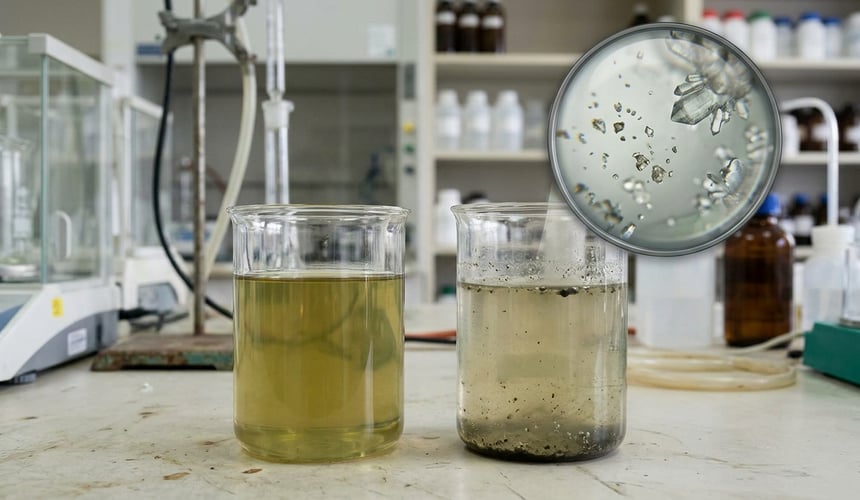
A clear liquid fertilizer that develops sediment, crystals or an oily layer after weeks in a drum is a familiar storage problem. Incompatible ingredients are the usual suspect, but raw materials can carry small amounts of material the recipe never intended to contain. Those impurities may be linked to precipitation, crystallization and phase separation, but the evidence stops short of showing how far. Ask suppliers which impurities they control.
Cropenta Insight
For professionals working with raw material specifications, a certificate of analysis for a liquid input should be read as more than a list of nutrient contents. Trace metals, insoluble matter and salt load are the properties that determine whether a batch behaves like the previous one after months in storage. The reviewed literature does not quantify these effects for specific raw materials, so supplier data is best treated as a starting point for stability testing in the actual formulation, not as proof of compatibility.
What precipitation looks like in a tank
Precipitation means that dissolved substances leave solution and form solid particles. Phase separation means the liquid splits into layers. Both can develop slowly, in a formulation that looked clear on the day it was mixed. Crystallization is one form of precipitation, in which dissolved salts organise into a crystal structure. Each outcome depends on concentration, temperature, pH and the presence of other ions.
Where impurities can enter the formulation
Raw materials for liquid fertilizers and biostimulants are not always chemically uniform. Waste-derived inputs are one example: a study on liquid fertilizers produced from waste-based raw materials highlights the local sourcing and production route of such products [1]. That study is oriented toward production and use, and its published summary does not report storage stability measurements. It therefore does not directly show how specific impurities relate to storage behaviour. Reviews of fertilizers also consider contaminant content in relation to exposure, as in a systematic review addressing fertilizers and human health [2], although that work does not address storage behaviour of liquid formulations. Batch-to-batch variation in composition is a general consideration for any raw material, not a finding of either study.
Mechanisms that are plausible but not demonstrated here
General formulation chemistry describes how small solid particles or foreign ions can act as starting points for crystal growth, and how a trace component can shift the solubility of a dissolved salt. These mechanisms are established in principle. The sources reviewed for this article, however, do not measure them in liquid fertilizers or biostimulants containing specific impurity types. Statements about which trace metals or insoluble particles cause instability in a given product would therefore be speculation.
What the evidence does and does not support
Impurities can plausibly contribute to physical instability, but the magnitude of the effect, the threshold levels and the impurity types that matter most are not established by the evidence available here. A formulation that is clear at mixing shows short-term miscibility only, not long-term storage stability. Physical stability, in turn, says nothing about agronomic effectiveness.
What to check in practice
Storage trials of the finished formulation at realistic temperatures, filtration of a retained sample and inspection for sediment can show whether a problem exists in a given product. Comparing several batches of the same raw material is another practical step. Requesting insoluble content and metal data from suppliers can help frame those trials, although such data alone does not predict storage behaviour.
Technical Summary
Precipitation, crystallization and phase separation in liquid fertilizers are physical instability outcomes. Trace metals, insoluble particles and unintended byproducts may act as starting points for these changes in principle. The reviewed sources do not quantify impurity effects in storage, so batch testing of the finished formulation remains the practical check.
This article was created with the help of AI and reviewed by the Cropenta editorial team. It is general information, not professional advice.
Technical Questions
Does a clear liquid fertilizer at mixing guarantee that it will stay stable in storage?
No. Clarity at mixing indicates short-term miscibility of the components. Precipitation, crystallization or phase separation can develop later, depending on temperature, concentration, pH and the composition of the raw materials. Storage trials on the finished formulation are needed to assess long-term stability, and the evidence reviewed here does not establish a fixed timeframe for this.
Related articles


Related Products




Looking for something specific?
Our team is there to help you find the right raw materials and solutions for your formulations

