Why Some Liquid Fertilizer Ingredients Mix Cleanly and Others Separate
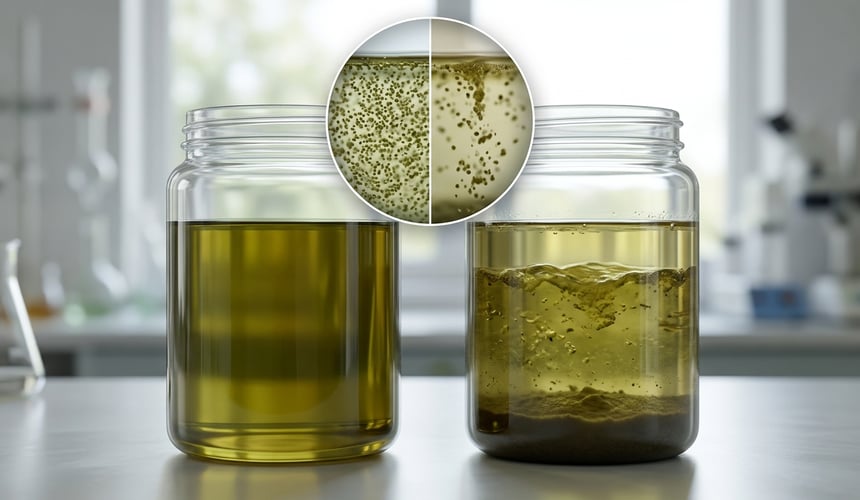
Two liquid fertilizer recipes can use the same ingredient list and still behave completely differently in the tank. One blends into a smooth, uniform liquid; the other thickens within minutes, forms a layer at the bottom or separates after a few days on the shelf. The difference is often not the chemistry on the label but the flow behaviour of the raw materials themselves.
Viscosity is a measure of how strongly a liquid resists flow. A low-viscosity material pours and disperses quickly; a high-viscosity one moves slowly and can trap air or form lumps before it is fully hydrated. In liquid fertilizer and biostimulant production, this property sits at the intersection of mixing ease and long-term physical stability, and it is frequently overlooked during ingredient selection.
Cropenta Insight
Viscosity is not a fixed number on a specification sheet. Many raw materials are shear-thinning: they flow more easily when stirred and thicken again at rest. That means a mixing test in a small beaker at high speed can look perfect while the same blend settles or gels in a storage tank under low-shear conditions. Checking flow behaviour at realistic shear rates is more informative than a single viscosity value.
Why raw material viscosity varies so widely
The range between ingredients is larger than most formulators expect. In a comparison of plant protein raw materials, viscosity spanned from 11 kPa·s for pea protein isolate to 165 kPa·s for potato protein concentrate, a roughly 15-fold difference across the same material class [1]. That variation reflects differences in molecular structure, particle size and how much water the material binds.
Concentration and water content push viscosity further. In a study of protein raw materials, each material behaved as a shear-thinning fluid, and viscosity rose as water concentration fell [2]. The practical consequence is that a raw material delivered at a higher solids level, or one that absorbs water strongly during mixing, can turn a thin blend into a paste without any change in the recipe.
Not all liquid systems behave the same way. Rheological properties of plant-based fluids range from low-viscosity liquids to thick creams depending on composition and processing [3]. For fertilizer and biostimulant formulators, this means viscosity cannot be assumed from the ingredient category alone; it has to be checked for the specific raw material batch.
How viscosity affects the mixing step
During mixing, viscosity controls how quickly a raw material disperses and how much energy the agitator must deliver. A high-viscosity ingredient can form a viscous layer around itself when it first contacts water, slowing hydration and leaving lumps that are hard to break down later. Low-viscosity materials disperse quickly but may also be more prone to foaming or to settling if the final blend is too thin to keep fine particles suspended.
This is where ingredient compatibility and formulation mixing meet. Two raw materials can be chemically compatible and still produce a poor blend if their viscosity profiles differ sharply. One may thicken the continuous phase before the other has dispersed, trapping particles and creating an uneven mixture. The result is not a chemical incompatibility but a physical one, and it often shows up as sedimentation or stratification during storage.
From mixing tank to storage: suspension stability
Once a liquid fertilizer is filled and stored, viscosity takes on a different role. Suspension fertilizers need enough viscosity to keep solid particles from settling under gravity and low-shear pumping conditions, while still flowing well enough to be pumped and applied [4]. A formulation with too little structure may separate; one with too much may become difficult to handle or fail to redisperse.
The tricky part is that these two requirements pull in opposite directions. A blend that is easy to pump at the filling line can be too thin to hold its particles over weeks of storage. A blend thick enough to stay uniform may be slow to mix and harder to move through lines and nozzles. Raw material viscosity is one of the levers that sets where a formulation lands between these extremes.
Shear-thinning behaviour complicates prediction further. A material that is thick at rest may thin dramatically during pumping, then recover its structure in the tank. Whether that recovery is complete, partial or delayed depends on the raw material and on how the blend was mixed. This is one reason direct miscibility at the moment of mixing does not prove long-term stability; the two properties must be assessed separately.
What this means for ingredient selection
Viscosity belongs on the list of raw material characteristics that deserve attention alongside pH, salt content and solubility. A certificate of analysis rarely reports it, so a simple bench check at the intended dilution and a realistic shear rate can reveal more than a specification sheet. Formulators working with protein hydrolysates, seaweed extracts or other colloid-rich raw materials may find this check especially useful, because these ingredients can change the flow behaviour of a blend at relatively low inclusion levels.
A stable formulation is not automatically agronomically effective, and good mixing does not guarantee good storage. Viscosity is a physical property that helps explain and predict handling behaviour, not a measure of nutritional value. Treating it as one part of the compatibility picture, rather than the whole answer, keeps expectations realistic.
The reader can conclude that raw material viscosity is a practical screening factor: it helps explain why similar recipes behave differently, it flags blends that may thicken or separate, and it is best assessed under conditions that resemble the mixing tank and the storage tank rather than a single high-speed laboratory test.
Technical Summary
Raw material viscosity varies widely between ingredients and changes with concentration and shear. It influences how quickly materials disperse during mixing and whether a finished liquid fertilizer holds its particles in suspension or separates in storage. Because many raw materials are shear-thinning, a single viscosity value is a weak predictor; checking flow behaviour at realistic dilution and shear rates gives formulators a more reliable basis for judging ingredient compatibility and formulation stability.
This article was created with the help of AI and reviewed by the Cropenta editorial team. It is general information, not professional advice.
Technical Questions
Is a high-viscosity raw material always a problem in liquid fertilizer blending?
Not necessarily. Some viscosity can help keep fine particles suspended and reduce settling during storage. The difficulty arises when viscosity is uneven across ingredients or too high for the mixing and pumping equipment. The goal is a controlled flow behaviour, not simply the lowest possible viscosity.
Why can a blend that mixes perfectly in the lab separate after a few weeks in storage?
Many raw materials are shear-thinning, so they flow easily under the high shear of a lab mixer and thicken again at rest. Storage involves low-shear conditions, where the same blend may lose structure and allow particles to settle. Mixing ease and long-term suspension stability are different properties and should be tested separately.
What practical check can a formulator use when viscosity data are missing from the specification?
A simple bench test at the intended dilution, stirred at a realistic speed and then left to stand, can reveal whether a raw material thickens, foams or settles. Comparing several batches of the same ingredient also shows how much viscosity varies between deliveries, which matters for keeping a formulation consistent.
Looking for something specific?
Our team is there to help you find the right raw materials and solutions for your formulations