What Encapsulation Can and Cannot Do for Beneficial Microbes
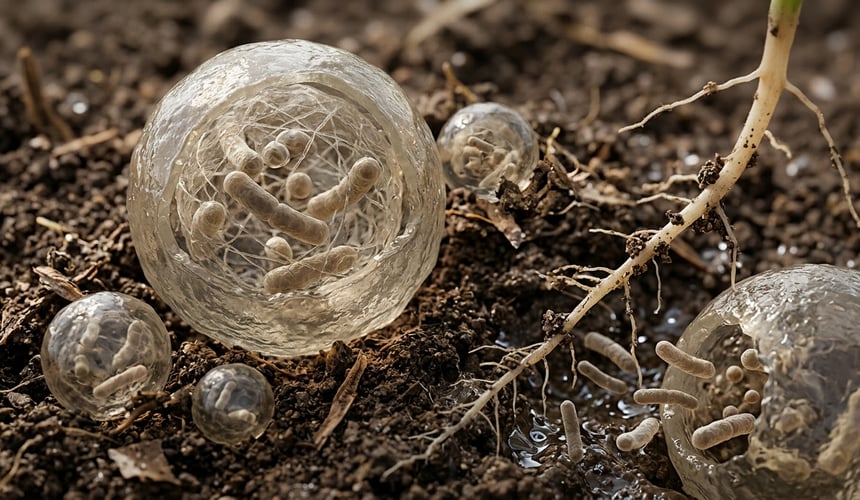
A microbial biostimulant can leave the factory with a high viable count and still perform poorly after application. Ultraviolet radiation, desiccation, temperature swings, extreme pH and competition with the resident soil microbiome all act on the introduced cells within days. Liquid and powder formulations offer limited physical protection. Encapsulation addresses this by embedding microbial cells inside a biodegradable matrix that is intended to slow the loss of viability and release the organisms under conditions closer to those the species encounters in the root zone.[1]
Cropenta Insight
Encapsulation research is easy to misread because viability, activity and field effect are three separate measurements. A high count of surviving cells after encapsulation does not confirm that the organism still performs its intended nutrient-mobilizing or root-associated function, and neither result alone proves a crop benefit. Formulators and advisers evaluating encapsulated inputs should ask which of the three steps a given study actually tested, and under what conditions.
What Encapsulation Actually Protects
The central problem is not microbial fragility in general but specific stressors at specific moments. Cells held in a liquid carrier can remain viable on the shelf, yet they encounter a sharp transition at application. Encapsulation in a biodegradable matrix is reported to extend shelf life and to support vitality during storage and transport, which describes the first protection step rather than field establishment.[1] Once in soil, the matrix may reduce direct exposure to ultraviolet light, slow water loss from the cell and buffer local pH around the released organism. These mechanisms are physically plausible and described in formulation research, but how strongly each one contributes under field conditions varies with matrix composition, soil type and moisture, and the published evidence is uneven.
Which Matrices and Methods Are Used
Polysaccharide polymers such as alginate and carrageenan have long been proposed as carriers for inoculant cells, forming gels that entrap microbes in a hydrated environment and can be shaped into beads or granules.[2] Matrix selection is not neutral: polymer type, crosslinking, drying method and additive choice are studied in relation to encapsulation efficiency and the survival of the enclosed cells, and these effects are reported to differ between microbial groups.[3] Spray drying into polymer matrices offers an alternative route, tested with model plant growth-promoting bacteria, and illustrates that the drying step itself is a stressor that the encapsulation process has to manage.[4] A matrix that protects one organism well may protect another poorly; a property of one strain is not a property of every strain.
Controlled Release and the Rhizosphere
Encapsulation is also a delivery question. A matrix that releases cells gradually near germinating roots places them closer to the exudate-rich zone where colonization is more likely, rather than leaving them exposed in bulk soil. Release depends on matrix degradation, which is driven by moisture, temperature and microbial activity in the soil itself. This creates a genuine limitation: release behavior is strongly site-dependent, and a system tuned to one soil moisture regime may behave differently in another. Competition with the native soil microbiome remains a factor that encapsulation cannot remove.
Where the Evidence Stops
Most encapsulation work reports viability, encapsulation efficiency or survival under controlled conditions. That is step one and part of step two. Sustained activity of the released organism and demonstrated crop benefit in the field are separate evidence steps that are less consistently reported, and some studies report no advantage of encapsulation over conventional formulation depending on the organism and conditions. A high viable count after encapsulation is not the same as effective root colonization, and laboratory or greenhouse results should not be extrapolated directly to commercial field performance. Encapsulation is studied as a way to improve the odds of survival through storage and application; it has not been shown to guarantee establishment or agronomic effect.
Technical Summary
Encapsulation embeds microbial cells in a biodegradable matrix, which is reported to extend shelf life and support viability during storage and application. Polysaccharide carriers such as alginate and carrageenan are widely studied, and matrix selection affects encapsulation efficiency and survival differently across organisms. Protection during storage, activity in soil and demonstrated field effect are separate evidence steps; most studies address the first, and field benefits are not guaranteed.
This article was created with the help of AI and reviewed by the Cropenta editorial team. It is general information, not professional advice.
Technical Questions
Does a high viable count after encapsulation prove the product will work in soil?
No. Viable count measures survival during storage or handling, which is only the first step. The organism must still retain its intended function and establish itself in the root zone, where soil moisture, pH and competition with native microbes all intervene. A high count is necessary for a viable product but does not by itself demonstrate activity or a crop benefit.
Why can one encapsulation matrix work for one microbe and fail for another?
Matrix behavior depends on polymer type, crosslinking and drying method, and different organisms tolerate these process steps differently. Cell wall structure, spore-forming ability and sensitivity to dehydration all vary between species and strains. A result obtained with one organism, or one strain of a species, should not be generalized to others.
What determines how quickly encapsulated cells are released in soil?
Release is driven mainly by degradation of the matrix, which depends on soil moisture, temperature and the activity of resident microorganisms. Because these factors vary between fields and seasons, release behavior is site-dependent. A system tuned to one moisture regime may behave differently elsewhere, which complicates comparisons between trials.
Why is encapsulation research often not comparable between studies?
Studies differ in organism, matrix, encapsulation method, drying conditions and whether measurements are made in storage, in culture or in soil. Some report only viability, others encapsulation efficiency. Without a consistent set of measured endpoints, results cannot be placed on the same scale, and apparent contradictions may simply reflect different test conditions.
Looking for something specific?
Our team is there to help you find the right raw materials and solutions for your formulations