How Different Processing Methods Affect the Oxidative Stability of Liquid Fat Blends
A liquid fat blend can pass incoming checks and still show rising peroxide values after a few weeks in the silo or the coating drum. Feed buyers and mill technicians often see that the same nominal blend behaves differently from one delivery to the next. The processing history of the fat, and how it is handled afterwards, is one of the main reasons.
Cropenta Insight
For buyers of blended fats, the useful distinction is between the composition of a blend and its stability in a finished feed. The recent work on coated extruded dog kibble examined lipid source and kibble matrix together, which means a stability result for one blend in one matrix cannot be transferred to another feed type without further data.[1] Oxidation markers measured in the finished product provide information about a specific blend in a specific feed.
Why some fats oxidise faster than others
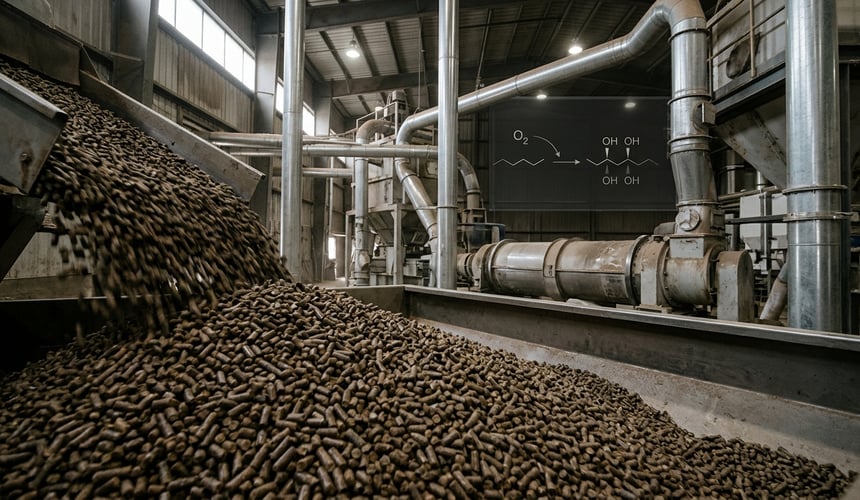
Oxidation is a chemical reaction between unsaturated fatty acids and oxygen. In the fat itself it runs as a chain reaction: a hydrogen atom is removed from a carbon next to a double bond, oxygen attaches, and unstable hydroperoxides form. These primary oxidation products then break down into secondary products such as aldehydes and ketones, which cause the rancid odour and flavour and reduce the quality of the fat.[1]
The number of double bonds in the fatty acid chains is the main structural factor. Each double bond provides a site where the reaction can start, so polyunsaturated fatty acids oxidise faster than saturated ones. Fatty acid composition therefore sets the baseline stability of a blend before any processing takes place.[1]
Free fatty acids, which are released from triglycerides, are a second factor that buyers should track separately. Acid oils and fat by-products usually contain more free fatty acids than refined oils. A rising free fatty acid content is usually a sign that the fat has already been through hydrolysis, which is often linked to moisture and storage history. Phospholipids in lecithin-containing blends form a distinct fraction, with composition depending on the raw material and the degumming or fractionation route, so the three fractions should not be treated as one number.
Processing steps that change the starting point
Heat is the processing factor most often linked to oxidation. Heating a fat accelerates the initial reaction and can increase the formation of primary oxidation products. In practice this matters at deodorising, at blending in heated tanks and at any step where a blend is kept warm for long periods before use.
Mixing and transfer are less visible but still relevant. Pumping, recirculation and open-air mixing introduce oxygen into the fat, and blends that are agitated with air contact often show a higher initial oxidation load than blends handled in closed systems. Metal ions, from tanks, pipes or pump components, can act as catalysts for the decomposition of hydroperoxides, which is one reason why equipment condition and cleaning routines matter for fat quality.
Once a blend is in the feed, the process conditions change again. In extruded products, the fat that is applied as a coating after extrusion sits on the outside of the kibble, where it is directly exposed to air. The study on coated extruded dog kibble was designed to examine these conditions, including lipid source, kibble matrix and antioxidant inclusion, and to measure oxidation and shelf life in that setting.[1]
What the dog kibble study reports
The study on coated extruded dog food addresses how lipid source and kibble matrix relate to oxidative stability and to the loss of n-3 fatty acids in the product.[1] The available summary confirms the design and the variables studied. It does not establish specific numerical outcomes or a ranking of processing steps, so those details should be checked in the full paper before they are used in any formulation decision.
The study is a petfood study. Its findings describe coated dog kibble and cannot be transferred directly to poultry, pig or ruminant feeds, or to a liquid blend sold for separate application. The mechanisms of lipid oxidation are general, but the rate and the outcome depend on the matrix, the fat and the storage conditions.
The role of antioxidants and their limits
Antioxidants are commonly added to fat blends to slow the chain reaction, and the question of whether combinations of antioxidants behave differently from single compounds has been studied in feed matrices. Research on antioxidant blends reports that oxidation products may be associated with reduced nutritional value and with intestinal and hepatic inflammation in animals, which is one reason why oxidation control matters beyond shelf life.[2] That study is a comparative study in feed matrices, and its findings should be read as specific to the materials and conditions tested, not as a general ranking of antioxidant systems.
Research on anhydrous milk fat blended with vegetable oils describes blending as one approach to modifying the fatty acid profile and oxidative stability of a fat. That work concerns food fats, and the transfer of its conclusions to feed blends is an interpretation that still needs testing.[3]
Parameters worth monitoring
- Peroxide value, as a marker of primary oxidation products, measured on receipt and at defined points during storage.
- Anisidine value, which tracks secondary oxidation products that build up as a blend ages.
- Free fatty acid content, which indicates hydrolysis and the quality of acid oils or by-products.
- Time between blending and use, and storage temperature, since heat accelerates both primary and secondary oxidation.
- Air contact during mixing and transfer, and the condition of tanks and pumps that may contribute metal ions.
Limits of the current evidence
The available sources do not provide a validated threshold for when a liquid fat blend becomes unsuitable for a given species. Most of the work reviewed here addresses food fats, petfood or general feed matrices, and the link between oxidation markers and animal performance has not been demonstrated in these sources. Oxidation measurements show the state of the fat, not the feeding value of the finished diet.
Technical Summary
Oxidative stability of a liquid fat blend depends on its fatty acid composition, its free fatty acid content, heat and oxygen exposure during processing, metal contamination and storage conditions. Recent work on coated extruded dog kibble examined lipid source, kibble matrix and antioxidant inclusion. Its findings apply to that petfood setting and should be verified in the full paper before use.
This article was created with the help of AI and reviewed by the Cropenta editorial team. It is general information, not professional advice.
- 1.Lipid source and kibble matrix determine oxidative stability and n-3 fatty acid loss in coated extruded dog food - PMC
- 2.Synergistic Effects of Antioxidant Blends: A Comparative Study on Oxidative Stability of Lipids in Feed Matrices
- 3.Oxidative stability and health-related indices of anhydrous milk fat and vegetable oil blends
Looking for something specific?
Our team is there to help you find the right raw materials and solutions for your formulations