How Does Elemental Sulfur Affect Soil pH in Calcareous Soils?
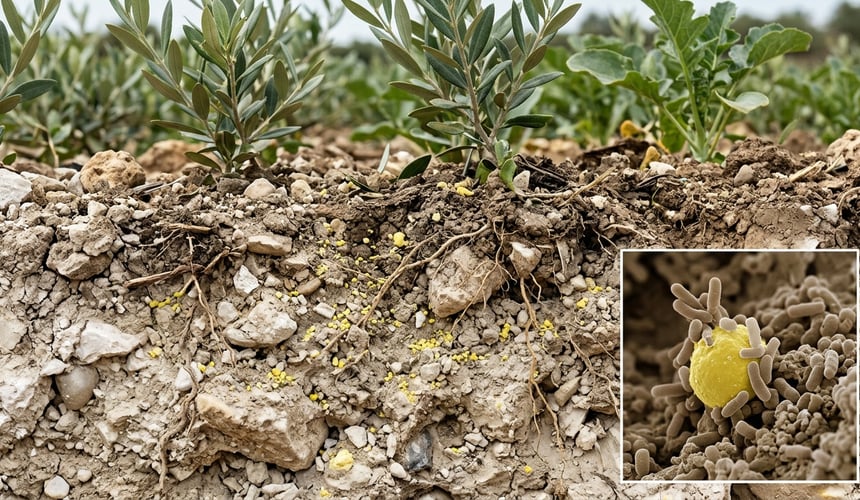
A grower with alkaline soil and a sulfur recommendation often wants to know how far the pH will actually move. In calcareous soils, which contain free calcium carbonate, the answer is usually more limited than the phrase 'sulfur lowers pH' suggests. Several studies indicate that elemental sulfur can be added to lower soil pH and restore the acid-base balance of the soil[1], but the size and speed of that change depend strongly on soil conditions.
Cropenta Insight
Before expecting elemental sulfur to move pH in a calcareous soil, the free carbonate content matters more than the application rate. The oxidation step is slow, and carbonates neutralize the acid as it forms, so a shift may be small or delayed. Elemental sulfur and sulfate should be kept apart when reading trial data, because only elemental sulfur relies on microbial oxidation to release acidity. Results from seedling or laboratory studies should be checked against field soil conditions before they are applied.
Why elemental sulfur is not the same as sulfate
Elemental sulfur is not an acid in itself. Sulfur-oxidizing soil bacteria convert it step by step into sulfate, and this process releases hydrogen ions that lower soil pH. Sulfate supplied directly as a salt does not follow this pathway, so it does not produce the same acidifying effect. Readers comparing product results should keep these two forms apart.
The bottleneck: oxidation speed and lime buffering
Oxidation depends on soil temperature, moisture, aeration, the particle size of the sulfur and the activity of the native sulfur-oxidizing population. Small particles expose more surface and generally oxidize faster. The acid produced then meets calcium carbonate, which reacts with it and neutralizes it. In calcareous soils this buffering capacity can be large enough to offset much of the acidity that sulfur oxidation generates, which is why pH change may be slow, limited or uneven.
Buffering is a recognized constraint in these soils more broadly. A cotton study in semi-arid calcareous and alkaline soils reported that nutrient availability is limited in such conditions, and in that work this was linked to reduced yield and fibre quality[2]. Work on acidifying amendments in calcareous soils has examined phosphorus availability, a nutrient whose uptake is strongly influenced by soil carbonate content[3].
What the seedling study shows and where it stops
A study on elemental sulfur and soil pH measured the effects on two woody species, Saskatoon berry and beaked hazelnut seedlings[1]. This is a useful reference for how sulfur interacts with soil pH and seedling growth, but it does not directly show what happens in a field of calcareous soil under annual crops. Before transferring its pH results to high-carbonate soils, the soil type, incubation or growing conditions and measurement period should be checked in the full paper.
Nutrient availability: a lower pH is not automatically a gain
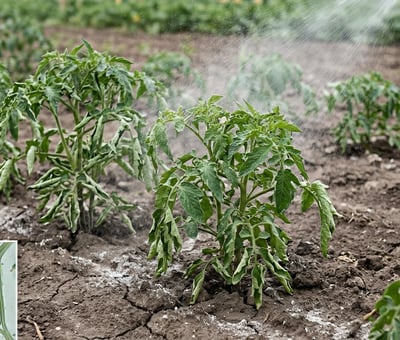
Lowering pH can increase the solubility of some micronutrients, such as iron, manganese and zinc, that become less available in alkaline soils. This is a general soil chemistry principle, but in calcareous soils a modest or slow pH shift may not reach the range where these changes matter. An overly acidic root zone can also create its own constraints. The practical effect depends on the crop, the soil and the starting nutrient status, and should be judged against local soil data.
Technical Summary
Elemental sulfur lowers soil pH only through microbial oxidation to sulfate, and in calcareous soils the free carbonate buffers much of the acid produced. The pH response can therefore be slow, small or uneven. A lower pH does not automatically improve nutrient availability, and the evidence for specific crops and soils remains limited.
This article was created with the help of AI and reviewed by the Cropenta editorial team. It is general information, not professional advice.
Technical Questions
Why does the same amount of elemental sulfur change pH differently across soils?
Oxidation rate and buffering capacity are the main reasons. Soil temperature, moisture, aeration, particle size and the native population of sulfur-oxidizing bacteria all affect how quickly acid forms. Calcium carbonate and other buffers then neutralize that acid, so the pH response can be slow, small or uneven. Measuring carbonate content and pH before application helps set realistic expectations for the change.
Is a lower pH always better for nutrient availability in calcareous soils?
No. Lowering pH can increase the solubility of some micronutrients that become less available in alkaline soils, but it is not automatically an improvement for the crop. Phosphorus availability in calcareous soils follows its own pattern, and an overly acidic root zone can create other constraints. The benefit depends on the crop, the soil and the starting nutrient status, and should be checked against local data.
- 1.Effects of Elemental Sulfur on Soil pH and Growth of Saskatoon Berry (Amelanchier alnifolia) and Beaked Hazelnut (Corylus cornuta) Seedlings
- 2.Nutrient management in calcareous soils under semi-arid environments: effects on cotton productivity and soil health
- 3.Effect of acidifying amendments on P availability in calcareous soils
Looking for something specific?
Our team is there to help you find the right raw materials and solutions for your formulations