How Heat Treatment Shapes Intestinal Digestion of Protected Soy Protein
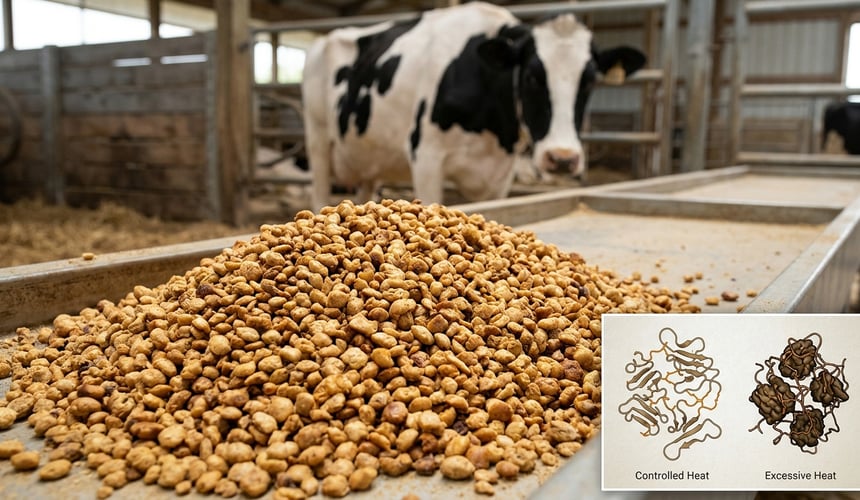
A protected soy protein can look excellent on paper and still deliver little to the dairy cow. The number that decides how much protein a dairy cow actually absorbs is not the share that escapes the rumen, but the share of that escaping protein which the small intestine can still break down. Both are set by the same heat treatment, and they rarely move in the same direction. In practice, a nutritionist comparing two batches of treated soybean meal may see nearly identical crude protein and similar calculated rumen-undegradable protein (RUP) values, yet very different responses in the ration. The difference usually sits in the processing history: how hot the protein got, how long it stayed hot and how much moisture was present.
Cropenta Insight
Reactive lysine is the practical early-warning indicator in protected soy proteins, but it is only meaningful when read against processing history. A falling reactive lysine alongside a rising calculated RUP points to over-processing rather than improved protection. For formulators, the strategic implication is that specification sheets for this ingredient category should carry both figures together with the measurement method, because the analytical signal appears well before animal performance diverges.
Why Heating Soy Protein Changes Where It Is Digested
Untreated soybean meal is fermented quickly in the rumen. Its protein is soluble and readily attacked by micro-organisms, so most of it never reaches the small intestine. Heat changes that by unfolding the protein and, when reducing sugars are present, driving the Maillard reaction: reducing sugars such as glucose, fructose or xylose react with free amino groups, notably the epsilon-amino group of lysine, via a Schiff base and Amadori products towards melanoidins. The result is a protein matrix that rumen micro-organisms cannot easily break down [1].
The same chemistry continues in the small intestine. Up to a point, the Maillard products still release amino acids when the abomasum acidifies the digesta and pepsin, trypsin and chymotrypsin act on it. Beyond that point, the bonds become indigestible. So heat treatment is a trade-off: enough reaction to protect protein from rumen degradation, not so much that the intestine can no longer use it. Protein protection must therefore always be judged together with intestinal digestibility, because over-processing lowers both degradation and digestibility.
Temperature, Time and Moisture: Three Levers, One Trade-Off
Heat treatment parameters interact. Temperature sets the reaction rate, time sets how far it proceeds, and moisture governs how evenly heat penetrates the meal. Mild conditions, such as 100 °C for 30 minutes, have been reported to raise in-vitro protein digestibility of soy protein compared with untreated soy protein, largely by inactivating trypsin inhibitors and unfolding the protein structure [1]. Those are the conditions under which protection and digestion can both improve.
Push temperature or duration further and the balance tips. Lysine is the most vulnerable amino acid because its free epsilon-amino group is the main entry point for the reaction. Total lysine can stay unchanged in a laboratory analysis while reactive lysine falls sharply, which is the clearest early signal that intestinal digestion has started to decline [1]. Moisture matters here too: uneven moisture distribution means some particles are over-reacted while others are barely protected, so a single average value hides real variation in the batch.
For feed manufacturers this shows up as batch-to-batch variation that is not visible in crude protein. Two loads of treated soy protein can analyse the same on protein while behaving differently in the ration, which is a specification problem rather than a formulation problem.
Reading RUP Values Correctly
RUP is calculated from measured degradation characteristics at an assumed passage rate (Kp), not measured as such. Degradation kinetics come from in-situ nylon-bag incubation in rumen-fistulated cows: the soluble fraction, the washable but insoluble fraction, the potentially degradable fraction and its fractional degradation rate per hour. RUP follows from the potentially degradable fraction, the degradation rate and Kp, which is estimated from intake and production rather than measured in the bag. Two RUP figures are only comparable at the same Kp [2].
This is where many comparisons go wrong. A protected protein may show a high RUP percentage because the reaction has gone far, while the intestinal digestibility of that undegraded protein is modest. A high RUP percentage on its own says nothing about how much usable protein reaches the dairy cow, so RUP should be read together with intestinal digestibility, the assumed passage rate and the protein valuation used. Intestinal digestibility itself is measured in cows fitted with duodenal cannulas using the mobile nylon bag technique, and is reported as a rounded percentage.
In-vitro tests and protected proteins
Enzymatic and fractionation tests run in the laboratory correlate poorly with in-situ measurement in rumen-fistulated cows, particularly for heat- and Maillard-protected proteins, where they tend to overstate rumen protection [2]. A declared value based on an in-vitro method is therefore not comparable with an in-situ value, and mixing the two in one comparison table produces conclusions that do not hold up in the ration.
From Measured Values to Metabolizable Protein
The step from measurement to formulation is a calculation, not an animal result. Systems such as DVE/OEB, nXP/RNB, INRA PDI and CNCPS metabolisable protein convert degradation and digestibility data into values a formulator can use, and they differ in how they treat both [3]. Because these systems assume a passage rate and a set of conversion factors, the same ingredient can produce different formulation values in different systems.
Microbial protein synthesis sets the ceiling on how much extra bypass protein is worth. Rumen-degradable protein feeds microbial growth together with fermentable energy, and microbial protein is a major amino acid source for the dairy cow. When a ration already supplies more rumen-degradable protein than the microbes can use, additional unprotected meal adds little; when the ration needs more digestible bypass protein, the intestinal digestibility of that bypass fraction becomes the deciding factor.
Composition measurements alone cannot settle this. Amino acid digestibility measured in animals is the only indicator that shows what the animal can use; composition and heat indicators such as reactive lysine are useful screening tools, not substitutes.
What This Means When Comparing Protected Soy Proteins
Ask for the passage rate behind any RUP figure, the method used to measure degradation and the measured intestinal digestibility of the undegraded fraction. Ask whether the digestibility value comes from in-vivo work in cannulated cows or from a laboratory estimate, and ask for reactive lysine alongside total lysine. Where the processing history is not documented, the protection level cannot be interpreted with confidence.
Products like Bypass Soy Protein MP, offered by Cropenta, are examples of protected soy proteins derived from non-GMO soybean meal and treated molasses, where the protein is bound to selected C5 and C6 reducing sugars via a Maillard reaction, without added formaldehyde. As with any protected protein, the two figures belong together.
Technical Summary
Heat treatment protects soy protein from rumen degradation through protein unfolding and Maillard reactions, but the same reactions reduce intestinal digestion when temperature, time or moisture go too far. Reactive lysine falls before total lysine does. RUP is calculated at an assumed passage rate and must be read with measured intestinal digestibility and a defined protein valuation.
It is general information, not professional advice.
This article was created with the help of AI and reviewed by the Cropenta editorial team. It is general information, not professional advice.
Technical Questions
Why do two protected soy proteins with the same crude protein provide different nutritional value in the ration?
Crude protein says nothing about how much protein escapes the rumen or how much of that escape the intestine digests. Processing history, especially temperature, duration and moisture, sets both. Two batches can analyse identically on protein while differing in reactive lysine and in measured intestinal digestibility of the undegraded fraction.
How can heat-treatment history change the way a formulator interprets protein quality measurements?
A declared RUP value depends on the assumed passage rate and on the method used to measure degradation. For heat- and Maillard-protected proteins, in-vitro tests tend to overstate rumen protection compared with in-situ measurement in fistulated cows. Without the processing history and the method, a single RUP percentage cannot be placed in a ration.
Which analytical indicators help flag over-processing of a heat-treated soy protein?
Reactive lysine is the most direct indicator, because the Maillard reaction binds the epsilon-amino group of lysine first. Total lysine may remain unchanged while reactive lysine drops. A falling reactive lysine alongside an unusually high calculated RUP suggests the reaction has gone past the point where intestinal digestion is preserved.
Why are RUP values from different sources not directly comparable?
RUP is calculated from measured degradation characteristics at an assumed passage rate, estimated from intake and production rather than measured in the bag. Change the assumed passage rate and the calculated RUP changes. Comparison is only valid when both figures use the same passage rate, the same measurement method and the same protein valuation system.
- 1.Current insights into heat treatment for improving functionalities of soy protein
- 2.Soy protein concentrate replacing animal protein supplements and its impact on intestinal health and growth performance of nursery pigs
- 3.Efficacy of soy protein concentrate replacing animal protein supplements in mucosa-associated microbiota, intestinal health, and growth performance of nursery pigs
Looking for something specific?
Our team is there to help you find the right raw materials and solutions for your formulations