Forage Quality Drift and the Real Rumen-Protected Soy Protein Response in Dairy Cows
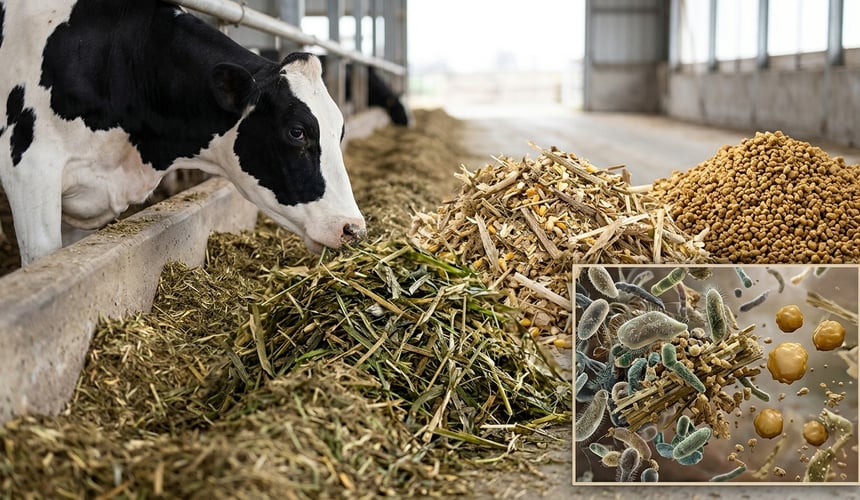
A ration change that looks minor on paper can shift the return on a bypass protein by more than the ingredient itself ever varies. Ensiled grass sampled one week at 30% dry matter and three weeks later at 24% dry matter is not the same feed, even when it comes from the same clamp. The crude protein fraction moves, the digestible fiber fraction moves, and the rate at which the whole ration passes through the rumen moves with it. Feed a consistent rumen-protected soy protein into that moving background and the milk production response in a trial becomes a measure of the forage as much as of the protein.
Cropenta Insight
Forage that is analysed and then assumed stable for months is a common source of error in ration evaluation. Dry matter, crude protein and fiber digestibility shift with harvest conditions, wilting and ensiling, and each of these changes the rumen environment in which a protected protein is assessed. Recording actual analysed values per batch is more informative than relying on book values or on the ingredient specification alone.
What Rumen-Protected Soy Protein Is Really Delivering
Rumen-protected soy protein is soy protein treated so that less of it is broken down by rumen micro-organisms and more of it reaches the small intestine. The protection route matters: heat, controlled Maillard reactions with reducing sugars, lignosulfonate treatment and, historically, formaldehyde have all been used to hold protein against rumen degradation. The proportion that escapes is expressed as rumen-undegradable protein (RUP), and RUP is calculated from measured degradation characteristics at an assumed passage rate; values are only comparable between ingredients at the same passage rate.
An RUP figure on its own says nothing about what the cow can use. The protein that escapes the rumen still has to be digested in the small intestine, and intestinal digestibility is measured separately, for example with the mobile nylon bag technique in cows fitted with duodenal cannulas. A high RUP with low intestinal digestibility delivers little usable protein. Over-processing illustrates the trap: an excessive Maillard reaction can bind lysine into melanoidins, so total lysine stays unchanged while reactive lysine falls and digestibility drops. Protection must therefore always be read together with intestinal digestibility and the protein valuation, not as a single percentage.
Where Inconsistent Forage Enters the Calculation
The protein valuation systems used in practice, including DVE/OEB, nXP/RNB, INRA PDI and CNCPS metabolisable protein, translate measured degradation and digestibility into formulation values. These are calculations, not animal results, and they depend on the passage rate assumed for the ration. That is the hinge on which forage quality acts.
Forage dry matter content affects intake and the rate at which feed leaves the rumen. Wetter silage with lower dry matter and higher organic acid load tends to move differently through the rumen than a well-wilted crop, and the assumed Kp in a formulation is intended to capture exactly that. When the actual passage rate in the cow differs from the assumed one, the effective degradation of both the forage protein and the protected ingredient shifts, and the predicted metabolisable protein supply no longer matches what the animal receives.
Forage crude protein content sets how much rumen-degradable protein (RDP) is available for microbial growth. Rumen micro-organisms build protein from degradable protein, ammonia and fermentable energy, and microbial protein is a major amino acid source for the cow. A high-protein legume silage may already cover the RDP requirement, so the marginal value of extra bypass protein declines. Conversely, a low-protein grass silage or a cereal-based forage can leave RDP short, and here protected protein takes on a different role. The same product sits in two very different ration contexts.
Fiber digestibility connects the third variable. Digestible fiber drives rumen fermentation and microbial protein synthesis, and lower fiber digestibility slows fermentation and reduces microbial yield. Trials that look like they are testing a protein are often, in practice, comparing the amount of fermentable energy available to the microbes. This is why meta-analyses combining trials with rumen-protected amino acids and lower-protein diets can report effects such as reduced ruminal ammonia and a shift in nitrogen utilisation, while individual farm trials with inconsistent silage may show no milk response at all [1].
Why Two Trials With the Same Product Disagree
The measurement gap between methods adds to the confusion. In-vitro degradation tests, including enzymatic and fractionation methods, correlate poorly with in-situ measurements in rumen-fistulated cows, and for heat- and Maillard-protected proteins they tend to overstate rumen protection. Declared RUP values based on in-vitro methods are not comparable with in-situ values, and mixing them in a trial discussion can make the ingredient appear to vary when only the analytical basis changed.
Forage sampling practice matters too. A single harvest analysis that never gets repeated cannot show drift. Archival work on forage quality consistently shows that digestible dry matter tracks acid detergent fiber inversely; the higher the ADF, the lower the digestibility [2]. When ADF rises in a later cut without a fresh analysis, the ration is reformulated against a feed that no longer exists. Soybean meal itself illustrates how much ruminal degradability can vary with treatment: processing and drying method change the in-vitro dry matter and crude protein degradation of the same raw material [3]. Whether or not a protection treatment is applied, the starting material is not a fixed quantity.
Ration context can also mask an effect in a feeding trial. Protein supplementation studies that include a rumen modifier show that intake, apparent digestion and ruminal parameters respond to interactions between supplements, not to a single ingredient [4]. A protected protein evaluated inside such a system cannot be isolated cleanly, especially when forage characteristics differ between the control and treatment groups. Where a trial reports no significant milk response, that absence may reflect insufficient RDP, mismatched fermentable energy at the time of feeding, or forage that was simply more digestible in the control group. Attributing the result to the protected protein alone would be inconsistent with the design.
Reading a Trial Through the Forage Lens
When comparing trial results, it helps to check what the forage analysis was, when it was taken and whether it was repeated during the trial. Passage rate assumptions, RDP balance and fermentable energy supply should accompany any RUP and intestinal digestibility figure. In-situ work characterises an ingredient; it is not a feeding trial, so it cannot support a milk production claim on its own. Separating the experimental characterisation from the nutritional valuation keeps the two types of evidence in their proper places.
The practical takeaway is that keeping a protected protein constant while forage moves is not a controlled comparison. To judge whether the ingredient is contributing, keep the analyzed forage values, the RDP balance and the passage rate assumption visible alongside the protected protein specification. The single most informative step for most dairy operations is to sample forage regularly and reconcile the result with the ration actually being fed, rather than assuming that a specification sheet or a book value still applies.
Technical Summary
Rumen-protected soy protein supplies intestinal digestible amino acids only when the rumen environment supports it. Forage dry matter, crude protein and fiber digestibility alter passage rate, RDP balance and fermentable energy for microbial protein. Inconsistent forage therefore changes the metabolisable protein the cow receives. RUP must be read with intestinal digestibility, passage rate and the protein valuation, and recent forage analyses should accompany any trial comparison.
This article was created with the help of AI and reviewed by the Cropenta editorial team. It is general information, not professional advice.
Technical Questions
Why should RUP values only be compared at the same passage rate?
Rumen-undegradable protein is not a fixed laboratory number. It is calculated from the measured degradation fractions and rate at an assumed fractional passage rate, Kp. Because Kp depends on intake and production level, the same ingredient can carry a different RUP value in two rations. Comparing figures from different assumed passage rates gives a misleading impression of ingredient differences.
How can a single forage analysis overstate the stability of a silage-based ration?
Forage dry matter, crude protein and fiber digestibility shift with wilting, harvest timing, fermentation and clamp management. A single analysis taken shortly after ensiling describes that moment, not the months of feeding that follow. Without repeated sampling, the ration may be formulated against a forage that has since changed, hiding the real cause of a variable response.
What is the significance of intestinal digestibility alongside a high RUP figure?
Escape from the rumen only moves protein to the small intestine. The share of that undegraded protein actually digested there determines how much usable amino acid reaches the cow. Excessive heat or Maillard binding can push RUP up while lowering intestinal digestibility and reactive lysine, so protection and digestibility must be evaluated together rather than as separate specifications.
Why can in-vitro degradation results differ from in-situ measurements for protected proteins?
In-vitro enzymatic and fractionation tests correlate poorly with in-situ incubation in rumen-fistulated cows, particularly for heat- and Maillard-treated proteins. The in-vitro methods tend to overstate rumen protection, so declared values based on them are not directly comparable with in-situ results. Mixing the two analytical bases in a comparison can suggest variability that is methodological.
How does fiber digestibility interact with protected protein in a dairy ration?
Digestible fiber supplies the fermentable energy rumen microbes need to build microbial protein from degradable protein and ammonia. When fiber digestibility falls, fermentation and microbial protein yield tend to fall with it, and the marginal value of additional bypass protein changes. The protein and the fiber fraction cannot be evaluated as independent inputs.
- 1.The use of rumen-protected amino acids and fibrous by-products can reduce the environmental impact of dairy production: a meta-analysis
- 2.Forage Quality
- 3.Effect of tannins and drying methods on in vitro dry matter and crude protein degradability of soybean meal
- 4.Effects of monensin and protein supplementation on intake, apparent digestion and ruminal parameters in cattle
Looking for something specific?
Our team is there to help you find the right raw materials and solutions for your formulations