Why Fat Digestion Improves as Young Animals Grow and What It Means for Feed
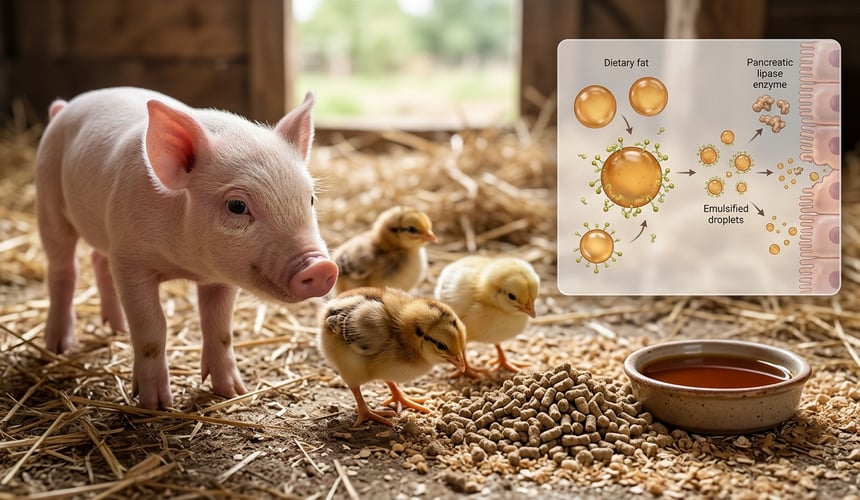
Anyone who has formulated starter diets for piglets or chicks has seen the same pattern: a fat source that performs well in a grower diet can deliver less than expected in the first weeks of life. The difference is not the fat itself but the digestive capacity of the animal receiving it. Young monogastric animals are born with an immature lipid digestion system, and their ability to break down and absorb dietary fat develops gradually after birth. Understanding which parts of that system mature, and when, helps formulators decide how much fat to include, which fat sources to use and where lecithin fits into the energy supply.
Cropenta Insight
Fat digestibility in young animals is limited less by the fat source than by the animal's own enzyme and bile output. Formulation decisions that look only at the gross energy or fatty acid profile of a fat can miss this point. Matching fat type and emulsifier use to the developmental stage of the gut is a more reliable way to interpret energy values in starter feeds.
What limits fat digestion in the newborn animal
Dietary fat arrives in the small intestine mostly as triglycerides, three fatty acids esterified to a glycerol backbone. Before these can be absorbed, they must be emulsified into small droplets, hydrolysed by pancreatic lipase and packaged into micelles that carry the fatty acids to the intestinal wall. In young piglets and chicks, each of these steps is constrained by the immature digestive system. Pancreatic lipase output is low at birth and rises with age, and bile salt synthesis and recycling are also limited in the first weeks. The result is that young animals digest fat less completely than older animals on the same diet, and the gap is widest for fat sources with a high proportion of saturated fatty acids.
Fatty acid composition matters here because saturated fatty acids have higher melting points and depend more heavily on efficient emulsification and micelle formation. The extent to which a young animal digests a given fat is associated with its emulsification and hydrolysis capacity, and this association is most pronounced when the animal's own bile and lipase capacity is still developing. A formulator comparing two fat sources on paper may see similar energy values, but the young animal cannot always access that energy to the same degree.
How lipase and bile salt production change with age
The developmental change is gradual and species-specific. In piglets, pancreatic lipase activity and bile salt production increase over the first weeks after birth, and research indicates that fat digestibility rises accordingly. Chicks show a similar pattern, with fat utilisation changing as the digestive tract matures. The practical consequence is that the same fat source can have a different effective energy value at different ages. A fat blend that is fully adequate in a grower diet may be underused in a prestarter diet, not because the fat is poor but because the animal cannot digest it efficiently yet.
This is where the distinction between gross energy, digestible energy and metabolisable energy becomes relevant. Gross energy measures combustion and says nothing about how much the animal can actually capture. Digestible energy subtracts faecal losses, and metabolisable energy further subtracts urinary and gas losses. In young animals, the gap between gross energy and digestible energy for fat is larger than in older animals, and that gap is what formulation needs to account for. Comparing fats within one energy system, and preferably within one age group, avoids misleading conclusions.
Fat source, fatty acid profile and lecithin
Lecithin is not a single substance. It is a mixture of phospholipids, glycolipids, triglycerides and other components that varies with raw material (soy, rapeseed, sunflower) and processing. Phospholipids are amphiphilic, meaning they have both water-loving and fat-loving regions, and this gives lecithin emulsifying properties. In a young animal with limited bile salt output, that emulsifying action can help disperse fat into smaller droplets and improve the conditions for lipase to work. An emulsifying property improves the conditions for digestion, but it does not by itself prove higher fat digestibility in a given diet. That has to be measured, not assumed from the emulsifier label.
Lecithin also supplies fatty acids and energy, so it can be treated as a nutritional fat raw material rather than only as an additive. The three uses are distinct: lecithin as a separate emulsifying additive, lecithin as a component of a compound fat raw material, and lecithin-oil blends as an alternative to conventional fat sources such as soybean oil. Each use has different implications for energy value, fatty acid composition and processing behaviour. A lecithin-oil blend may be economically interesting compared with soybean oil, but lower price is not the same as higher nutritional value, and price claims require current market data.
What this means for starter feed formulation
For young animals, the practical lesson is to match fat supplementation to digestive capacity rather than to push maximum fat inclusion from day one. Fat sources with emulsifying properties can help where bile salt output is still low, and research suggests that the degree of unsaturation is among the factors associated with how completely a young piglet or chick digests a given fat. As the animal matures and its own lipase and bile production increase, the formulation can shift toward higher fat inclusion and a broader range of fat sources, including more saturated options that are cheaper per unit of energy.
Operationally, fat blending and liquid application also matter. Fat blends with high free fatty acid content or poor oxidative stability can create storage and handling problems in the mill, and more unsaturated fats are more prone to oxidation. Antioxidants and good storage practice protect the fat before it reaches the animal. In the mixer and the pellet die, fat addition affects mash texture and pellet quality, so the choice of fat source is not only a nutrition decision but also a processing one. A fat that is easy to handle and stable in storage may be preferable even when its fatty acid profile is not the most unsaturated, provided the energy value and digestibility are adequate for the target age group.
Where the evidence stops
The age-related rise in fat digestibility is well documented in piglets and poultry, but the exact rate of maturation differs between species, genotypes and rearing conditions. Lecithin's emulsifying properties are established, but the link from emulsification to improved digestibility in a specific diet requires diet-specific evidence. Formulators should treat emulsifier claims with the same scrutiny as energy claims: check the fat source, the age of the animal, the control diet and the measured outcome. A digestibility result in one species or age group does not automatically transfer to another.
Technical Summary
Young piglets and chicks have limited pancreatic lipase and bile salt output, so fat digestibility changes with age and is lower for fats rich in saturated fatty acids than for more unsaturated oils. Formulation should match fat source and emulsifier use to developmental stage, compare fats within one energy system, and treat emulsifying properties as a condition for digestion rather than proof of higher digestibility.
This article was created with the help of AI and reviewed by the Cropenta editorial team. It is general information, not professional advice.
Technical Questions
Why does the same fat source give a lower energy value in a prestarter diet than in a grower diet?
The fat itself has not changed, but the young animal's pancreatic lipase and bile salt output are still developing. Less fat is emulsified and hydrolysed, so more passes through undigested. The gap between gross energy and digestible energy is therefore wider in young animals, and the effective energy value of the same fat is lower.
Does an emulsifier guarantee better fat digestibility in piglets?
No. Emulsifying properties improve the conditions for lipase to act, but they do not prove higher fat digestibility in a specific diet. The outcome depends on the fat source, the age of the animal, the bile salt status and the rest of the diet. Emulsifier claims should be checked against measured digestibility data for the relevant species and age group.
How should a formulator compare a lecithin-oil blend with soybean oil?
Compare them within one energy system and one age group, and look at fatty acid composition, free fatty acid content and oxidative stability, not only at price. A blend may be economically interesting, but lower price is not the same as higher nutritional value. Digestibility and storage behaviour should be assessed for the target species and stage.
Which processing factors affect fat quality before it reaches the animal?
Unsaturation, free fatty acid content, trace metals and storage conditions all reduce oxidative stability. Fats with high peroxide or anisidine values can deteriorate in the mill and in the feed. Antioxidants and controlled storage help preserve quality. In the mixer and pellet die, fat addition also affects mash texture and pellet quality, so handling behaviour belongs in the selection decision.
Looking for something specific?
Our team is there to help you find the right raw materials and solutions for your formulations