How Does Silicon Change Gene Expression During Drought and Heat Stress?
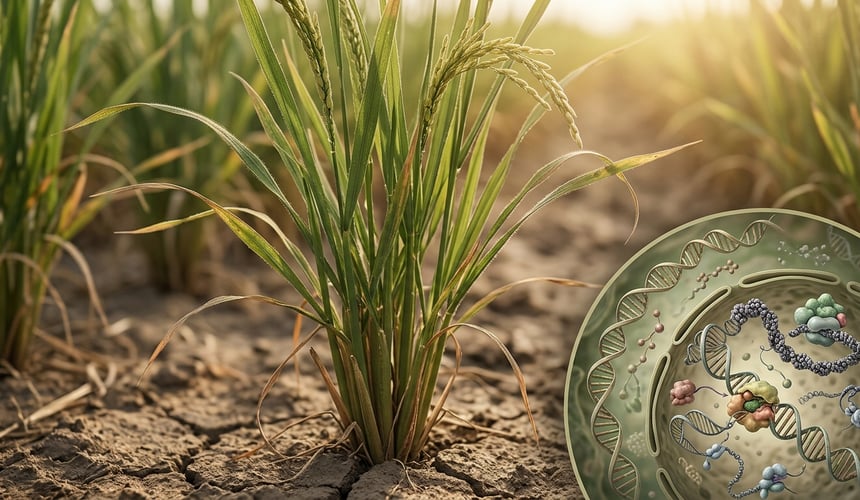
Drought and heat stress rarely announce themselves in a single way. A crop may close its stomata, accumulate osmolytes, activate antioxidant enzymes and adjust hormone balance, all within hours of a stress event. Silicon is usually discussed in this context as a structural element, deposited in cell walls and leaf epidermis. That view is incomplete. Over the past decade, molecular studies have proposed that silicon may also be associated with altered expression of stress-related genes, including genes involved in water relations, antioxidant metabolism and hormone signalling, although the evidence base remains largely at the level of proposed mechanisms rather than confirmed field outcomes.[1]
Cropenta Insight
A practical distinction matters when interpreting this research. Silicon uptake capacity differs widely between crops, and observations from rice, a high accumulator, are not automatically transferable to wheat, tomato or soybean. The genes reported to respond to silicon under drought or heat stress in these studies appear species-specific and condition-dependent. For advisers and growers, the useful question is not whether silicon alters gene expression in general, but which genes have been reported to respond in the crop at hand, under which stress intensity and at what silicon status.[1, 2]
What Silicon Does Beyond the Physical Barrier
Silicon is taken up by roots as monosilicic acid, Si(OH)₄, through specific transporters. In rice, the Lsi1 channel and Lsi2 efflux transporter move silicic acid from soil solution into root cells and then into the xylem. Once deposited as amorphous silica in cell walls and intercellular spaces, silicon can reduce transpiration and improve leaf erectness. These physical effects are well documented. The genetic layer is more recent: in several studies, silicon application has been proposed to be associated with changes in the expression of genes encoding aquaporins, antioxidant enzymes such as superoxide dismutase and catalase, and enzymes of the ascorbate-glutathione cycle, though these remain proposed mechanisms rather than independently confirmed outcomes.[1]
The Manivannan 2017 review collated evidence that silicon may be associated with regulation of physiological, biochemical and antioxidant metabolism under abiotic stress. The authors reported that silicon treatment was associated with upregulation of genes related to reactive oxygen species scavenging and downregulation of genes linked to stress-induced senescence in several species, presented as proposed mechanisms.
Signalling Pathways and Transcription Factors
How might silicon signal to the nucleus? Current evidence points to several proposed routes. Silicon may modulate abscisic acid (ABA) signalling, potentially influencing stomatal closure under water deficit. In one transcriptomic study on drought-stressed rice, silicon application was associated with altered expression of ABA-responsive transcription factors and heat shock proteins, suggesting that silicon may prime parts of the stress-response machinery, though this remains a proposed mechanism.[3] A 2025 study on salt-stressed rice reported that silicon nutrition may be associated with intracellular signal transduction pathways, including calcium-dependent signalling and mitogen-activated protein kinase cascades, at the level of proposed mechanism.[4]
These findings do not mean silicon directly switches genes on or off. More likely, silicon alters the cellular environment, for example by reducing oxidative load or modifying cell wall properties, which in turn changes the signals that reach transcription factors. The distinction matters: silicon is not a hormone or a transcription factor itself.
Contradictory Findings and Limitations
A critical review by Coskun et al. (2019) challenged the idea that silicon widely alters gene expression. In their analysis, silicon supplementation had essentially no effect on gene expression in rice, with only one of approximately 9,000 genes significantly altered.[2] This does not erase the positive reports, but it emphasises that silicon-driven gene regulation is not universal and may depend on stress presence, dose and timing. Where drought or heat stress is absent, silicon may have little transcriptional effect. Where stress is severe, silicon may moderate the response rather than amplify it.
For professionals, the practical implication is to treat silicon as a conditional modulator of stress physiology, not a guaranteed switch. Crop species, silicon uptake capacity and stress conditions all shape whether gene expression changes appear and whether they translate into measurable agronomic benefit.
Technical Summary
Silicon may influence drought and heat responses partly through gene regulation, but the evidence remains at the level of proposed mechanisms. Studies have linked silicon to altered expression of aquaporins, antioxidant enzymes, ABA-related transcription factors and heat shock proteins under stress. However, effects are species-specific and condition-dependent, and a critical review found minimal transcriptional change in unstressed rice. Silicon is best viewed as a conditional modulator, not a universal gene switch.[1, 2, 3, 4]
This article was created with the help of AI and reviewed by the Cropenta editorial team. It is general information, not professional advice.
Technical Questions
Does silicon change gene expression in all crops?
Silicon uptake capacity varies widely, and reported gene expression changes depend on species, stress type and duration. Observations from rice, a high accumulator, are often different from those in low-accumulating crops. A critical review found minimal gene expression changes in unstressed rice, indicating that any effects on transcription are conditional rather than universal.
Which genes have been most consistently linked to silicon under drought stress?
Genes encoding antioxidant enzymes such as superoxide dismutase and catalase, aquaporins, and some ABA-responsive transcription factors appear in multiple studies. However, the specific gene sets differ by crop and experimental conditions, and no single universal silicon-responsive gene has been confirmed across species. These remain proposed associations.
Can silicon gene regulation be separated from its physical effects?
The two overlap. Silicon deposition in cell walls reduces transpiration and oxidative stress, which can indirectly alter gene expression. Some studies propose that silicon also activates signalling pathways, such as calcium-dependent cascades, but these are difficult to isolate from physical protection. Current evidence supports both direct and indirect proposed mechanisms.
Why do some studies find no effect of silicon on gene expression?
Field and greenhouse conditions, silicon dose, timing, stress presence and plant genotype all influence results. When stress is absent or mild, silicon may have little transcriptional effect. When stress is severe, silicon may moderate gene expression rather than amplify it, so a null result does not invalidate positive findings from stressed systems.
- 1.Silicon Regulates Potential Genes Involved in Major Physiological Processes in Plants to Combat Abiotic Stress
- 2.The controversies of silicon's role in plant biology
- 3.Transcriptomic and metabolomic reveals silicon enhances adaptation of rice to drought stress
- 4.Mechanism of silicon nutrition sensing in salt-stressed rice plants
Looking for something specific?
Our team is there to help you find the right raw materials and solutions for your formulations