Heat-treated rapeseed meal as a rumen bypass protein source for ruminants
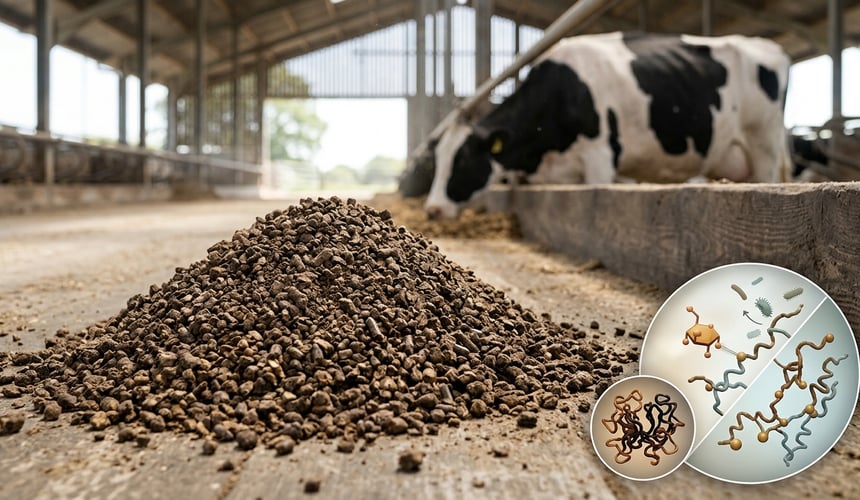
A rumen-fistulated cow is not a simple protein digester. Everything she eats first passes through a fermentation vat where micro-organisms break down protein to ammonia and rebuild it into microbial protein. Some of that microbial protein is valuable, but the amount is limited by fermentable energy, not by how much protein the ration contains. Any protein that escapes fermentation intact reaches the abomasum and small intestine, where acid and enzymes can release amino acids that the cow actually absorbs. That escape fraction is what nutritionists call rumen-undegradable protein (RUP), or bypass protein.
Rapeseed meal is a widely used protein source in dairy and beef rations, but in its conventional form a large share of its protein is fermented in the rumen. Heat treatment changes that balance. The question is not simply whether heat-treated rapeseed meal has more bypass protein, but what kind of bypass protein it delivers and whether the cow can still digest it.
Cropenta Insight
Rapeseed meal sits in the same commercial category as other vegetable protein concentrates that feed mills buy on protein content, fibre and processing history. Those three variables decide how a batch behaves in the rumen. A specification sheet rarely states degradation rate or intestinal digestibility, yet those are the values that determine whether the ingredient contributes usable amino acids or mostly rumen ammonia.
What Heat Treatment Actually Changes in the Protein
Protein protection is a processing decision, not an ingredient property that appears by itself. When rapeseed meal is heated in the presence of reducing sugars such as glucose, fructose or xylose, the free aldehyde group of the sugar reacts with free amino groups, notably the epsilon-amino group of lysine. The reaction proceeds through a Schiff base and Amadori products towards melanoidins, the brown pigments associated with the Maillard reaction. In a controlled form, this chemistry makes the protein less accessible to rumen micro-organisms while the acid environment of the abomasum and the enzymes of the small intestine still release amino acids.
The same reaction, pushed too far, works against the animal. Lysine with a free epsilon-amino group, so-called reactive lysine, becomes bound and unavailable. Total lysine in a laboratory analysis can stay almost unchanged while reactive lysine falls, and intestinal digestibility declines with it. That is why heat treatment has an optimum rather than a direction: under-processed meal ferments in the rumen, over-processed meal passes through the rumen but resists digestion further down.
RDP and RUP: Why the Balance Matters More Than the Percentage
Rumen-degradable protein (RDP) supplies the ammonia and peptides that rumen micro-organisms need to build microbial protein. Rumen-undegradable protein escapes that fermentation and is digested in the small intestine. A ration needs both fractions, and the correct split depends on the energy supply, the production level and the other ingredients in the mix.
Heat treatment lowers the degradable fraction of rapeseed meal and raises the undegradable fraction. That shift can be useful in high-yielding dairy rations where microbial protein alone does not cover the amino acid requirement. It is less useful when the ration is already short of rumen-degradable nitrogen, because the microbial population then has less to work with. Formulators who simply replace conventional rapeseed meal with a protected grade without checking the rumen protein balance can move the problem rather than solve it.
Reading RUP Correctly: Passage Rate and the In-Situ Method
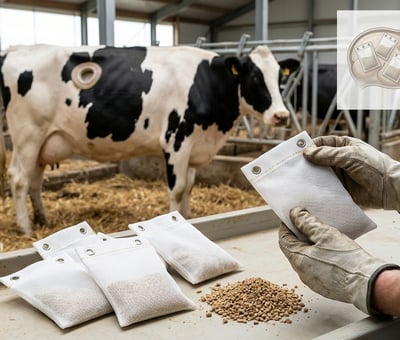
RUP values are not measured directly. They are calculated from degradation characteristics obtained by in-situ nylon bag incubation in rumen-fistulated cows. Those characteristics include the soluble fraction, the washable but insoluble fraction, the potentially degradable fraction, the undegradable fraction and the fractional degradation rate per hour, usually written as Kd. The calculation also needs an assumed fractional passage rate, Kp, which is estimated from intake and production level and is not measured in the bag. Effective degradation and RUP follow from the degradable fraction, Kd and Kp together.
Two consequences follow from this. First, a RUP percentage is only comparable with another RUP percentage calculated at the same assumed passage rate. Second, RUP is not the protein left after a fixed number of hours of incubation; describing it that way confuses a calculation with a measurement. A slowly degraded protein may show near-complete degradation only after a very long incubation, yet still deliver a high RUP value at a realistic passage rate, because the feed does not stay in the rumen long enough for that degradation to finish.
Intestinal Digestibility: The Half That Is Often Missing
A high RUP figure says only that protein left the rumen. It says nothing about how much of that protein the animal can use. Intestinal digestibility is the share of the rumen-undegraded protein that is digested in the small intestine, measured for example with the mobile nylon bag technique in cows fitted with duodenal cannulas. A product with high RUP and low intestinal digestibility delivers little usable protein, and the ration may look better on paper than it performs.
Heat treatment illustrates this tension clearly. Research on a heat-treated rapeseed expeller found that the treatment lowered rumen degradability of protein but could also reduce protein digestibility further down the gastrointestinal tract, which is the central trade-off of thermal protection.[1] Work in pigs on processed soybean meal and 00-rapeseed meal points in the same direction: processing reduced protein digestibility and growth performance in that species, even though nitrogen solubilisation along the digestive tract was not affected in the same way.[2] Species differ, and pig results cannot be transferred directly to ruminants, but the underlying message about over-processing is consistent.
There is also a methodological warning. In-vitro protein degradation tests, including enzymatic and fractionation methods, correlate poorly with in-situ measurement in rumen-fistulated cows, particularly for heat- and Maillard-protected proteins, where they tend to overstate rumen protection. Declared values based on in-vitro methods are therefore not comparable with in-situ values, and a specification sheet does not always state which method was used.
From Measured Values to Formulation Values
The experimental characterisation of an ingredient and its nutritional valuation are two separate steps. Degradation and digestibility are measured; formulation values are calculated from them within a protein evaluation system. The Dutch DVE/OEB system expresses intestinal digestible protein and rumen protein balance, the German system uses nXP and RNB, and INRA PDI and CNCPS metabolisable protein are further examples. Values differ between systems and between assumed passage rates, so a valuation is a calculation, not an animal result.
This distinction matters commercially. Two rapeseed meals can carry the same crude protein declaration and behave very differently in the rumen, because crude protein says nothing about degradation rate. Feed mills buying on protein content alone may be comparing numbers that do not describe the same nutritional outcome. The fibre fraction of rapeseed meal, its glucosinolate content and its processing history all influence how the protein behaves, and the same rapeseed meal can be sold as conventional or as a protected grade depending on the treatment applied.
For ruminant rations, the practical conclusion is that heat-treated rapeseed meal is not automatically a better protein source than untreated meal. It is a different protein source. Its advantage lies in shifting amino acid supply towards the small intestine when the ration needs more metabolisable protein than microbial protein can provide. That advantage only holds when the heat treatment is controlled, when intestinal digestibility of the rumen-undegraded fraction is measured rather than assumed, and when RUP is compared at the same passage rate. Where over-processing has bound reactive lysine, the bypass value may look attractive while the amino acid supply to the cow does not follow.
Newer research on fermented rapeseed meal adds a further dimension. In a study with piglets, solid-state fermentation of rapeseed meal was associated with changes in growth performance and antioxidant status, indicating that processing history beyond heat treatment can also modify how rapeseed protein behaves in the digestive tract.[3] The findings come from young pigs and should not be read across to ruminants without caution, but they underline that the nutritional value of rapeseed meal is determined by the processing route, not by crude protein alone.
Technical Summary
Heat treatment uses controlled Maillard chemistry to shift rapeseed protein from rumen degradation towards the small intestine. The gain depends on processing intensity: over-heating binds reactive lysine and lowers intestinal digestibility. RUP values are calculations from in-situ degradation data at an assumed passage rate, so they are comparable only at the same Kp and must always be read together with intestinal digestibility.
This article was created with the help of AI and reviewed by the Cropenta editorial team. It is general information, not professional advice.
Technical Questions
Why can two rapeseed meals with the same crude protein content behave differently in the rumen?
Crude protein measures nitrogen content, not how fast rumen micro-organisms break that protein down. Degradation rate, soluble and degradable fractions and processing history determine the split between rumen-degradable and rumen-undegradable protein. A protected grade and a conventional grade from the same crop can therefore differ substantially in nutritional behaviour despite similar protein declarations.
How should a formulator interpret a RUP value quoted without a passage rate?
With caution. RUP is calculated from measured degradation characteristics at an assumed fractional passage rate, so a figure quoted without that assumption cannot be compared with another. Two products may show different RUP values purely because different passage rates were used. Ask for the assumed Kp, the degradation rate and the intestinal digestibility of the undegraded fraction.
Why do in-vitro protein degradation tests not match in-situ results for heat-treated rapeseed meal?
Enzymatic and fractionation methods correlate poorly with nylon bag incubation in rumen-fistulated cows, especially for heat- and Maillard-protected proteins, where they tend to overstate rumen protection. Declared protection values based on in-vitro methods are therefore not comparable with in-situ values, and the method used should be stated on the specification.
What processing information helps when comparing heat-treated rapeseed grades?
The heating conditions, the presence and type of reducing sugars, and whether reactive lysine was measured rather than only total lysine. Reactive lysine falls when Maillard reactions bind the epsilon-amino group, while total lysine may stay unchanged. Together with intestinal digestibility measured in vivo, these details show whether protection was achieved without over-processing.
- 1.Evaluation of rumen protected rapeseed expeller (NovaPro) as an alternative to soybean meal in dairy cow diets
- 2.Processing of soybean meal and 00-rapeseed meal reduces protein digestibility and pig growth performance but does not affect nitrogen solubilization along the small intestine
- 3.Fermented Rapeseed Meal Improves Growth Performance, Antioxidant ...
Looking for something specific?
Our team is there to help you find the right raw materials and solutions for your formulations