How In Vivo and In Situ Methods Evaluate Rumen-Protected Protein Efficacy
A ration balancing program cannot see the rumen. It works with numbers derived from measurements: how much protein disappears from a nylon bag, how much survives to the small intestine, how much of that is actually digested. When two bypass protein ingredients carry the same declared RUP percentage but behave differently in the cow, the explanation usually lies in how those numbers were produced. The measurement method, the assumed passage rate and the handling of the collected data determine whether the figures are comparable at all.
Cropenta Insight
Evaluation methods shape the values a formulator ultimately uses. In situ work in rumen-cannulated cows describes how quickly a protein source degrades, while in vivo mobile-bag work with duodenal cannulas shows how much undegraded protein is subsequently digested. For potato protein and other feed proteins alike, reported RUP is only meaningful together with the assumed passage rate and the intestinal digestibility figure, because nutritionists compare values only when these conditions match.
Why RUP Percentage Alone Says Little
Rumen-undegradable protein (RUP) is not a fixed property. It is calculated from degradation characteristics measured in situ at an assumed fractional passage rate (Kp), and that Kp is estimated from dry matter intake and production level of the animal being fed[1]. Feed a cow more and the particles leave the rumen faster; the calculated RUP rises without any change in the ingredient itself. Compare a RUP figure generated at 6%/h with one generated at 8%/h and you are comparing two different animals, not two different proteins.
This is where declared values can create confusion in the trade. A supplier citing a high RUP percentage may have measured effective degradation at a fast passage rate, while a competing value may reflect a slower rate. Without the assumed Kp, the intestinal digestibility of the RUP and the laboratory method, the numbers sit in isolated boxes. RUP and bypass protein digestibility must be evaluated together: a fraction that escapes the rumen but passes undigested through the small intestine delivers little usable amino acid.
What In Situ Measurement Actually Delivers
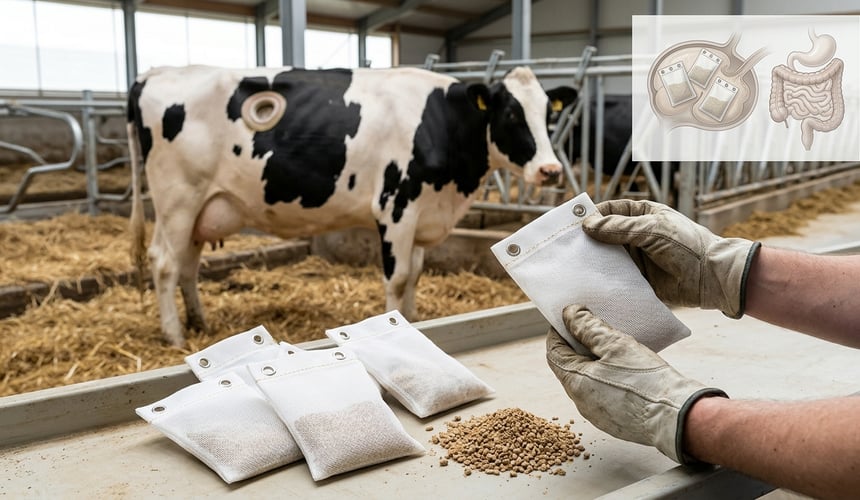
In situ rumen degradability is the classic technique for characterising protein sources in rumen-fistulated cows. Samples are sealed in nylon or Dacron bags with a defined pore size, incubated in the rumen for a series of time points, then washed and analysed for nitrogen. The disappearance curve is fitted to an exponential model with a soluble fraction (S), a potentially degradable fraction (D), an undegradable fraction (U) and a fractional degradation rate (Kd)[1]. Effective degradability and RUP are then calculated from D, Kd and Kp.
The method's strength is resolution. For heat- and Maillard-protected proteins, a short incubation may not distinguish treatments that a longer one can. Where a protected protein has been characterised in the literature, a slow Kd and near-complete degradation only at the end of a prolonged incubation have been reported in some cases, whereas a reference sample was largely degraded within two days; such kinetic contrasts cannot be captured by a single fixed incubation time, which is why a full degradation curve matters when protection depends on Maillard reactions.
In situ work also has limits that are rarely acknowledged in marketing. Kp is an assumption, not a measurement, and the bag method ignores particle loss through the pores, microbial contamination of the residue and differences in outflow behaviour between bag contents and rumen digesta. The technique characterises an ingredient; it is not a production test and says nothing about milk yield.
In Vivo Methods and the Intestinal Question
RUP is only half the story. Once the undegraded protein enters the small intestine, its value depends on intestinal digestibility. The mobile nylon bag technique addresses this directly. Bags containing the rumen-undegraded residue are incubated a second time and then inserted into the duodenum of cows fitted with duodenal cannulas, where they travel through the small intestine and are collected in the faeces[2].
In vivo work with duodenal cannulas is the closest approximation of what the cow experiences, but it is not a feeding study unless production outcomes are measured. It quantifies a biochemical fate: how much of the RUP is actually released as amino acids and absorbed. Reported intestinal digestibility of the rumen-undegraded fraction varies widely between protein sources, and a high RUP without a high intestinal digestibility simply shifts the problem further down the tract.
Total tract collection has also been used to validate in vitro estimates against in vivo results. One evaluation reported total tract digestibility values of roughly 84% with an in vivo method versus about 76% with an in vitro method, both within the expected range but not interchangeable[3]. That gap matters when a bypass protein source is specified against a declared value.
Why In Vitro Values Do Not Compare With In Situ Values
In vitro tests, enzymatic or fractionation based, are faster and cheaper than in situ work in rumen-fistulated cows, and in some ingredient categories they correlate acceptably with in vivo findings. For heat- and Maillard-protected proteins, however, the correlation breaks down. One comparative evaluation found that in vitro procedures commonly used to estimate rumen protein degradability and digestibility do not agree consistently with in situ measurements, particularly where heat treatment has altered the protein matrix[2]. The practical consequence is that an in vitro-based RUP set against an in situ-based RUP can overstate the protective effect by tens of percentage points.
The Maillard reaction explains part of this. Reducing sugars bind to the epsilon-amino group of lysine, forming Schiff bases and Amadori products that progress to melanoidins. Controlled enough, this makes protein resist rumen microbial breakdown while still releasing amino acids under the acid and enzymatic conditions of the abomasum and small intestine. Taken too far, it destroys lysine and depresses digestibility across the board. Total lysine may look unchanged while reactive lysine, the biologically available fraction, falls[2]. In vitro protein degradation methods that do not account for this shift tend to overstate rumen protection.
Reconciling the Two Methods in Practice
Nutritionists reading a bypass protein specification should treat it as the output of a chain, not a single number. The chain runs from the ingredient through the in situ degradation curve, the assumed passage rate, the measured intestinal digestibility of the residue and the protein valuation system used to translate these into formulation values. The Dutch DVE/OEB system, the German nXP/RNB, INRA PDI and CNCPS metabolisable protein all apply their own coefficients; none is a direct animal response. Better protein value does not automatically translate into more milk.
Where the literature is instructive is in showing how a protected protein with slow Kd and high intestinal digestibility behaves when the two methods are applied together[1]. The two techniques answer different questions. In situ degradation tells the formulator how much protein leaves the rumen at a given Kp. In vivo intestinal digestibility tells the formulator how much of that escaping protein the cow can actually use. Neither alone gives a metabolisable protein figure.
How to Read a Declared Bypass Protein Value
- Check the assumed passage rate. RUP values are only comparable at the same Kp; 6%/h is a common reference applied to high-producing dairy cows.
- Ask for intestinal digestibility of the RUP, not just RUP itself. High RUP with low digestibility delivers little usable amino acid.
- Identify the method behind the figure. An in vitro value cannot be placed alongside an in situ value; the two diverge especially for Maillard-protected proteins.
- Look for the reference sample. In situ protocols typically include a standard mixture of concentrate and roughage ingredients to anchor the run.
- Distinguish characterisation from valuation. Degradation rate and digestibility are measurements; DVE, nXP or PDI are calculations sitting on top of them.
None of this makes in situ or in vivo work interchangeable with routine feed analysis. Both remain research-grade techniques applied to a limited number of samples per ingredient. The value they deliver is transparency: they show what a protein source actually does in the rumen and small intestine, which is more than a single declared percentage can carry.
Technical Summary
Rumen-protected protein evaluation relies on two complementary techniques. In situ nylon-bag incubation in rumen-cannulated cows characterises degradation kinetics (S, D, U, Kd) and, with an assumed Kp, yields RUP. In vivo mobile-bag work with duodenal cannulas measures intestinal digestibility of the undegraded residue. RUP values are comparable only at the same Kp, and in vitro estimates diverge from in situ results particularly for Maillard-protected proteins.
This article was created with the help of AI and reviewed by the Cropenta editorial team. It is general information, not professional advice.
Technical Questions
Why can two bypass protein ingredients with the same declared RUP percentage deliver different amounts of digestible protein?
Because RUP is calculated at an assumed passage rate, not measured directly, and because the intestinal digestibility of that RUP varies between ingredients. An ingredient with 80% RUP at 6%/h but 70% intestinal digestibility supplies less usable amino acid than one with the same RUP and 90% digestibility.
What does the mobile nylon bag technique measure that a standard in situ incubation cannot?
The mobile nylon bag is used after rumen incubation to measure how much of the rumen-undegraded protein is digested in the small intestine. It is inserted through a duodenal cannula in cows and collected in the faeces, quantifying intestinal digestibility directly rather than estimating it from composition or in vitro tests.
Why do in vitro protein degradation tests overstate rumen protection for heat-treated proteins?
Maillard reactions bind lysine and change the protein matrix in ways that in vitro enzymatic assays do not reproduce. Comparative work shows in vitro estimates can diverge substantially from in situ results, particularly for heat- and Maillard-protected proteins, so a value generated in vitro cannot be placed alongside an in situ value.
How should a feed formulator interpret a RUP figure without knowing the assumed passage rate?
With caution. RUP depends on Kp, which is estimated from intake and production and is not measured in the bag. A RUP figure without a stated Kp cannot be compared with another value at a different Kp, and it cannot be plugged into a ration model without knowing the basis on which it was calculated.
Does a higher RUP value guarantee more metabolizable protein and better animal performance?
No. Metabolizable protein depends on RUP, intestinal digestibility and the amino acid profile of the fraction that is actually absorbed, as well as on microbial protein synthesis. A higher RUP with lower intestinal digestibility can deliver the same or less usable protein, and protein valuation systems convert these measurements into formulation values, not performance outcomes.
- 1.The use of rumen-protected amino acids and fibrous by-products can reduce the environmental impact of dairy cattle production
- 2.An evaluation of the validity of an in vitro and an in situ/in vitro method to estimate rumen protein degradability and intestinal digestibility
- 3.Methods to Evaluate Rumen Protected Lysine for Dairy Cows
Looking for something specific?
Our team is there to help you find the right raw materials and solutions for your formulations