How Do Temperature and pH Affect the Chemical Stability of Liquid Fertilizers?
When a liquid fertilizer turns cloudy, forms crystals on the bottom of the drum or separates into layers after a few weeks, the first question is usually what changed in the solution. Temperature and pH are usually the first factors to check, because they set how much of each dissolved component can stay in solution and how fast those components react. The sections below show how both drive precipitation, crystallization and phase separation, and where the evidence stops.
Much of the published work on this subject does not test product storage directly. A 2025 study on balanced fertilization in soil, for example, focused on soil microbial communities and their resilience to environmental stress, not on the shelf life of a formulated liquid.[1] Its findings cannot be transferred to tank or storage stability, so the mechanisms below rest on general solution chemistry and on the more limited data available for liquid organic fertilizers.
Cropenta Insight
For raw-material buyers and formulators, the practical point is that a pH value measured on the day of blending says little about the chemistry six months later unless the whole solution has been checked under storage temperatures. Raw-material specifications such as salt index, mineral content and certificate-of-analysis pH give a starting point, but they do not replace storage trials. Growers and distributors who see a change in a stored product should ask first about temperature history and pH at packaging, not only about the nutrient label.
How precipitation, crystallization and phase separation develop
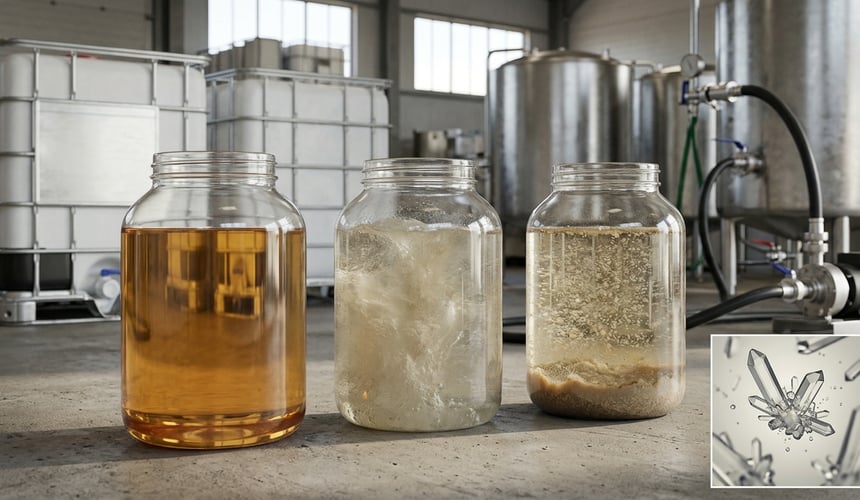
A liquid fertilizer can only hold dissolved salts up to a solubility limit. When a component exceeds that limit, solid material can form. Precipitation refers to solid particles appearing in the liquid, often as a fine haze or sediment. Crystallization is the ordered growth of those solids into crystals, which usually needs a supersaturated solution to start. Phase separation is different: the liquid splits into layers, typically when dispersed components lose their ability to stay mixed. Each of these pathways can appear in the same product, and an observed deposit does not reveal which one caused it.
Temperature changes solubility and reaction speed
Temperature affects two things at once. It changes the solubility of dissolved salts, and it changes how fast chemical reactions proceed. The direction of the solubility change depends on the compound. Some salts become less soluble when cooled, so a cold storage area can push them out of solution. Others become less soluble when warmed. Higher temperatures generally speed up reactions between dissolved components, so a product that is stable at a low temperature may change faster in a warm warehouse. Repeated freezing and thawing adds a further risk of crystal formation, although the sources reviewed here do not quantify this for specific formulations.
pH controls which chemical forms are present
pH determines the ionic form of many dissolved nutrients and additives. When pH shifts, some forms become more or less soluble, and the interaction with other ions changes. Phosphate and calcium are a common example in general solution chemistry: under certain pH conditions they can form sparingly soluble compounds. Liquid organic fertilizers show a related pattern. A 2026 study on liquid organic fertilizer made from agricultural waste reported that pH does not directly change nutrient concentrations in the product, but it can affect nutrient availability and fertilizer efficiency.[2] This distinction matters in storage. A stable pH reading does not prove that nutrients remain in the same chemical form, and a change in form does not automatically mean that the measured nutrient content has changed.
What the current evidence does not show
None of the sources reviewed here measured precipitation, crystallization or phase separation across combinations of temperature and pH in a formulated liquid product. The primary study addresses soil biology, and the storage-related work covers a different product type. Thresholds for shelf life, and the interaction between temperature and pH, cannot be generalized from these data. A solution that remains clear in storage also shows only physical stability. It does not show that plants take up or respond to its nutrients.
Technical Summary
Temperature and pH drive liquid fertilizer instability by changing solubility limits and the chemical forms present in solution. This can lead to precipitation, crystallization or phase separation. Temperature mainly affects solubility and reaction speed, while pH governs ionic forms. The available sources do not test these interactions in formulated products, so storage behaviour needs to be checked for each specific composition.
This article was created with the help of AI and reviewed by the Cropenta editorial team. It is general information, not professional advice.
Technical Questions
Why can a liquid fertilizer stay clear at one pH and form deposits at another?
Changing pH can alter which chemical forms of a dissolved component are present, and some forms are less soluble than others. Phosphate and calcium, for example, can form sparingly soluble compounds when conditions shift, which may appear as sediment over time. Whether this occurs depends on the full composition, concentrations and temperature, so a clear solution at one pH does not confirm stability at another.
Does a physically stable liquid fertilizer prove that it will perform in the field?
No. Physical stability in storage describes whether the solution remains homogeneous, not whether plants take up or respond to its nutrients. Those are separate questions that depend on the crop, application method, soil or substrate conditions and the form of the nutrients. Storage stability studies and crop response studies should be read separately.
Looking for something specific?
Our team is there to help you find the right raw materials and solutions for your formulations