How Do Plants Regulate Amino Acid and Peptide Levels Inside Their Cells?
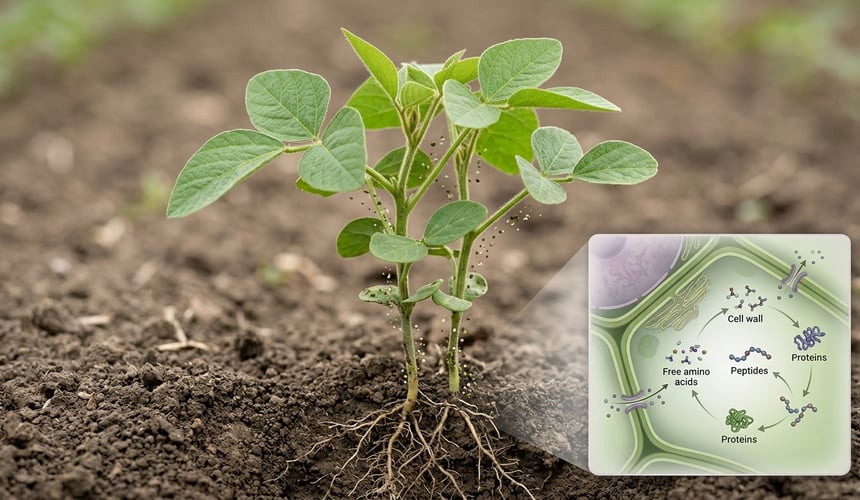
Inside a plant cell, amino acids are never simply stored and used up. Their level has to stay within a working range, because the same molecules serve as protein building blocks, carry nitrogen between organs and feed into other metabolic pathways. So how does a plant keep this internal pool balanced while it grows, flowers and responds to changing conditions?
Cropenta Insight
The distinction that matters most when reading this research is the one between endogenous regulation and applied amino acids. The balance described here is set by the plant's own synthesis, breakdown and transport. Showing how these processes work inside a plant does not show what an externally applied amino acid source does on a crop. For growers and advisers, that gap is the key limit when interpreting the evidence.
Where the internal pool comes from
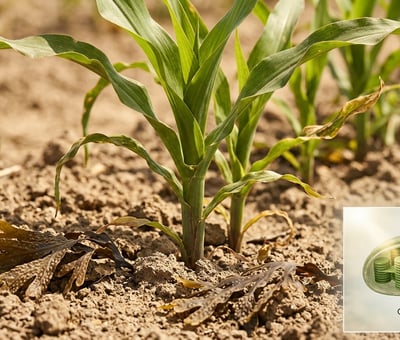
Plants make most of their amino acids from nitrogen taken up from the soil, combined with carbon skeletons produced in photosynthesis and respiration. Synthesis is only one input. Proteins are constantly built and broken down, so amino acids also come from protein turnover. Peptides, short chains of amino acids, sit between free amino acids and whole proteins in this pool. The balance therefore depends on how fast each of these routes runs.[1]
Moving amino acids to where they are needed
Amino acids are not fixed where they are made. Roots, leaves, shoots and growing tissues exchange them through the vascular system, and transporter proteins in cell membranes control their passage into and out of cells. Recent review work describes amino acids as nitrogen transport compounds that take part in allocation between growth and defense, which means a plant can direct the same pool toward new leaves, seeds or defensive responses depending on demand.[2] The details differ between species and organs, and many are still being mapped for individual crops.
Breakdown as the other side of the balance
When amino acids are in surplus, or when proteins are recycled, the plant degrades them. The carbon and nitrogen released can be reused in respiration or in new amino acids, which keeps unused material from accumulating. Reviews of amino acid function also cover roles beyond protein building, including responses to stress conditions such as drought or salinity, where amino acid patterns can change.[1] Such changes are observations of levels, not proof of a single regulatory switch. The enzymes that control each step vary by pathway and by crop, and the literature does not provide one complete control map that applies to all plants.
What the evidence does and does not show
Much of what is known comes from reviews and from studies of individual species under controlled or specific conditions. Amino acid pools are often measured at a single point in time, which gives a snapshot rather than the full flow between synthesis, breakdown and transport. A balanced internal pool describes a physiological state. It does not by itself show that adding amino acids to a crop changes growth, yield or nutrient uptake in the field. Those questions need separate, comparative trials.
What this means for practice
For a grower or adviser, the practical point is that internal balance is a plant-side process, shaped by nitrogen supply, growth stage and environment. When a claim about applied amino acids is discussed, it helps to ask whether the evidence concerns the plant's own pool or an external input. Those are different questions, and an answer to one does not settle the other.
Technical Summary
Plants keep free amino acids and peptides in balance through synthesis from nitrogen and carbon, protein turnover, breakdown of surplus material, and membrane transport between cells and organs. Reviews place amino acids beyond their role as protein building blocks, including transport and allocation between growth and defense. Most of the evidence describes these processes in specific species and conditions and does not show what applied amino acids do on a crop.
This article was created with the help of AI and reviewed by the Cropenta editorial team. It is general information, not professional advice.
Technical Questions
Does the internal amino acid balance change when a plant is under drought or salinity?
Reviews of amino acid function report that levels and patterns of individual amino acids can shift during drought, salinity and other stress conditions. The shifts differ by species, organ and severity of the stress, and a changed level is an observation rather than proof of a specific regulatory cause. A single measurement of leaf or root levels rarely shows the full flow between synthesis, breakdown and transport.
Why can't a plant's internal amino acid balance be read as evidence for a product effect?
The internal balance describes what a plant does with amino acids it makes or takes up itself. An applied product is a different input, and its uptake, transport and breakdown would need to be measured separately. Research on endogenous pools therefore does not show whether an applied amino acid source changes crop performance. That question requires comparative trials with the specific product, crop and conditions.
Looking for something specific?
Our team is there to help you find the right raw materials and solutions for your formulations