How Does Feed Processing Influence Intestinal Digestion of Bypass Protein?
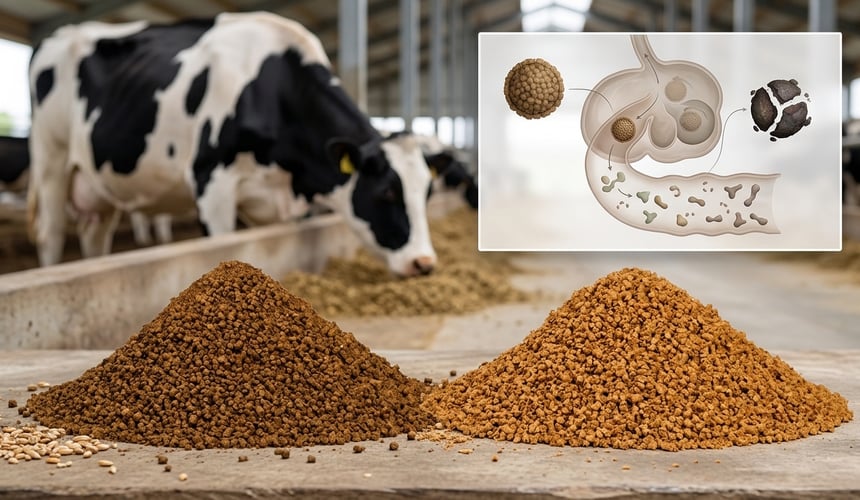
Two protected protein batches can carry the same calculated rumen-undegradable protein (RUP) figure and still deliver completely different amounts of amino acids to the cow. The reason usually sits upstream, in the processing line. Heat, moisture, sugars and residence time do not only decide how much protein escapes the rumen; they also reshape the protein structure that pancreatic and intestinal enzymes later have to attack. When the structure is altered too far, high bypass becomes an empty number: the protein leaves the rumen intact and then leaves the animal undigested.
Cropenta Insight
For buyers and formulators, the practical lesson is that RUP and intestinal digestibility have to be read as a pair, at the same assumed passage rate. Processing decisions made at the ingredient supplier's plant determine both. Because heat treatment and Maillard chemistry shift the balance between rumen protection and post-ruminal release, the analytical package behind a protected protein matters as much as the headline bypass figure when comparing ingredient options.
Why bypass is only half of the story
Rumen-degradable protein (RDP) fuels microbial protein synthesis, while RUP escapes the rumen and is supposed to be digested in the small intestine. RUP is not a fixed property of a feed; it is calculated from measured degradation characteristics at an assumed fractional passage rate (Kp), which depends on intake and production level. This means two RUP values can only be compared when the same Kp is assumed. A high RUP percentage tells you the protein survived the rumen. It says nothing about how much of that protein the animal can actually use.
Intestinal digestibility measures exactly that second step. In dairy research it is often quantified with the mobile nylon bag technique in cows fitted with duodenal cannulas, where the rumen-undegraded residue is inserted post-ruminally and recovery of protein is measured. When a protected protein combines high RUP with low intestinal digestibility, the formulation assumes digestible protein that is not really there, and the ration is over-valued on paper.
How heat treatment changes protein structure
Heat is the most widely used protection tool, and its effects are dose-dependent. Mild heating unfolds globular proteins, exposes hydrophobic regions and can make them more susceptible to enzymatic hydrolysis. Excessive heating does the opposite: it drives aggregation, cross-linking and, when reducing sugars are present, the Maillard reaction.
The Maillard reaction begins when a reducing sugar such as glucose, fructose or xylose reacts with a free amino group, most notably the epsilon-amino group of lysine, forming a Schiff base and then Amadori products and eventually melanoidins. Controlled, this chemistry makes protein resistant to rumen micro-organisms while acid and enzymes in the abomasum and small intestine can still release amino acids. Pushed too far, it binds lysine irreversibly and reduces both digestibility and palatability. Total lysine can stay numerically unchanged while reactive lysine, the fraction with a free epsilon-amino group available for digestion, falls sharply [1].
This distinction is central to feed processing bypass protein studies: the same heat application that raises RUP can quietly lower the amino acid availability that the RUP was meant to deliver.
What the evidence shows across species
Direct ruminant data on processing and intestinal digestion are relatively scarce, but the underlying protein chemistry is well documented in other species and increasingly in processed plant proteins. A 2023 review on heat treatment and protein digestion concluded that thermal processing alters both the digestibility of food proteins and the absorption of their digestion products in the small intestine, with outcomes depending on temperature, time and matrix [2].
Comparative work on pea protein concentrate illustrates the point. High-pressure processing and conventional heat treatment affected protein and starch digestibility differently, showing that the mode of processing, not just the intensity, shapes the final digestive behaviour of a protein ingredient [3]. In tilapia, thermal processing of protein-rich material was reported to shift protein structure in ways that influenced digestibility and amino acid availability, though the responses were not uniform across all amino acids [4].
For ruminant formulation, the takeaway is that the same mechanistic logic applies: any processing that alters protein conformation or creates Maillard products modifies enzyme accessibility in the small intestine, and this effect is not captured by the RUP figure alone.
Protection methods and their trade-offs
Several protection routes exist, and each interacts differently with post-ruminal digestion:
- Heat alone can raise bypass by denaturation and aggregation. Without a sugar source the effect on intestinal digestibility varies, and overheating risks cross-linking that resists enzymatic attack.
- Maillard-based protection uses reducing sugars to bind amino groups. Done with control over sugar distribution, temperature penetration, moisture and time, it can produce melanoidins that resist rumen breakdown while acid denaturation in the abomasum and pepsin, trypsin and chymotrypsin in the small intestine still release amino acids. Done poorly, it destroys reactive lysine.
- Lignosulfonate treatment and historically formaldehyde have been used, with the latter largely abandoned for regulatory and safety reasons.
Analytically, the way protection is measured matters. In-vitro protein degradation tests correlate poorly with in-situ measurement in rumen-fistulated cows, especially for heat- and Maillard-protected proteins, where they tend to overstate rumen protection. Declared values based on in-vitro methods are therefore not directly comparable with in-situ values, and a formulator comparing two protected proteins should confirm which method produced each figure.
Reading the numbers correctly
Nutritional protein valuation systems, such as the Dutch DVE/OEB, German nXP/RNB, INRA PDI or CNCPS metabolisable protein, translate measured degradation and digestibility into formulation values. These are calculations, not animal results, and they differ between systems and assumed passage rates. A higher digestible protein value does not by itself prove higher milk production; it is a formulation input that only becomes performance when the rest of the ration, the cow's intake and microbial protein supply allow it.
This is why in-situ characterisation, intestinal digestibility and calculated valuation should be kept in separate analytical compartments. In-situ work using rumen-fistulated cows characterises the ingredient; it is not a feeding trial. A RUP value above 80% at a stated Kp, paired with an intestinal digestibility of the rumen-undegraded fraction, is a far more informative pairing than bypass percentage alone. For reference, a rumen reference sample is a defined mixture of concentrate and roughage ingredients for high-producing dairy cows, which allows comparison against a consistent baseline.
Technical Summary
Feed processing, especially heat and Maillard chemistry, determines both how much protein escapes the rumen and how much of that protein the small intestine can digest. High RUP with low intestinal digestibility delivers little usable amino acid. Compare RUP values only at the same passage rate, keep experimental characterisation apart from nutritional valuation, and check that intestinal digestibility of the undegraded fraction has been measured rather than assumed.
This article was created with the help of AI and reviewed by the Cropenta editorial team. It is general information, not professional advice.
Technical Questions
Why can two protected proteins with the same calculated RUP behave differently in the small intestine?
RUP values derived from different assumed passage rates are not interchangeable. Passage rate depends on intake and production, so a figure calculated at 6%/h cannot be compared with one at 5%/h. When comparing protected proteins, verify that both figures were derived from in-situ data at the same Kp, ideally with intestinal digestibility of the undegraded fraction measured in cows.
How can heat-treatment history change the way I interpret amino acid analysis of a protected protein?
Total lysine may remain unchanged after heat treatment while reactive lysine, the fraction with a free epsilon-amino group, drops significantly. The Maillard reaction binds lysine to reducing sugars, making it unavailable for digestion. This explains why total amino acid analysis can overstate the nutritional value of an over-processed protected protein, and why reactive lysine or in-vivo intestinal digestibility is more informative.
Which analytical method should I rely on when comparing protected protein ingredients?
In-vitro protein degradation tests correlate poorly with in-situ measurement in rumen-fistulated cows, especially for heat- and Maillard-protected proteins. They tend to overstate rumen protection by tens of percentage points. Declared RUP values based on in-vitro methods are not directly comparable with in-situ values, so when comparing ingredients, confirm which analytical method produced each figure.
Does a higher calculated digestible protein value guarantee more milk protein production?
No. Higher digestible protein value in a valuation system is a formulation input, not a performance result. Whether it translates into milk protein or yield depends on total metabolisable protein supply, microbial protein synthesis, amino acid balance, energy intake and animal status. The valuation is a calculation; only a feeding trial can demonstrate production effects.
- 1.Role of Feed Processing on Gut Health and Function in Pigs and Poultry: Conundrum of Striking the Right Balance Between Feed Processing and Gut Health
- 2.The Effect of Heat Treatment on the Digestion and Absorption of Food Proteins
- 3.Comparative effects of high pressure processing and heat treatment on in vitro digestibility of protein and starch in pea protein concentrate
- 4.Effects of thermal processing on protein quality and bioactivity of tilapia
Looking for something specific?
Our team is there to help you find the right raw materials and solutions for your formulations