Why Do Introduced Microbes Struggle to Persist in Diverse Soil Ecosystems?
A microbial product can look convincing in a laboratory dish, with clear counts and healthy cultures. Once the same organisms enter field soil, the picture changes, and microbial biostimulant persistence becomes the central issue.
A recent review describes microbial biostimulants as one technology considered for meeting modern agricultural needs.[1] Its ecological challenges are what matter for the question of why introduced organisms often struggle to remain in soil.
Cropenta Insight
The most useful distinction for practitioners is between a microbe that is still alive in soil, one that is still active, and one whose effect on a crop has been measured in the field. Each step needs its own evidence. Soil studies suggest that responses can appear with a delay, so a single early observation may not describe what happens over a season. Interpreting microbial biostimulant results therefore depends on knowing the soil, the timing and the crop.
Three questions, three separate steps
Three things are often mixed together. Survival asks whether the organism stays viable. Activity asks whether it still performs its intended function. Field effect asks whether a crop benefit has been demonstrated under real cultivation. A positive answer on survival does not answer the other two, and a high viable count is not proof of effectiveness in soil.
Some terms help here. In agriculture, a probiotic is a live introduced microbe, a prebiotic is a substance intended to feed microbes already present, and a synbiotic combines both. A single organism and a combination each need their own evidence, and results for one should not be assumed for the other.
Competition with the existing soil community
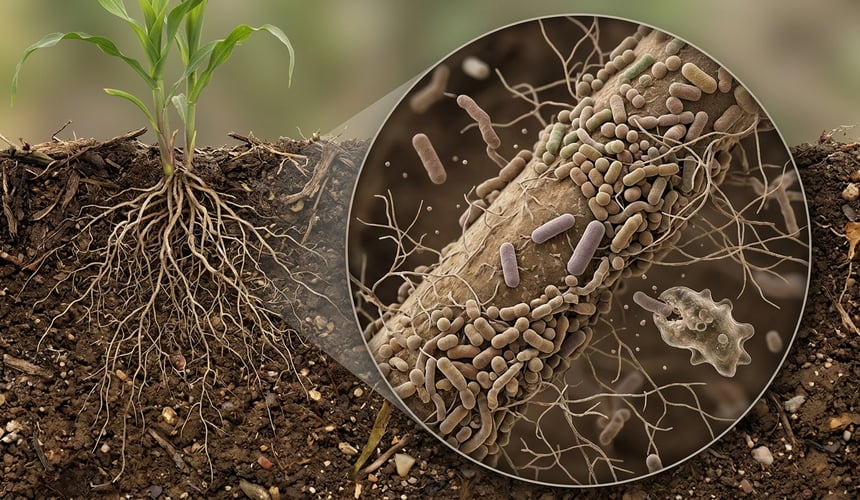
Soil already holds a dense community of bacteria and fungi. These organisms compete for space on roots, for the sugars and amino acids that roots release, and for minerals. An introduced organism arrives in small numbers and has to find a niche in that crowded system. An established native community can limit the newcomer, and an organism that survives well in one soil may not do so in another. Results for one strain should not be applied to every member of the same species.
Predation, nutrients and changing conditions
Soil protozoa and other grazing organisms feed on bacteria, which can reduce the number of introduced cells over time. Nutrient supply matters as well. An organism that depends on a readily available carbon source may struggle where that source is scarce. Moisture, temperature, pH and soil structure all shape which microbes remain active. Field conditions also change with season and management, so the conditions at application are rarely the conditions weeks later.
Timing is visible in the data too. In one soil study, a soil biostimulant showed a delayed effect on active soil microorganisms rather than an immediate one.[2] That study used a soil biostimulant rather than an introduced microbial product, so it does not directly measure how long an added organism persists.
Where the laboratory-field gap comes from
Laboratory conditions are usually stable, with uniform media, few competitors and controlled moisture and temperature. A field soil offers none of that. Laboratory activity therefore does not prove field efficacy. The sources used here do not quantify how often introduced microbes persist in field soils, so no general failure rate can be stated, and the evidence does not show that every introduced microbe fails.
What to check when evaluating persistence
A grower or adviser should ask whether persistence was measured in soil, over what period, in which crop and soil type, and whether a crop response was recorded separately from survival. Results for a single strain, a combination or a consortium should be read separately.
Technical Summary
Introduced microbes must survive in soil, remain active and then produce a measurable field effect, and each step is separate. Persistence is shaped by competition with the existing soil community, predation, nutrient supply and changing moisture, temperature and pH. Laboratory viability does not establish field activity, and the evidence on field persistence remains limited for many products.
This article was created with the help of AI and reviewed by the Cropenta editorial team. It is general information, not professional advice.
Technical Questions
Does a high viable count on a product label show that a microbe will work in the field?
No. A viable count shows that cells were alive at the time of measurement under specific conditions. It does not show that they remain active in soil, compete successfully with the native community or produce a measurable crop response. These are separate steps and each needs its own evidence.
Why might a soil biostimulant show effects later rather than immediately?
One soil study reported a delayed effect on active soil microorganisms, which suggests that responses in soil may follow a time lag. That study used a soil biostimulant rather than an introduced microbe, and it does not establish how long any effect lasts or whether it translates into crop performance. Timing should be considered when judging early results.
Looking for something specific?
Our team is there to help you find the right raw materials and solutions for your formulations