Why Rumen-Protected Protein Trials in Dairy Cows Do Not Always Match In Vitro Results
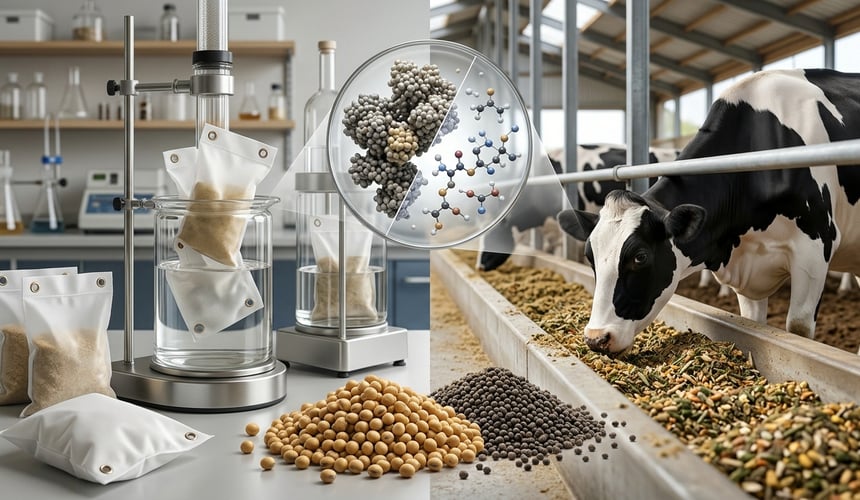
A rumen-protected protein can look convincing on a data sheet and still disappoint in a feeding trial. Two products with similar laboratory degradation values may give different results in cows, and trials that appear to contradict each other are common. The discrepancies arise from the different physiological and methodological contexts of in vitro and in vivo assessments, which determine how far a laboratory value can be carried over to a live animal.
Cropenta Insight
For readers who specify protein ingredients, a concrete check is whether a RUP value, its Kp assumption and intestinal digestibility are reported for the same product lot, together with the heat or Maillard conditions used in processing. A lower in situ degradation value on its own does not show how much amino acid reaches the duodenum, so matched data sets are the more reliable basis for comparison.
How protection is measured
Protein protection is the treatment of a protein source so that less of it is broken down by rumen micro-organisms and more reaches the small intestine. Heat and Maillard reactions with reducing sugars are common routes. In-vitro tests, such as enzymatic or fractionation methods, are fast and cheap, but they correlate poorly with in-situ measurements made in rumen-fistulated cows, especially for heat- and Maillard-protected proteins. For these products in-vitro tests tend to overstate rumen protection, so a value from one method cannot be compared with a value from the other.
In-situ work uses nylon bags incubated in the rumen. The degradation kinetics describe a soluble fraction, a washable but insoluble fraction, a potentially degradable fraction, an undegradable fraction and a fractional degradation rate per hour. The rumen-undegradable protein (RUP) value is then calculated using an assumed fractional passage rate (Kp), which is an estimate from intake and production rather than something measured in the bag. RUP values are therefore only comparable at the same Kp. A high RUP figure that is not stated together with its Kp, or without an intestinal digestibility value, tells a reader little about what reaches the animal.
Protection that is pushed too far also lowers the protein's usefulness. Excessive Maillard reactions bind the epsilon-amino group of lysine, so total lysine can stay unchanged while reactive lysine falls. The bound protein is then resistant to the rumen but may be poorly released by acid and enzymes in the abomasum and small intestine. Intestinal digestibility, measured with the mobile nylon bag technique in cows fitted with duodenal cannulas, shows what share of the undegraded protein is actually digested. A protein with high RUP and low intestinal digestibility delivers little usable amino acid.
Microbial supply and the wider ration
This is where in vivo data separate products that look similar in the lab. Two processed proteins may share a comparable RUP at a given Kp and still differ in how much of the bypass fraction is digested, which changes the amino acid supply to the animal.
Rumen-protected products do not act alone. Microbial protein synthesis supplies a large share of the amino acids a cow absorbs, and it depends on the degradable protein, ammonia and fermentable energy available in the rumen. Extra bypass protein adds less value when the microbial supply is already adequate, and it may add more value when a ration is short of degradable protein or of specific amino acids. A protein evaluation system such as the Dutch DVE/OEB, the German nXP/RNB system, INRA PDI or CNCPS translates these measurements into formulation values, but each system uses its own assumptions. A valuation is a calculation, not an animal response.
Protected feed additives can also change digestion of other ration components. In a study of rumen-protected methionine, some supplemented groups showed significantly higher disappearance of crude protein and neutral detergent fibre in the measurements reported, which shows that a protected product can affect the wider digestion picture rather than only its own protein fraction.[1]
A recent trial on rumen-protected amino acids and fibrous by-products reported that milk production and fibre digestibility were highest on one of its diets, while the authors concluded that refinements of the ration strategy are still needed to maintain animal performance.[2] The result shows how a whole ration, not a single protein value, shapes the outcome. It does not establish which protected protein caused the difference, and it cannot be read as proof that a higher protein value gives higher milk production.
Research on protein supply also points to a broader question. Reducing crude protein in the diet while keeping animal performance has been proposed as a way to lower nitrogen excretion, which puts more weight on each gram of supplied amino acid being used efficiently.[3] That goal depends on the same chain of protection, digestion and microbial supply that the laboratory tests only partly describe.
Practical questions when reviewing trials
When a trial shows little or no benefit, the first questions are practical. Was the same Kp used when RUP values were compared? Was intestinal digestibility measured on the protein itself, and was it reported as a rounded percentage? Was a reference sample included in the same ration design? Was the control diet balanced for degradable protein and energy, and were the statistics able to detect a difference of practical size? A non-significant result can mean that the protected protein made no difference under those conditions, or that the trial was too small or too uneven to show one.
Technical Summary
In vitro tests can differ from in vivo results for protected proteins, particularly after heat or Maillard treatment. RUP is only comparable at the same passage rate and must be read together with intestinal digestibility and the ration context. Differences between trials can reflect the whole diet, microbial protein supply and statistical power as well as the protein itself.
This article was created with the help of AI and reviewed by the Cropenta editorial team. It is general information, not professional advice.
Technical Questions
Why do formulators compare RUP values only at the same passage rate?
RUP is calculated from degradation parameters and an assumed fractional passage rate, Kp, which is estimated from intake and production rather than measured in the nylon bag. A change in Kp changes the calculated undegraded fraction, so a RUP value at one Kp cannot be ranked against a value at another Kp. Comparisons are valid only when both products are evaluated with the same assumption.
Why is intestinal digestibility needed next to a high RUP figure?
RUP describes the protein that escapes rumen degradation, not the protein the animal digests. Over-processing can lower the share of the bypass protein that is digested in the small intestine, so a high RUP with low intestinal digestibility supplies fewer usable amino acids. Reading both values together gives a more realistic picture of amino acid supply.
Looking for something specific?
Our team is there to help you find the right raw materials and solutions for your formulations