How Does Formulation pH Affect Calcium Compatibility in Liquid Fertilizers?
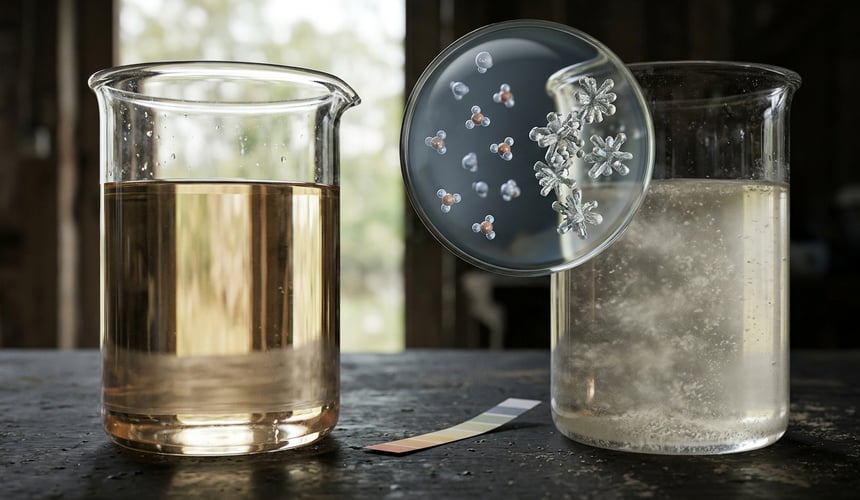
Calcium is one of the ingredients formulators most often find difficult in liquid fertilizers. Add it to a solution that already contains phosphate, sulfate or carbonate and the mix can turn cloudy, leave sediment in the tank or clog filters and lines. Formulation pH is one of the main factors that decides whether this happens.
The question is not only whether calcium and another ingredient can be mixed, but why the pH of the finished solution changes the outcome. The answer lies in how calcium pairs with the anions around it, and in how those anions change form as pH moves up or down.
Cropenta Insight
For growers and advisers, the practical point is that a tank mix can change after it is made. Calcium precipitation depends on pH, concentration and the other ingredients, so a clear solution at mixing is not a guarantee for storage or dilution in the field. In the calcareous soil study cited, a liquid phosphate formulation was associated with less calcium phosphate precipitation than a granular one, but that is soil evidence, not a formulation threshold. Raw material specification, including salt index and ingredient origin, is a sensible starting point when compatibility is in doubt.
How pH changes what calcium binds to
pH measures the concentration of hydrogen ions in a solution. Many of the anions that pair with calcium in fertilizers are weak acids, so their charge and form depend on pH. Phosphate is the clearest example: in acid solutions it is mostly present as dihydrogen phosphate, while at higher pH increasingly deprotonated forms take over. Those more highly charged forms bind calcium more readily, and calcium phosphate compounds have low solubility. Carbonate follows a similar pattern, with calcium carbonate forming more easily as pH rises.
In practical terms, a formulation can look compatible at one pH and precipitate after the pH drifts upward, for example after adding an alkaline raw material or after a change in dilution. Concentration matters too, because precipitation depends on whether the ion concentrations exceed the solubility limit, not on pH alone.
Where precipitation shows up
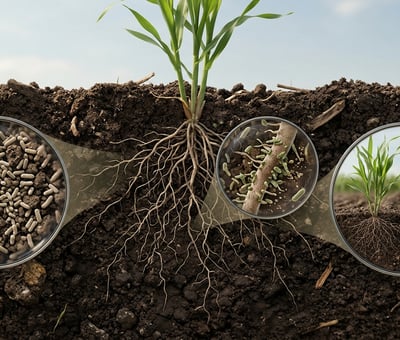
Calcium phosphate precipitation is well documented in soils. A recent study on fertilizer form reports that, in calcareous soils, liquid phosphate formulations were associated with less calcium phosphate precipitation than granular equivalents.[1] That study concerns soil application, not formulation pH in a tank, so it shows the chemical risk rather than a threshold for any specific product.
The broader review of sustainable plant nutrition that informed this article covers nutrient management challenges in general and does not report pH compatibility data for calcium mixes.[2] Specific pH limits for a given combination therefore have to come from testing with the actual raw materials, concentrations and temperatures.
Keeping calcium in solution in practice
Formulators commonly check compatibility in a transparent container before scaling up. Measuring pH and electrical conductivity after each addition shows where the solution moves, and watching for haze or sediment over several hours and after a day of storage captures slower reactions. Adding calcium-containing components separately from phosphate or sulfate sources is a common approach, and the order of addition can matter.
A lower pH is not automatically the better target. Acidifying a solution can change calcium phosphate behaviour, yet it can also affect other raw materials, pH-sensitive components and the final use conditions. The right pH window depends on the full recipe, and a clear mix at mixing is not proof of long-term stability.
Technical Summary
Formulation pH controls how calcium pairs with phosphate, sulfate and carbonate in liquid fertilizers, because those anions change form with pH. Precipitation depends on pH, concentration and the full recipe. Compatibility should be checked with the actual raw materials, and short-term mixing results do not establish long-term stability.
This article was created with the help of AI and reviewed by the Cropenta editorial team. It is general information, not professional advice.
Looking for something specific?
Our team is there to help you find the right raw materials and solutions for your formulations