Why Consistent Bypass Protein Quality Matters for Dairy Feed Formulation
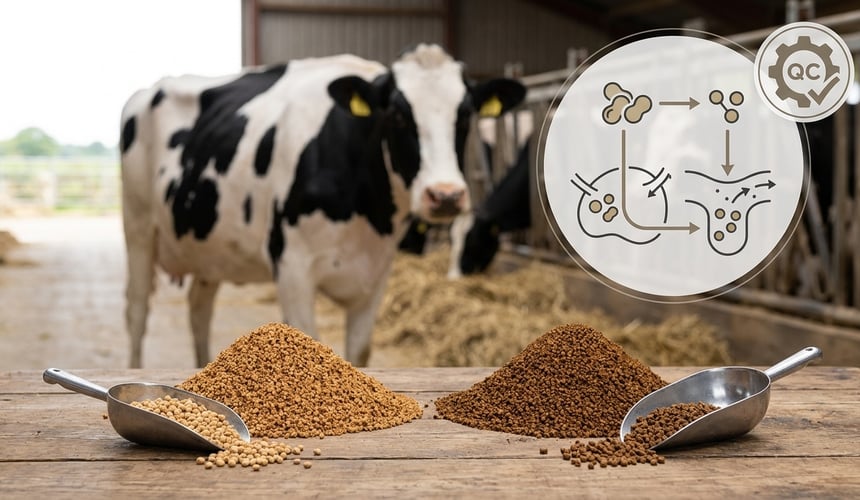
A dairy nutritionist who buys a bypass protein on crude protein content and a nominal protection level may find that the ration does not behave as calculated. The cause is rarely the total protein figure. What matters is how much of the soy protein survives the rumen, whether it is digested in the small intestine, and whether the same product delivers the same values every time it arrives at the mill. Comparisons between protein sources often start from the amino acid profile, and a review of plant- versus animal-based protein highlights that anabolic responses depend on more than total protein content [1].
Bypass protein, also called rumen-undegradable protein (RUP) or UDP, is the fraction of feed protein that escapes degradation by rumen micro-organisms and is digested further down the tract. The rest, rumen-degradable protein (RDP), feeds microbial protein synthesis. Microbial protein is itself a major amino acid source for the cow, so extra bypass protein only adds value when it reaches the small intestine and is digested there.
Cropenta Insight
Protection is often summarised as one RUP figure, but that number only means something with its assumed passage rate and the intestinal digestibility of the undegraded fraction attached. Values from different laboratories or valuation systems should be compared only when both the passage rate and the calculation method are stated. For any protected protein, request both figures alongside the lot-level data.
How protection is created and where it can drift
Protein protection treats a feed protein so that less of it is degraded in the rumen. In soy-based products, a common route is a controlled Maillard reaction, in which reducing sugars bind free amino groups, notably the epsilon-amino group of lysine, forming melanoidins that resist microbial breakdown. Protection methods used in ruminant diets range from heat treatment to chemical treatment [2].
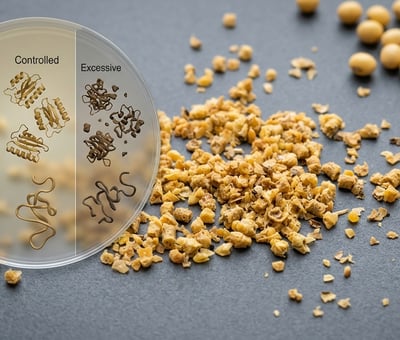
The same reaction has a narrow window. Under-treated meal stays largely degradable in the rumen. Over-treated meal binds lysine so strongly that it is no longer available for digestion, lowering intestinal digestibility and palatability. Total lysine can remain unchanged while reactive lysine falls, so a standard composition analysis may not reveal the difference. Small variations in sugar distribution, moisture, temperature penetration or processing time between batches are therefore a realistic source of variation.
Why a high RUP figure is not enough
RUP is calculated from in-situ degradation parameters: the potentially degradable fraction, the degradation rate and the assumed fractional passage rate (Kp). It is not the protein left after a full incubation. Because Kp is an assumption based on intake and production, RUP values are only comparable when they are calculated at the same Kp. A RUP of 80% at one passage rate and 75% at another cannot be ranked without correction.
A high RUP with low intestinal digestibility delivers little usable protein. Protection and digestibility therefore have to be read together. In-vitro protein degradation tests tend to correlate poorly with in-situ measurement for heat- and Maillard-treated proteins and can overstate rumen protection, so values based on in-vitro methods are not directly comparable with in-situ values.
Effects on metabolizable protein and amino acid balance
Formulation systems translate degradation and digestibility into values such as intestinal digestible protein, rumen protein balance or metabolizable protein. A shift in the RUP fraction changes how much protein reaches the small intestine per kilogram of product, and the calculated supply moves with it. If a ration is built on a fixed assumption, a batch with lower digestibility of its bypass fraction leaves the ration short of protein and of the amino acids that the intestine absorbs from it.
Amino acid supply is the less visible part of the problem. Ration models are sensitive to lysine and methionine, and a loss of reactive lysine after over-processing reduces the amino acid contribution even when the crude protein figure looks normal. In poultry research, formulation models that ignore non-essential amino acids have been noted as a limitation [3]. Ruminant rations face a different set of constraints, but the same principle applies: the formulation is only as accurate as the protein values it is built on.
Economic consequences in the ration
When protein is bought on crude protein, a batch with lower intestinal value costs more per unit of usable protein. Overshooting RDP wastes nitrogen through the rumen, while undershooting RUP can leave the ration short of bypass protein. Neither outcome is visible in the feed price alone. Cost comparisons between protected proteins are only valid when both values use the same passage rate and the same valuation system.
An illustrative calculation shows the mechanism. Suppose a ration was formulated assuming a given digestibility for its bypass fraction, and a delivered lot is five percentage points lower. The formulator must then either add protein from another source, at its own price per unit of digestible protein, or accept a shortfall in metabolizable protein. The milk or growth response to such a shortfall is not shown by the sources used here, so its size should be checked against the herd's own records and the formulation model.
Operationally, a receiving check can help: request the Kp used for each RUP value, the method behind the digestibility figure, and certificates of analysis for successive lots. Storing retained samples from each delivery makes it possible to trace a change in performance back to the ingredient rather than to the forage or the mixing process. Formulation software is also a practical place to see the effect of a changed protein value before it reaches the bunk.
What the current evidence does and does not show
The sources available for this article do not include a feeding trial in which rumen-protected soy protein was tested for milk production, and no milk response can be derived from the degradation and digestibility measurements. In-situ work characterises the ingredient; it does not show how a cow responds to a ration built with it. Likewise, the protein valuation is a calculation, not an animal result.
Batch-to-batch variation data for protected soy products are also not covered by the sources used here. The consistency of protection over time therefore needs to be verified by each buyer, using lot-level documentation and, where possible, repeated characterisation. Until such data are available, the safest assumption is that a protected protein's value is only as stable as its processing.
Technical Summary
Consistent bypass protein quality depends on rumen protection and intestinal digestibility staying stable together, not on crude protein alone. RUP values are only comparable at the same assumed passage rate, and in-vitro results can overstate protection for Maillard-treated proteins. Variation shifts metabolizable protein, amino acid supply and ration cost, so lot-level documentation of both protection and digestibility helps formulators interpret the protein they buy.
This article was created with the help of AI and reviewed by the Cropenta editorial team. It is general information, not professional advice.
Technical Questions
Why does a formulator need the assumed passage rate next to a RUP value?
RUP is calculated from degradation parameters and an assumed fractional passage rate, not measured in the bag. Values calculated at different passage rates describe different amounts of escaping protein, so they cannot be ranked against each other. Requesting the Kp used for each value makes the comparison valid before it reaches the ration model.
Can a normal total lysine result rule out over-processed soy protein?
Not on its own. Maillard reactions bind the epsilon-amino group of lysine, so total lysine can stay unchanged while reactive lysine falls. Intestinal digestibility and reactive lysine information are needed to judge whether the lysine is still available for absorption.
Looking for something specific?
Our team is there to help you find the right raw materials and solutions for your formulations